
How to Tell if Your Overland Park Tree Is Dead, Dying, or Just Stressed
You’re standing in your backyard in Overland Park, looking up at a tree that just doesn’t look right. The leaves came in late this year. A few big branches in the canopy never leafed out at all. There’s a strip of bark missing on the south side of the trunk. And you’re wondering — is this tree dying, or is it just having a rough year?
The good news is that most “concerning” trees are actually salvageable. The hard truth is that some of them aren’t, and the longer you wait on a truly dead tree, the more dangerous and expensive it becomes to remove.
Our crew has assessed thousands of trees across Overland Park and the rest of Johnson County over the past 35 years. Here are the seven warning signs we look for, in the order they actually matter — plus how to tell when a dead tree is dangerous enough to need same-week removal versus when it can safely wait.
Warning Sign #1: No Spring Leaves (But Wait Until June to Be Sure)
This is the clearest sign a tree is in serious trouble — and also the one homeowners get wrong most often. A bare tree in April doesn’t necessarily mean a dead tree.
Some species in the KC metro are notoriously slow to leaf out. Bur oaks, hackberries, and certain catalpas often wait until mid-May before they fully leaf. After a cold snap or a dry winter, even faster species like silver maples can lag by two or three weeks.
Here’s the rule we use: if a tree hasn’t pushed leaves by June 1, it’s almost certainly dead or in terminal decline. By that date, every healthy tree in Overland Park should be in full leaf. Branches that remain bare are dead branches. If the entire canopy is bare on June 1, the tree is gone.
One quick check before you write off a tree in spring: snap a small twig from a low branch. If the wood underneath is green and flexible, the branch is alive. If it’s brown, brittle, and snaps cleanly, that section is dead. Try this on several branches around the canopy to get a real picture.
Warning Sign #2: Bark Sloughing Off the Trunk
Healthy trees shed bark in normal patterns — sycamores peel in patches, river birches curl in papery strips, and shagbark hickories do exactly what their name says. None of that is a problem.
What is a problem: large sheets of bark falling off a species that shouldn’t be shedding, and exposing dead wood underneath. When you can see smooth, dry wood with no living tissue beneath the bark, that section of the trunk is dead.
We see this constantly on ash trees in Overland Park, where emerald ash borer destroys the cambium layer beneath the bark. We also see it on storm-damaged silver maples where the bark on one side of the trunk dies after the tree splits. If more than a third of the trunk circumference has lost its bark down to dead wood, the tree is unlikely to recover.
Look closely at the exposed wood for S-shaped tunnels (a sign of borers) or dark staining (a sign of fungal infection). Both confirm the underlying problem and help our arborists figure out what killed the tree.
Warning Sign #3: Mushrooms or Fungus at the Base
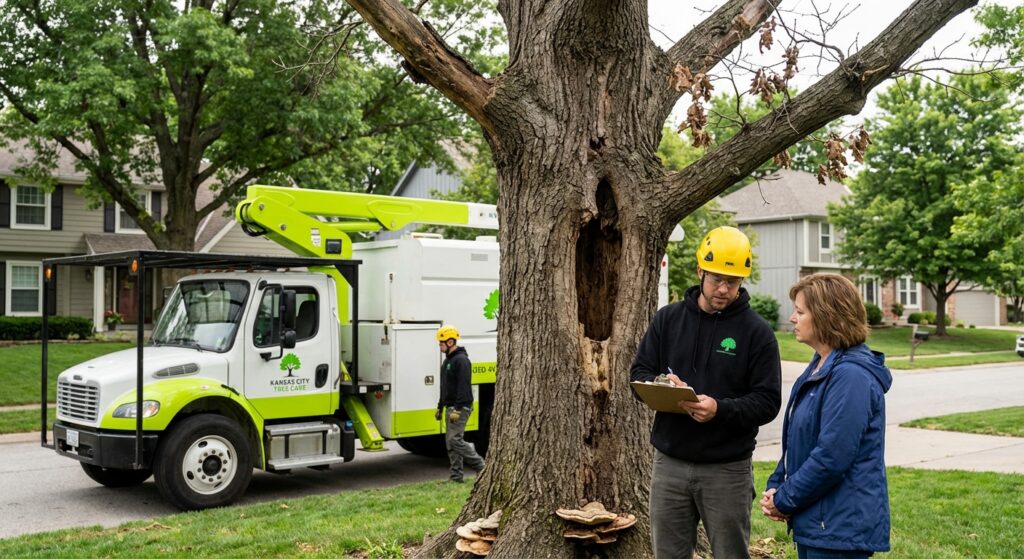
Mushrooms growing at the base of a tree, on the root flare, or directly on the trunk usually mean root rot. The fungus is feeding on dead or dying wood beneath the soil, which is exactly where you don’t want it — because that’s where the tree’s structural anchoring lives.
The species we see most often in Overland Park are armillaria (honey mushrooms — clusters of yellow-brown caps), ganoderma (large shelf-like brackets at the base), and inonotus dryadeus (white shelf fungus often found on oaks). All three are bad news. They indicate that significant portions of the root system are already compromised.
A tree with root rot can look completely healthy in the canopy and still fall over in the next strong wind. We’ve removed perfectly green, fully leafed trees in Leawood and Overland Park where root rot had eaten away 70% of the structural roots and the homeowner had no idea until we did a professional assessment.
If you’re seeing fungus at the base of a tree near your house, driveway, or any walkway, this is the warning sign that needs the fastest response. Hazardous tree evaluation by an ISA-certified arborist is the right next step — not a wait-and-see approach.
Warning Sign #4: Large Dead Branches in the Upper Canopy
A few small dead twigs scattered through a healthy canopy are normal. Trees naturally shed weak branches as they grow.
What’s not normal: large dead branches — three inches in diameter or bigger — high in the canopy, especially if they’re clustered on one side or in the top third of the tree. Arborists call this “crown dieback,” and it’s one of the most reliable indicators that a tree is in decline.
The reason it matters: when a tree starts losing energy, it abandons the parts of the canopy that are hardest to support — usually the highest branches first. If you’re looking up and seeing bare, gray limbs in the top of an otherwise leafy tree, the tree is telling you it can’t keep up with itself anymore.
Crown dieback in Overland Park is most common on mature silver maples, ash trees (EAB-related), and pin oaks suffering from iron chlorosis in our alkaline soil. Catching it early sometimes allows for corrective pruning that extends the tree’s life by years. Catching it late usually means removal.
Warning Sign #5: A Lean That Has Gotten Worse
Most trees lean a little. That’s not the issue. The issue is when a tree’s lean is increasing — when soil is heaving on one side of the root flare, when cracks appear in the ground near the base, or when the lean visibly worsens after a storm.
A new lean of more than 15 degrees is a serious red flag. So is any lean accompanied by exposed roots on the opposite side of the trunk, or fresh soil disturbance at the base. These are signs that the root system is failing and the tree is starting to come out of the ground.
Here’s a simple test: if you can stand at the base of the tree and clearly see that the trunk is at a different angle than it was a year ago, that’s a tree that needs professional evaluation immediately. We responded to a call in central Overland Park last summer for a 60-foot pin oak that had developed a 20-degree lean over a single week after heavy rain. The root plate was lifting visibly. We removed it three days later, before it took out the homeowner’s garage.
Trees lean toward sunlight gradually over decades — that’s normal. Trees that suddenly lean more after a storm are different, and they need to be looked at right away.
Warning Sign #6: A Hollow Trunk (And How to Check Without Climbing)
Hollow trunks are tricky. A tree can be partially hollow and still structurally sound for many years — trees evolved to handle some internal decay. But significant hollowing in the wrong place dramatically increases the risk of trunk failure.
Here’s the easy version of what arborists call a “sounding test”: tap firmly around the trunk with the back of a hammer or a heavy stick. Healthy wood produces a solid, dense thud. Hollow or decayed wood produces a hollow, drum-like echo. Walk all the way around the tree and tap at different heights. If you hear a clear hollow sound across more than 30% of the trunk circumference, the tree’s structural integrity is compromised.
The more precise rule arborists use: if the remaining solid wood is less than one-third the radius of the trunk, the tree is at high risk of failure. We measure this with specialized tools during a hazardous tree evaluation.
Hollows are most common in mature silver maples, cottonwoods, and willow trees in Overland Park — three species that are also notorious for failing during ice storms and summer wind events. If you’ve got a hollow tree within striking distance of your house, schedule an assessment.
Warning Sign #7: Woodpecker Damage Clusters and Missing Root Flare
Two more signs we look for that homeowners often miss.
The first: concentrated woodpecker activity. Woodpeckers don’t randomly attack healthy trees. They’re hunting insects, and the insects they’re hunting live in dead or dying wood. If you suddenly notice woodpeckers working a specific tree — especially making lots of small holes in a cluster — there’s a good chance that tree has a borer infestation. EAB-infested ash trees in Johnson County almost always show heavy woodpecker activity in the year before they die.
The second: a missing or buried root flare. The root flare is the slight widening at the base of the trunk where it transitions into the root system. On a healthy tree, you should clearly see this flare above the soil line. When the flare is buried — by mulch piled too high, by grading during construction, or by years of soil accumulation — the trunk stays wet, develops rot, and the tree slowly declines.
This problem is incredibly common in newer Overland Park subdivisions where landscape crews mound mulch around tree trunks. We call it “volcano mulching,” and it’s killed more young trees in Johnson County than any disease. The fix is simple if you catch it early: pull the mulch back, expose the root flare, and let the trunk dry out.
When a Dead Tree Is Dangerous (and When It Can Wait)
Not every dead tree is an emergency. Here’s how we triage them in the field:
Remove within days to weeks (high priority):
- Within striking distance of your house, garage, or any structure
- Over a driveway, walkway, deck, or patio where people walk regularly
- Near power lines (call Evergy first if the tree is touching wires)
- Showing active root failure, soil heaving, or worsening lean
- Hollow with less than one-third solid wood remaining
Remove within the next 6-12 months (moderate priority):
- Standing alone in a field or back corner of the yard, away from targets
- Dead but structurally still solid, with no fungal decay at the base
- Small to medium size (under 30 feet)
Can wait, but monitor regularly:
- Snags (dead trees) in wooded areas with no targets nearby — these provide wildlife habitat and can stand for years safely
The wood of a dead tree starts deteriorating within 12-18 months. After that, removal gets harder, more dangerous, and more expensive because the tree becomes unpredictable to climb and rig. If a dead tree has any chance of hitting something valuable, the smart move is to remove it sooner rather than later.
What an ISA Arborist Assessment Actually Costs
A professional arborist consultation in the Overland Park area typically runs $100-$300. Here’s what that gets you:
- An on-site visit by an ISA-certified arborist
- Visual inspection of the canopy, trunk, and root flare
- Sounding test for trunk decay
- Species identification and disease assessment
- A written or verbal recommendation with risk rating
- Honest guidance on whether the tree can be saved with cabling and bracing, treatment, or pruning — or whether removal is the right call
For most homeowners, the assessment fee is rolled into the cost of any work we end up doing. If we remove the tree, the consultation is usually included. We charge separately when the homeowner just wants a second opinion or a written report for an HOA or insurance claim.
Overland Park has a tremendous concentration of mature silver maples and ash trees that were planted in the 1970s and 1980s — and a lot of them are now failing the assessment. If you’ve got one of these older trees and you’re seeing any of the seven warning signs above, an arborist visit is money well spent.
What Tree Removal Actually Costs in Overland Park
If the assessment confirms your tree needs to come down, here’s what to budget. These are real ranges from jobs we do every week across Johnson County:
- Small dead tree (under 30 feet): $500-$1,200
- Medium dead tree (30-50 feet): $1,200-$2,500
- Large dead tree (50-70 feet): $2,500-$4,000
- Very large or difficult access (70+ feet, near structures or lines): $4,000-$6,500
Several things move the price. Dead trees are riskier than live ones — the wood is brittle, branches break unpredictably, and our climbers have to use slower, more careful rigging. Trees over a house, near power lines, or with limited equipment access cost more. Stump grinding is usually $200-$500 additional.
The single biggest cost driver is timing. A tree removed within six months of dying costs significantly less than the same tree removed three years after dying. The wood is still solid, the branches are still predictable, and we can work efficiently. After the wood deteriorates, every part of the job gets harder.
Frequently Asked Questions
How can I tell if my tree is just slow to leaf out or actually dead?
Wait until June 1. Every healthy tree in Overland Park should be fully leafed by then. If branches are still bare, snap a small twig — green wood underneath means alive, brown and brittle means dead. If most of the canopy is still bare on June 1, the tree is gone.
How much does a hazardous tree assessment cost in Overland Park?
An ISA-certified arborist assessment typically costs $100-$300. The fee covers an on-site visit, visual and sounding inspection, species identification, and a clear recommendation. If we end up doing removal or other work, the assessment is usually rolled into the project cost.
How fast do I need to remove a dead tree?
If the tree is within striking distance of your house, a structure, or a walkway, remove it within weeks. If it’s standing alone in the back corner of a large yard with nothing under it, you have months. Either way, the wood deteriorates within 12-18 months and becomes more dangerous and expensive to remove the longer you wait.
Can mushrooms at the base of a tree always mean it’s going to fall?
Not always — but it’s the warning sign that needs the fastest professional response. Fungus at the root flare usually indicates root rot, which compromises the tree’s structural anchoring underground where you can’t see it. A tree with root rot can look perfectly healthy and still fail in a storm.
Is volcano mulching really killing my tree?
Yes, slowly. Mulch piled high against the trunk traps moisture, encourages rot at the root flare, and suffocates the upper roots. Pull the mulch back at least three inches from the trunk and expose the root flare. We see volcano mulching damage on young trees throughout newer Overland Park subdivisions.
Will my homeowner’s insurance pay to remove a dead tree?
Usually not — most policies only cover removal after a tree has fallen and damaged something. Preventive removal of a hazardous-but-still-standing tree is the homeowner’s responsibility. That’s why catching warning signs early matters financially, not just for safety.
Get a Straight Answer From a Local Arborist
The hardest part of dealing with a possibly-dying tree is the uncertainty. You don’t want to spend thousands of dollars removing a tree that might bounce back, and you don’t want to wait too long on a tree that’s actually dangerous.
That’s where having a trusted Kansas City tree service on call makes all the difference. We’ve been helping homeowners across Overland Park, Olathe, Leawood, and the rest of the metro for over 35 years. Our crew is ISA certified, BBB accredited, and fully licensed and insured. We’ll give you an honest assessment — even if the answer is “your tree is fine, leave it alone.”
Call Kansas City Tree Care at 913-894-4767 for a free tree assessment. We’ll come out, take a careful look, and tell you exactly what we’d do if it were our own yard.