
A Tree Just Came Down on Your Overland Park Property — Here’s What to Do First
It’s 6 a.m. the morning after a spring storm rolled through Overland Park. You walk out to your driveway and there’s a massive limb on your garage, or worse, a whole tree across the back of the house. Your first instinct is to start cleaning up. Don’t. The first hour after storm damage is the most important hour for your insurance claim.
Here’s the honest answer most homeowners need: filing a storm damage tree insurance claim is straightforward if you know the rules, and frustrating if you don’t. Whether your insurance pays a little or a lot depends almost entirely on what the tree hit, what you documented, and who you hired to do the removal.
We’ve walked dozens of Overland Park homeowners through storm claims over the past 35 years — after the 2017 ice storm, the 2019 spring tornado outbreak, and every major thunderstorm cluster in between. Here’s the step-by-step guide we wish every homeowner had before the next storm.
What Homeowners Insurance Actually Covers
This is where most of the confusion starts. Insurance doesn’t pay for tree damage the way most people assume it does. The rule is simple, even if the reasoning isn’t:
If the tree hit a covered structure, insurance typically pays. If it just fell in your yard, insurance typically doesn’t.
Here’s how that breaks down in practice:
- Tree on your house, garage, shed, or fence — covered under most standard homeowners policies. The damage to the structure is covered, and the cost to remove the tree is usually covered up to a cap
- Tree on your car in the driveway — covered under the comprehensive portion of your auto policy, not your home policy
- Tree across your driveway blocking access — sometimes covered if it blocks a handicap ramp or primary access point, otherwise usually not
- Tree down in the yard, no structure damaged — not covered by most policies. You pay for removal out of pocket
- Tree on a power line — Evergy handles lines and their immediate clearance, but the tree itself is still the homeowner’s responsibility
The logic behind this is that insurance is designed to protect against damage to property the policy covers — the house, the garage, personal belongings. A tree on its own isn’t considered “damage” unless it hit something the policy insures. Frustrating but consistent across almost every carrier.
Tree Removal Coverage Limits You Should Know About
Even when the tree hit your house and insurance covers the claim, there’s usually a cap on how much the policy will pay for tree removal itself. This is separate from the cost to repair the structural damage.
The typical tree removal cap on a standard homeowners policy in Kansas is $500 to $1,000 per incident. Some policies go higher. Some go lower. A few premium policies have no cap at all. Check your declarations page under “Other Structures” or “Debris Removal” — it’s usually spelled out there, or you can call your agent and ask directly.
Here’s why this matters in Overland Park. A large oak or cottonwood tree on a house often costs $2,500 to $6,000 or more to remove safely — because of the extra rigging required to cut sections without worsening the damage, the crane fees, the cleanup, and the haul-off. If your removal cap is $500, you’re paying most of that out of pocket.
The damage repair itself — the holes in your roof, the broken trusses, the interior water damage — is covered separately under your dwelling coverage and subject only to your deductible. That’s usually the bigger-dollar side of the claim.
Deductibles in Overland Park typically run $1,000 to $2,500 for standard policies, with some carriers using a percentage-based deductible (1% to 2% of the dwelling coverage) for wind and hail claims. On a $400,000 home with a 1% wind deductible, that’s $4,000 out of pocket before coverage kicks in.
The First Hour: What to Do Before Anything Else
The decisions you make in the first hour after a storm shape the entire claim. Don’t start cutting anything. Don’t hire the first person who knocks on your door. Here’s the order of operations:
Step 1: Check for immediate safety hazards. Are power lines involved? Stay far away and call Evergy immediately. Is anyone injured? Call 911. Is there active water intrusion? That’s the only reason to move fast on temporary repairs like tarping.
Step 2: Document everything before you touch anything. Take photos from multiple angles — wide shots showing the whole scene, medium shots showing how the tree hit the structure, and close-ups of specific damage. Shoot video too. Get photos before cleanup starts. This is the single most valuable thing you can do for your claim.
Step 3: Call your insurance company to open a claim. Do this before you hire anyone for removal or repairs. The claim adjuster assigns you a claim number and tells you what documentation they need. Write down the claim number and the adjuster’s direct contact info.
Step 4: Arrange emergency services only if necessary. If rain is coming through a hole in the roof, you need tarping right now. Most insurance companies reimburse emergency mitigation costs to prevent further damage. Keep every receipt. Don’t authorize full tree removal yet.
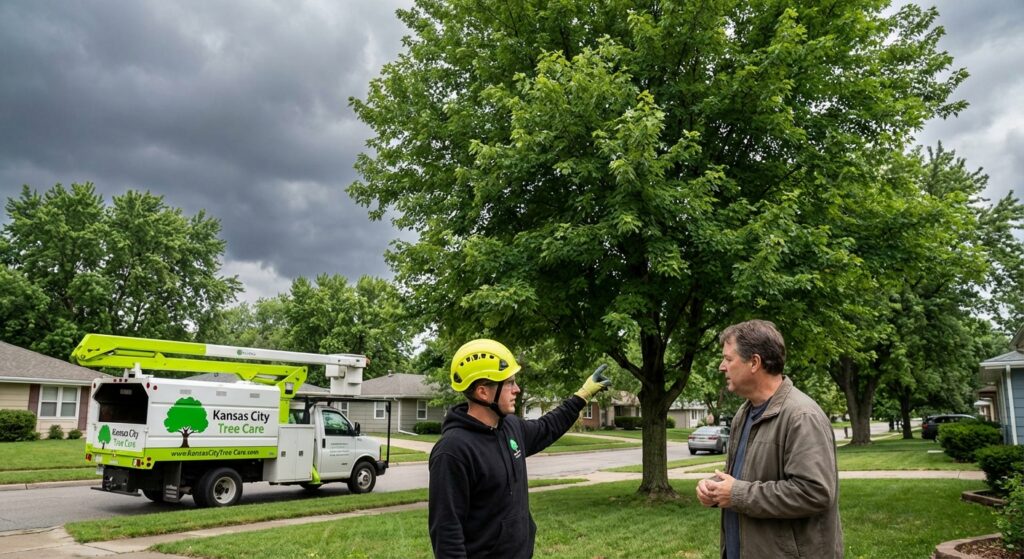
Step 5: Get an arborist assessment in writing. Before a full removal starts, a professional assessment letter from a licensed, insured tree service adds weight to your claim. Our hazardous tree evaluations document the species, size, estimated value, damage scope, and safe removal plan — exactly what adjusters want to see.
Documentation That Makes or Breaks Your Claim
Insurance adjusters see thousands of claims. What separates a smooth claim from a drawn-out denial fight is documentation. Here’s what to gather:
- Time-stamped photos of the damage from every angle, ideally taken within the first few hours before any cleanup
- Video walkthroughs showing the full extent of the damage and the path the tree took as it fell
- Weather reports from the storm — National Weather Service Kansas City office records are accessible online and document wind speeds, hail size, and tornado reports
- An arborist assessment letter identifying the tree species, approximate age, estimated pre-damage value, and whether the tree showed prior signs of decay that would affect coverage
- Written estimates from licensed tree services for the removal work — not a scribble on the back of a business card
- Receipts for any emergency work you paid for out of pocket (tarping, board-up, emergency tree work to prevent further damage)
- Photos of the interior damage including water stains, broken drywall, ruined furniture, and damaged personal belongings
If your tree was healthy before the storm, the claim is much more likely to be approved. Insurance companies sometimes deny claims if they can argue the tree was already dead, diseased, or decayed — on the theory that a reasonable homeowner should have removed it before the storm. A written arborist assessment that documents the tree’s health status before the damage is strong evidence.
Kansas City Storm Patterns: What Insurance Companies Actually See
Insurance adjusters working the Kansas City market see two main categories of storm tree claims, and knowing which one you’re in helps you understand how your claim will be processed.
Ice storm claims (December through February): These are common in Overland Park. Ice loading causes branches and sometimes whole trees to fail under the weight. Claims usually involve multiple properties on the same street and adjusters move through neighborhoods systematically. Because ice storms are documented weather events, coverage is generally straightforward — but the sheer volume of claims can slow everything down.
Spring storm and tornado claims (March through June): Wind damage dominates. Twisted or uprooted trees, large limbs torn out of canopies, entire trees laid flat by straight-line winds. When a confirmed tornado touches down, coverage is usually automatic and fast. Straight-line wind damage from a severe thunderstorm sometimes gets more scrutiny, especially if the tree was old or showed signs of weakness.
Either way, document the weather event itself. The NWS Kansas City forecast office archives storm reports, peak wind gusts, and hail reports by date and location. Pulling that data for your claim strengthens the case that this was a real weather event, not pre-existing damage.
After major storms, our crew from storm recovery services often works directly with insurance adjusters on Overland Park properties. We can provide the arborist documentation, removal estimates, and the licensed, insured status that insurance companies require.
The Neighbor’s Tree Fell on Your Property: Who Pays?
This is the most common question we get after storms, and the answer surprises most homeowners. When your neighbor’s tree falls on your house in a storm, your insurance handles it, not your neighbor’s.
The reasoning: storm damage is considered an “act of God.” Unless the tree was visibly dead, diseased, or in obvious disrepair — and the neighbor had been warned about it and failed to act — the neighbor isn’t legally negligent. Your policy covers the damage to your house and, within limits, the removal of the tree that’s now on your property.
The exception: if you can prove the neighbor knew the tree was a hazard, you may have a negligence case. Documentation matters here. If you had previously told your neighbor the tree was leaning, dropping limbs, or visibly rotted — and you have texts, emails, or witness statements to prove it — their homeowner’s liability insurance may cover the damage instead. But this almost always requires legal action, and it’s a much slower path than just filing your own claim.
Practically speaking, file on your own insurance and move on. Fighting with a neighbor over a claim takes months and rarely changes the outcome.
Choosing a Tree Service the Insurance Company Will Accept
Insurance companies pay licensed, insured tree services. They don’t pay the guy with a chainsaw and a pickup who knocked on your door after the storm. This is probably the single biggest mistake homeowners make in the chaotic days after a storm.
Storm chasers — out-of-state crews that descend on storm-damaged neighborhoods — are common in Overland Park after major weather events. Some are legitimate. Many aren’t. Here’s what a legitimate tree service looks like from an insurance standpoint:
- Proof of general liability insurance (typically $1 million minimum) and workers’ compensation coverage — ask for current certificates
- Business license for Overland Park or the state of Kansas
- ISA-certified arborist on staff — the International Society of Arboriculture credential that adjusters recognize
- Written, itemized estimates on company letterhead — not a number scrawled on a notepad
- Verifiable local presence — a physical address, established phone number, and references in your area
- BBB accreditation or other third-party verification you can check independently
If a tree service can’t produce insurance certificates and a written estimate, your claim adjuster probably won’t pay them. Worse, if an uninsured worker gets hurt on your property, you could be personally liable. For emergency storm cleanup in Overland Park, hiring a verifiably licensed and insured service is non-negotiable.
Our crew has worked with every major insurance carrier in the KC metro. We provide certificates of insurance, itemized written estimates, and the documentation adjusters need — and we coordinate directly with them when you authorize it.
How Long Does the Claim Process Actually Take?
Here’s a realistic timeline for a storm tree claim in Overland Park:
- Day 1: Document damage, call insurance, arrange emergency mitigation if needed
- Days 2-5: Adjuster contacts you, schedules inspection, you gather estimates
- Days 5-10: Adjuster inspects the property (in-person or remote video)
- Days 10-21: Claim decision and initial payment for removal and emergency repairs
- Weeks 3-12: Structural repairs completed, final claim closeout
After major storms affecting hundreds of properties simultaneously, every step can take longer. The 2017 ice storm backed up some Overland Park claims for six weeks before adjusters could even schedule an inspection. The fastest claims are usually the ones with the most complete documentation submitted upfront.
Frequently Asked Questions
Does homeowners insurance cover tree removal if the tree just fell in my yard?
Usually no. Most standard policies only cover tree removal when the tree hits a covered structure — your house, garage, shed, fence, or driveway. A tree that falls in the yard without hitting anything is generally the homeowner’s responsibility. A few premium policies cover yard tree removal up to a small cap, but it’s the exception, not the rule.
How much does emergency tree removal cost after a storm in Overland Park?
Emergency storm removal typically runs $1,500 to $6,000 depending on the tree’s size, where it fell, and what it hit. A large oak or cottonwood on a house with complex rigging and crane work can exceed $8,000. Costs are higher than routine removal because of the urgency, the difficulty of cutting a tree already under tension, and the need for extra safety precautions.
Will my insurance rates go up after a storm claim?
In Kansas, weather-related claims — especially from named storms, tornadoes, or declared disaster events — typically don’t raise your individual rates. Rates can rise across the entire region after major storm seasons, but that’s separate from individual claim history. Claims from preventable tree failures (dead trees, long-known hazards) can affect your rate more directly.
What if my tree service isn’t licensed or insured — will my claim still be paid?
Probably not, or at least not in full. Insurance companies reimburse removal costs based on their own approved contractor list or verified licensed and insured vendors. If you hire an uninsured tree service, you may be left paying the entire removal cost yourself even on an approved claim. Always verify credentials before authorizing work.
How fast do I need to file a storm damage claim?
Most policies require “prompt” notification, which generally means within a few days of the damage. Don’t wait a month to file. Beyond that, document and file as soon as you’re safe. Waiting can give the insurance company grounds to argue that additional damage (water intrusion, mold) resulted from your delay, and they may reduce the payout accordingly.
Can I remove the tree myself to save money on the claim?
Don’t. First, storm-damaged trees under tension are extremely dangerous — more people are hurt in DIY storm cleanup than in almost any other home maintenance task. Second, insurance typically requires licensed vendor receipts to pay for removal. Paying yourself or hiring a handyman won’t qualify for reimbursement.
We’re Here When the Storm Hits
Storm cleanup is stressful, expensive, and complicated. The good news is that Overland Park homeowners with the right documentation, the right arborist assessment, and the right tree service almost always come through the claim process with a fair settlement and a clean yard.
Our team at Kansas City Tree Care has been helping homeowners navigate storm damage for over 35 years. We’re ISA certified, BBB accredited, fully licensed and insured, and we work directly with insurance adjusters on your behalf. We respond to emergency calls 24 hours a day and provide the documentation your claim needs to move quickly. For top-rated tree care in the KC metro, you can find us on Google.
Call Kansas City Tree Care at 913-894-4767 for emergency storm tree service in Overland Park. We’ll respond fast, document everything for your insurance claim, and handle the removal safely — no pressure, no storm-chaser tactics, just honest help when you need it most.