
Tree Cabling & Bracing in Kansas City
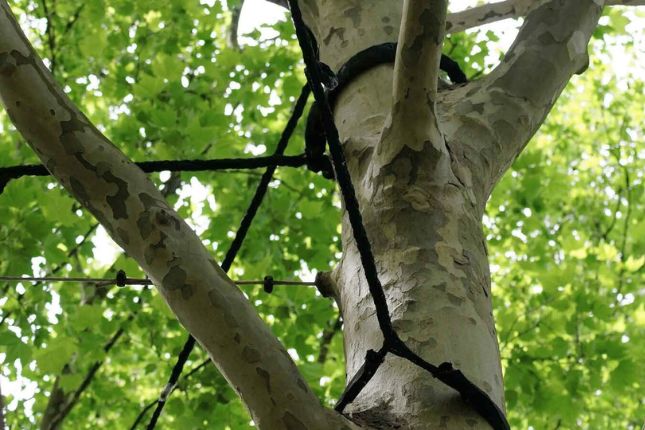
Protect Your Trees: The Importance of Cabling and Bracing in Kansas City
As responsible homeowners in Kansas City, keeping your trees in top shape is crucial. But how can you ensure their longevity? While a tree may seem strong on the outside, hidden structural weaknesses could compromise its integrity. Factors like environmental conditions, extreme weather, and natural growth patterns can weaken trees over time. That’s where Kansas City Tree Care, the trusted professionals in Kansas City, come in to save the day.
Through tree cabling and tree bracing, our team of skilled arborists enhances the structural stability of your trees. By installing strong metal cables and bracing rods, we provide the necessary support your trees need. This specialized service offers a range of important functions, including:
Supporting weak or drooping branches, improving overall tree health.
Preventing rubbing of tree limbs, promoting proper growth and development.
Bracing tree trunks that have started to split, preventing further damage.
Safeguarding your trees from storms reduces the risk of potential harm.
What Is Tree Cabling and Bracing?
Tree cabling and bracing are structural support systems installed by arborists to reduce the risk of failure in trees with structural weaknesses. Cabling uses high-strength steel cables installed between major limbs high in the canopy to limit the distance branches can move during wind events, redistributing stress loads so no single attachment point bears the full force of the wind. Bracing uses threaded steel rods installed through weak branch unions or split trunks to hold them together mechanically.
These techniques are used to preserve valuable trees that have structural defects but are otherwise healthy. Many Kansas City homeowners have mature trees worth thousands of dollars in landscape value that have co-dominant stems (two main trunks), heavy lateral limbs with included bark unions, or previous storm damage that has created structural weaknesses. Rather than removing an otherwise healthy 60-year-old oak because of a structural defect, cabling and bracing can extend the tree’s safe, functional life by decades. It’s a conservation approach that protects both the tree and the property beneath it.
When Does Your Tree Need Cabling or Bracing?
Our arborists recommend cabling and bracing when a tree has identifiable structural weaknesses but is otherwise healthy and worth preserving. The most common indications include co-dominant stems (two or more main trunks emerging from the same point) with included bark between them – this is a weak connection that is prone to splitting during storms. Heavy lateral limbs that extend far from the trunk create leverage that can tear the limb from the tree during high winds. Trees that have previously lost major branches may have compensatory growth that overloads remaining limbs.
Cabling and bracing are also used proactively on high-value trees in locations where failure would cause significant property damage. A large oak overhanging your home, a heritage tree near your deck, or a specimen tree that provides critical shade – these are situations where the cost of cabling is a fraction of the potential damage from failure. Our arborists assess each tree individually and recommend cabling only when it’s the right solution. Not every structurally compromised tree is a candidate – trees with significant decay, root problems, or canopy dieback are better served by removal.
The Cabling and Bracing Process
Our arborists begin with a thorough structural assessment of the tree, identifying the specific weaknesses that need support. We determine the optimal placement of cables and braces based on the tree’s architecture, the direction of potential failure, and the loads involved. For cabling, we install eye bolts in the upper third of the canopy between the limbs that need support, then connect them with high-strength steel cable tensioned to allow natural movement while preventing catastrophic separation. For bracing, we drill through the weak union or split and install threaded steel rods with washers and nuts on each side.
The installation process is minimally invasive and causes no lasting damage to healthy trees. The hardware grows into the wood over time, becoming a permanent part of the tree’s structure. After installation, we recommend annual inspections to check cable tension, hardware integrity, and tree growth around the hardware. Cables typically last 10+ years before replacement is needed, and bracing rods are permanent. The entire installation typically takes 2–4 hours depending on the tree’s size and the number of support points needed.
Cabling and Bracing vs. Tree Removal
The decision between cabling and tree removal depends on the tree’s overall health, the severity of the structural defect, the tree’s location, and its value to the property. Cabling and bracing make sense when the tree is healthy, the structural weakness is the primary concern, the tree has significant landscape or shade value, and the cost of support is reasonable relative to the tree’s value. Tree removal is the better choice when the tree has extensive decay, root problems, or disease in addition to structural issues, when the defect is too severe for cable support to be reliable, or when the tree has outgrown its location.
Our arborists give you an honest assessment of both options. We explain the expected lifespan of the cabling system, the ongoing maintenance requirements, and the realistic risk reduction you can expect. If a tree’s structural problems are too severe for cabling to provide meaningful protection, we’ll recommend removal rather than selling you a system that won’t adequately protect your property.
Cabling and Bracing Costs in Kansas City
Cabling and bracing costs in Kansas City range from $400–$2,000 depending on the tree’s size, the number of cables and braces needed, and the complexity of the installation. A single cable between two co-dominant stems on a medium tree might cost $400–$800. A large tree requiring multiple cables and braces throughout the canopy can cost $1,000–$2,000. Compared to the cost of removing a large tree ($1,500–$3,500) and the potential property damage from an unsupported failure, cabling and bracing is often the most economical option for healthy trees with structural defects. Kansas City Tree Care provides free assessments and estimates – call 913-894-4767 to schedule yours.
Frequently Asked Questions About Tree Cabling & Bracing
Tree cabling in Kansas City costs $400–$2,000 depending on the tree’s size and the number of cables needed. A single cable between two co-dominant stems on a medium tree runs $400–$800. Large trees requiring multiple support points cost $1,000–$2,000. Compared to potential property damage from tree failure, cabling is an economical way to protect valuable trees. We provide free assessments and estimates.
When installed by a certified arborist, cabling and bracing cause minimal and temporary damage. The eye bolts and drill holes are small relative to the tree’s size, and healthy trees compartmentalize (wall off) these wounds quickly. The hardware grows into the wood over time, becoming part of the tree’s structure. Improper installation by unqualified operators can damage trees, which is why professional arborist expertise is essential.
Steel cables typically last 10–15 years before replacement is needed. Bracing rods are permanent and generally last the life of the tree. We recommend annual inspections to check cable tension, hardware condition, and tree growth around the hardware. As the tree grows, cables may need retensioning or repositioning. Regular maintenance ensures the system continues to provide effective support throughout its lifespan.
If a tree is actively splitting but the split is relatively fresh and the tree is otherwise healthy, bracing with threaded rods can hold the sections together and allow the tree to heal. However, if the split is extensive (more than halfway through), if the tree shows decay at the split point, or if the two halves have separated significantly, removal is usually the safer option. Our arborists assess each situation and give you an honest recommendation.
No support system can guarantee a tree won’t fail under extreme conditions. Cabling and bracing significantly reduce the risk of failure during normal and moderate storm events, but tornadoes, derechos, and exceptional ice storms can overwhelm any support system. What cabling does is shift the odds dramatically in your favor - a properly cabled tree is far less likely to fail than an unsupported tree with the same structural weakness.
The right choice depends on the tree’s health, the severity of the structural defect, and the tree’s value to your property. Cabling makes sense for healthy trees with manageable structural weaknesses that have significant landscape value. Removal is better for trees with extensive decay, root problems, or multiple severe defects. Our arborists evaluate both options and give you an honest recommendation based on what’s safest and most cost-effective for your specific situation.