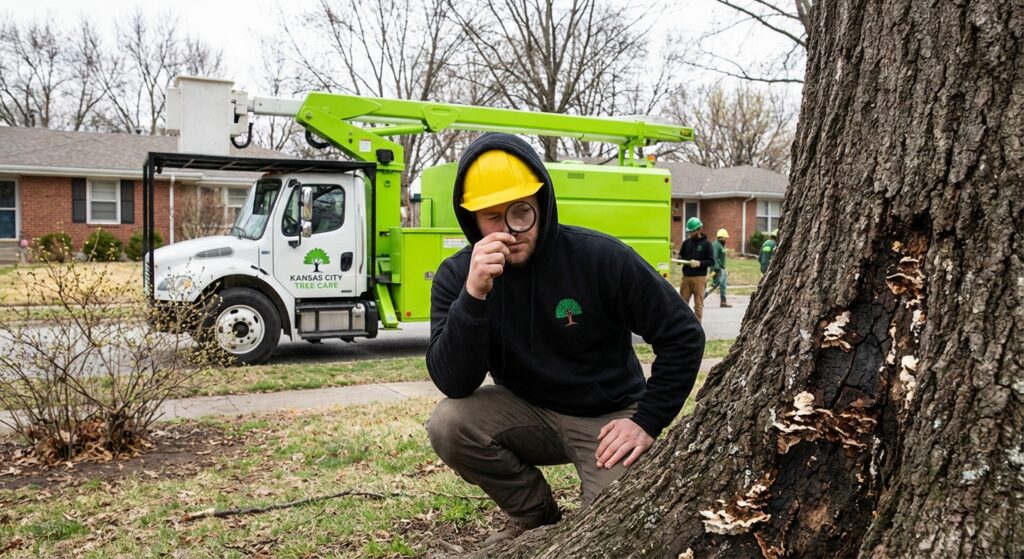

Why Overland Park Trees Are Quietly Struggling Through Summer
You walk out to the backyard in late July, and something looks off. The big silver maple that usually shades the patio has crispy brown edges on every leaf. The dogwood by the front porch dropped leaves a month early. The river birch is shedding bark and looking thin at the top.
It’s not a disease. It’s drought stress — and we see it every summer across Overland Park, especially during the dry stretches that have hit Johnson County hard the last several years.
The good news is that most drought-stressed trees recover beautifully when you catch the signs early and adjust your watering. Our crew has nursed thousands of struggling trees back to health across Overland Park and the surrounding KC metro. Here’s exactly what to look for, how to water properly in our heavy clay soil, and when it makes sense to call in a certified arborist.
Why Drought Stress Hits Overland Park Trees Hard
Johnson County averages about 38-40 inches of rainfall per year, but the distribution matters more than the total. Most of that rain falls in spring storms between April and June. By the time we get to July and August — when temperatures regularly push past 95 degrees — rainfall drops sharply, and trees go weeks without a meaningful drink.
The last several summers have been especially tough. Multiple recent years saw 6-8 week stretches with under an inch of total rainfall in the KC metro, combined with sustained heat that pushed evapotranspiration rates through the roof. Trees that looked fine in June were in serious trouble by August.
Then there’s the soil. Overland Park sits on the same heavy clay soil that runs through most of Johnson County. Clay holds water tightly, but it also resists absorbing new water once it dries out. When the surface bakes hard in August, sprinklers and rain just run off. The water never reaches the root zone where the tree actually needs it.
That combination — high heat, low rainfall, hard clay soil — creates the perfect setup for drought stress. And because the damage shows up slowly, most homeowners don’t realize anything is wrong until the tree is already in trouble.
The Early Warning Signs Most Homeowners Miss
Drought stress doesn’t announce itself the way a disease or pest infestation does. The signs are subtle at first, then accelerate quickly. Here’s what to watch for:
- Leaf scorch — brown, crispy edges on leaves that started out green. The damage usually starts at the leaf tip and works inward. It looks like the leaf was held over a flame
- Early fall color — your maple turning red in mid-July, or your oak going yellow in early August. The tree is shutting down ahead of schedule because it can’t support full leaves
- Wilting in the afternoon — leaves drooping during the heat of the day, even if they perk back up overnight. Healthy trees shouldn’t visibly wilt
- Premature leaf drop — finding green or yellow leaves on the ground in July and August. The tree is dropping foliage to reduce water loss
- Sparse, thin canopy — fewer leaves than the tree had last year, especially noticeable from the street
- Branch dieback at the top — small branches at the highest part of the tree dying back. This is the tree’s water-transport system failing at the most distant points first
- Bark cracks and peeling — vertical cracks or sections of loose bark, particularly on smooth-barked species like maples and birches
If you’re seeing any combination of these in midsummer, the tree is telling you it needs more water. The earlier you respond, the easier the recovery.
The Species Most Vulnerable in Overland Park Yards
Some trees handle our heat and clay better than others. After 35+ years working in Johnson County yards, here are the species we see struggling most:
Silver maple — the most planted shade tree in older Overland Park neighborhoods, and one of the most drought-sensitive. Silver maples have shallow root systems that can’t reach deep moisture, and their thin bark cracks easily when stressed. We’ve removed hundreds of declining silver maples across the city.
ND dogwood — beautiful but fragile in our climate. Dogwoods are understory trees in their native range, accustomed to filtered light and consistent moisture. A full-sun spot in clay soil during a dry July is brutal for them. Leaf scorch and dieback show up fast.
River birch — popular in Overland Park landscapes for the peeling bark and graceful shape. But river birches are riparian trees — they belong next to water. In dry summers without supplemental watering, they shed leaves, drop branches, and sometimes die back significantly.
Japanese maple — thin leaves, shallow roots, and zero tolerance for hot afternoon sun without water. Common in higher-end Overland Park landscapes and frequently in distress by August.
Sugar maple — a Midwest classic, but it prefers cooler, moister conditions than KC’s summers reliably provide. Leaf scorch is the most common symptom.
Newly planted trees of any species — for the first 2-3 years after planting, every tree is vulnerable. The root system hasn’t expanded enough to find its own water yet.
How to Water Trees Properly in Clay Soil
Here’s where most homeowners go wrong. They run their lawn sprinklers for 15 minutes a few times a week and assume the trees are getting watered. They’re not.
Lawn sprinklers wet the top inch or two of soil — exactly the depth where grass roots live. Tree roots are deeper, spread wider, and need a fundamentally different watering approach.
The right way to water a stressed tree:
- Water deeply, not frequently. Aim for one good soaking per week during dry spells, not daily light watering. Deep watering pushes moisture into the root zone and encourages roots to grow downward where they’re more drought-resistant
- Water at the drip line, not the trunk. The active feeder roots are out near the edge of the canopy — sometimes well beyond it for mature trees. Watering against the trunk does almost nothing
- Use a soaker hose or slow trickle. Lay a soaker hose in a circle around the drip line. Run it for 1-2 hours at low pressure. The slow application gives clay soil time to absorb water instead of letting it run off
- Aim for one inch of water per watering. Place a tuna can under the soaker hose to measure. When the can has an inch of water, you’re done
- Mulch the root zone. A 3-4 inch layer of wood chip mulch over the drip line cuts evaporation in half and moderates soil temperature. Keep mulch a few inches off the trunk itself
- Water in the evening or early morning. Less evaporation, more soaking
For a mature tree, that means 30-50 gallons of water per week during dry stretches. It sounds like a lot, but spread out over 1-2 hours of slow soaking, it’s exactly what the tree needs.
What Happens Inside a Drought-Stressed Tree
Understanding the biology helps explain why early action matters so much. When a tree doesn’t get enough water, several things start to fail:
First, the tree closes the small pores in its leaves (stomata) to reduce water loss. That also stops photosynthesis, which means the tree stops producing the sugars it needs to grow and defend itself. Energy reserves drain quickly.
Next, the tree starts shedding leaves, branches, or both. This reduces the total surface area losing water — essentially the tree is downsizing to survive. Branch dieback at the top of the canopy is a classic sign because those tips are the hardest to keep hydrated.
If the drought continues, the vascular system itself can fail. Air bubbles form in the water-conducting tissue (a process called cavitation), and once that happens, those branches can’t carry water again — even after the rain returns. That’s why a tree can look fine in early summer and then collapse a year later, even after the drought has ended.
The other major risk is opportunistic pests and diseases. Stressed trees give off chemical signals that attract bark beetles, borers, and fungal pathogens. We’ve seen healthy oaks survive a single bad summer only to be killed the following year by secondary infections they couldn’t fight off in their weakened state.
Recovery Timeline: What to Expect
Once you start watering correctly, how long until the tree bounces back? It depends on how stressed it was when you started:
Mild stress (some leaf scorch, full canopy): Recovery within 2-4 weeks of consistent deep watering. The current year’s leaves won’t repair themselves, but next spring’s flush should come in healthy and full.
Moderate stress (significant leaf drop, some branch dieback): Visible improvement over the rest of the growing season, but full recovery takes 1-2 years. The tree needs to rebuild energy reserves, regrow root mass, and replace lost canopy. Continue deep watering through fall and the next growing season.
Severe stress (major canopy loss, large branch dieback): Recovery may take 2-3 years if it happens at all. Get a hazardous tree evaluation from a certified arborist to assess whether the tree is structurally sound enough to keep. Some severely stressed trees become safety risks even if they survive.
The most important thing is consistency. A tree that gets deep watering once and then nothing for three weeks is barely better off than one that wasn’t watered at all. Pick a schedule and stick with it through the dry months.
The Cost of Saving vs. Replacing a Mature Tree
Sometimes homeowners ask whether it’s worth the effort and water bills to save a struggling tree. The math almost always favors saving it.
Saving a stressed mature tree:
- Deep watering supplies (soaker hose, mulch): $40-$80 one-time
- Increased water bill during dry months: $15-$40 per month
- Arborist assessment: $0-$150 (often free with us)
- Optional deep root feeding or treatment: $150-$400
- Total to save the tree: $200-$700
Removing and replacing a mature tree:
- Tree removal: $1,500-$3,500 for a typical mature shade tree
- Stump grinding: $200-$400
- New tree (2-3 inch caliper, installed): $400-$800
- Loss of property value: large mature trees add $5,000-$15,000 in value, and a small replacement won’t recover that for 15-20 years
- Total cost of removal + replacement: $2,100-$4,700, plus decades of lost shade and property value
Unless the tree is structurally compromised or already dead, saving it is the smarter financial move. We see far too many homeowners give up on trees that just needed a few summers of consistent watering to recover.
When to Call a Certified Arborist
A lot of drought stress is something a homeowner can handle with a soaker hose and a bag of mulch. But there are situations where professional help pays for itself:
- Major branch dieback in the upper canopy — dead limbs become fall hazards, especially over houses, cars, or play areas
- Mushrooms or fungal growth at the base — often a sign that root rot has set in alongside drought stress
- Bark cracks or sections peeling away — can indicate vascular damage that needs assessment
- Trees leaning more than they did last year — root damage from drought can destabilize even mature trees
- Multiple trees showing the same symptoms — points to a broader issue worth professional diagnosis
- Newly planted trees in distress — root issues from planting often combine with drought stress and need expert eyes
Our ISA-certified arborists handle drought assessments across Overland Park every summer. We’ll walk your property, identify which trees are in trouble, and give you an honest recommendation — sometimes that’s strategic pruning to reduce water demand, sometimes it’s deep root watering, and occasionally it’s removal of trees that are already past saving.
Building a Drought-Resistant Yard for the Long Term
If you’re planning to add or replace trees in your Overland Park landscape, plant for the climate we actually have — hot, dry summers and heavy clay soil. The species that thrive long-term include:
- Bur oak — native, deep-rooted, handles drought and clay beautifully
- Chinkapin oak — similar strengths, faster growing than bur oak
- Kentucky coffeetree — drought-tolerant native, almost no pest issues
- Hackberry — tough and adaptable, common throughout the KC metro
- Bald cypress — surprisingly drought-tolerant once established
- Shumard oak — great red fall color and excellent drought tolerance
For more on what to plant, the team at our Kansas City tree service is always happy to walk through species selection during a property visit. The right tree in the right place can shrug off summers that kill lesser species.
Frequently Asked Questions
How often should I water my trees during a Kansas City drought?
Once a week with a deep, slow soaking is the right rhythm during dry stretches. Aim for one inch of water applied at the drip line over 1-2 hours using a soaker hose. Mature trees need 30-50 gallons per week in the worst heat. Watering more often in shallower amounts trains roots to stay near the surface and actually makes the tree more vulnerable.
Can a tree recover from severe drought stress?
Many can, but it depends on how much canopy and vascular tissue was lost. Trees with mild to moderate stress usually bounce back within 1-2 years of consistent deep watering. Severely stressed trees with major branch dieback may need 2-3 years and aren’t always salvageable. An arborist assessment is the best way to know if recovery is realistic for your specific tree.
How much does it cost to save a drought-stressed tree in Overland Park?
Most homeowners can manage drought recovery for $200-$700 total, including supplies, increased water bills, and an optional professional treatment. Compare that to $2,100-$4,700 for removal and replacement of a mature tree, and saving it is almost always the better investment. Mature shade trees also add $5,000-$15,000 in property value that a small replacement can’t match for years.
Why do trees show drought damage after the rain returns?
Drought damage can take a year or more to fully appear because of how trees respond to stress. The vascular system can suffer hidden damage during the dry months, and the tree often uses up its energy reserves trying to survive. Once the tree’s defenses are down, secondary pests and diseases move in. This is why we see so many “sudden” tree deaths the spring after a hot, dry summer.
Is it too late to start watering my trees in August?
It’s never too late to help a stressed tree. Even if the current year’s leaves are scorched and falling, deep watering through August, September, and October helps the tree rebuild root mass and energy reserves before winter. That sets up a much stronger spring flush. Keep watering until the ground freezes if dry conditions persist into fall.
Will mulch really make that big a difference?
Yes — a good layer of mulch is one of the highest-impact, lowest-cost things you can do for a stressed tree. A 3-4 inch ring of wood chip mulch over the drip line cuts soil moisture loss roughly in half and keeps root temperatures more stable. Just keep it pulled back a few inches from the trunk itself to prevent rot.
Your Trees Can Make It Through Another Hot Summer
Drought stress is one of the most common — and most fixable — problems we see in Overland Park yards. Catch it early, water deeply and consistently, and most trees will bounce back beautifully. The summers aren’t getting any easier, but a little proactive care goes a long way.
We’ve been helping Kansas City homeowners protect their trees for over 35 years. Our crew is ISA certified, BBB accredited, and fully licensed and insured. Whether you need an honest assessment of a struggling tree, a deep root watering treatment, or expert pruning to reduce water demand, we’ll walk your property and give you a clear plan.
Call Kansas City Tree Care at 913-894-4767 for a free drought stress assessment. We’re happy to take a look and let you know what we’d recommend — no pressure, no obligation.