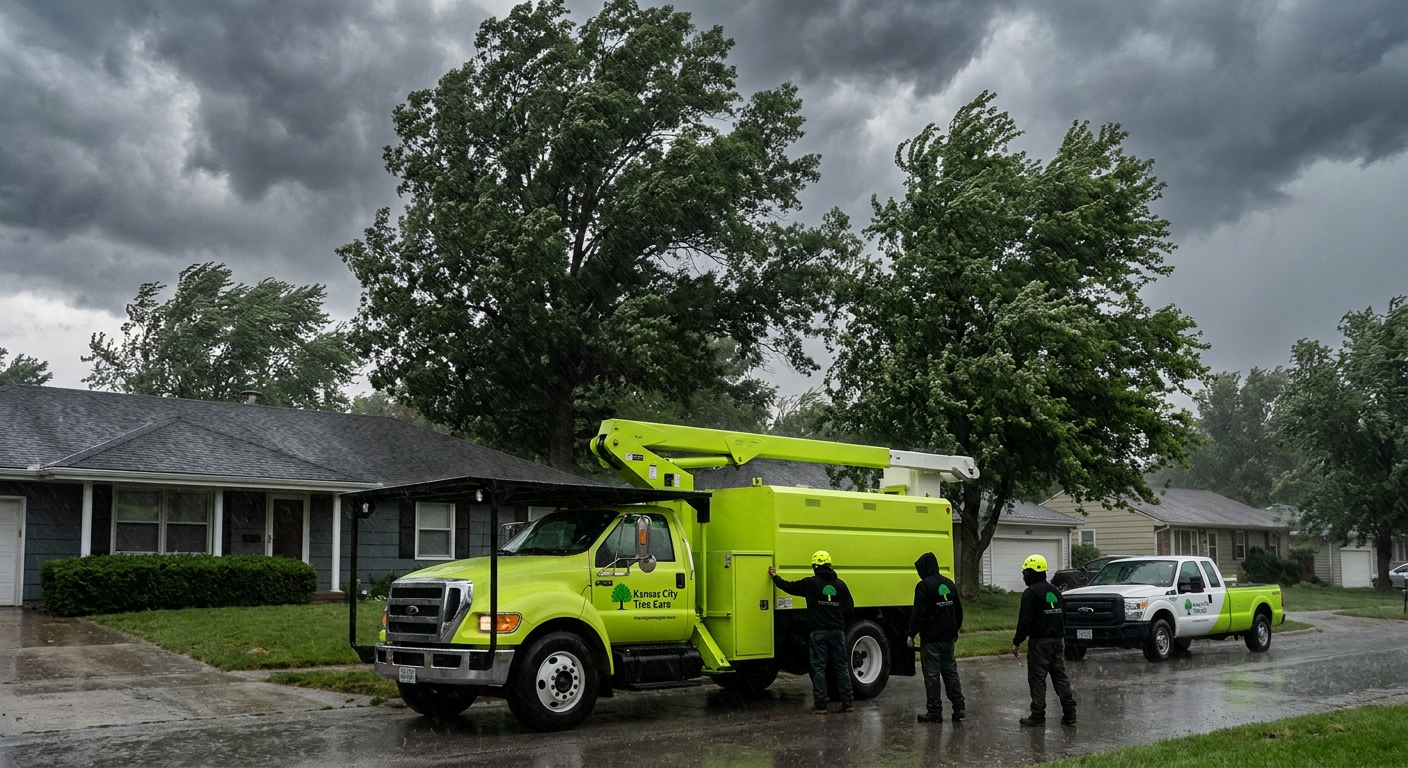
It’s a warm June evening in Kansas City, and the sky to the west turns that familiar shade of green-gray. You’ve lived here long enough to know what’s coming. The wind picks up, the trees start to sway, and you find yourself glancing at that big silver maple in the backyard, wondering if it can take another round.
We get it. Summer storm season in the KC metro keeps a lot of homeowners on edge, and for good reason.
The good news is that a healthy, well-maintained tree is one of the most resilient things on your property. With a little preparation now, your trees can ride out most summer storms just fine, and your home stays protected right along with them.
We’ve spent more than 35 years helping families across Overland Park, Olathe, Lee’s Summit, and the rest of the metro get their trees storm-ready. Here’s everything we’ve learned, so you can walk into storm season feeling confident instead of anxious.
What Summer Storms in Kansas City Actually Throw at Your Trees
Kansas City sits right in the path of some powerful summer weather. Knowing what you’re up against is the first step to staying ahead of it.
Most of our calls for Kansas City tree service during summer come down to a handful of repeat offenders:
- Straight-line winds and derechos. These are the big ones. A derecho can push 70 to 100 mph winds across the metro for hundreds of miles, and they snap weak limbs like twigs.
- Large hail. KC sits in a hail-prone corridor. Golf-ball and baseball-size hail strips leaves, scars bark, and stresses trees that were already struggling.
- Lightning. Tall, isolated trees draw strikes. A direct hit can split a trunk or quietly cook the tree from the inside.
- The occasional tornado. They’re rare for any single yard, but spring and early summer bring them to the region, and even a brief touchdown reshapes the canopy fast.
Here’s the encouraging part. A tree that’s structurally sound handles wind and hail far better than one carrying hidden weaknesses. When we get a tree ready ahead of time, we’re not fighting the storm. We’re just making sure your tree is strong enough to bend instead of break.
Timing matters too. Most of our severe weather lands between late May and early August, with June and July being the busiest. That gives you a clear window in spring to get ahead of it.
We’ve seen the same neighborhoods take a beating year after year, from Olathe out to Lee’s Summit. The homeowners who prepare consistently are the ones who sleep through the storms.
If a storm has already moved through and left a mess behind, our storm recovery service can have a crew out to clear it safely.
Why a Pre-Season Tree Inspection Pays Off
The smartest move you can make before storm season is a simple walk-around of your trees. Most homeowners don’t realize how much they can spot with ten minutes and a clear eye.
When our certified arborists do a pre-season inspection, here’s what we’re looking for:
- Deadwood. Dead branches have no flex left in them. They’re usually the first thing to come down in high wind.
- Codominant stems. These are two trunks of similar size growing from one point, often with a tight V-shaped fork. That junction is a natural weak spot.
- Cracks and splits. Vertical cracks in the trunk or seams where a limb meets the trunk tell us the wood is already under stress.
- Lean. A gradual lean a tree grew into is usually fine. A sudden new lean, especially with soil heaving at the base, is worth a closer look.
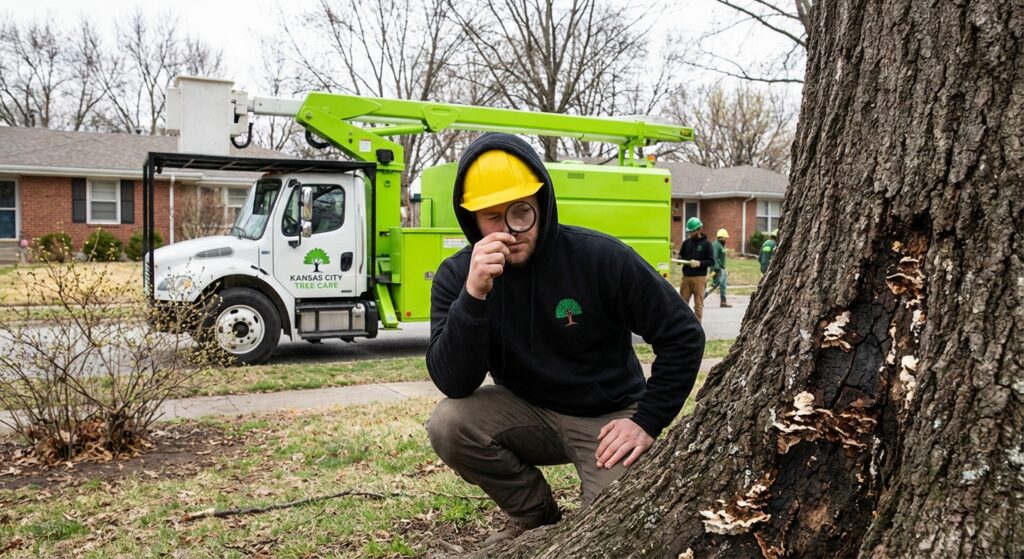
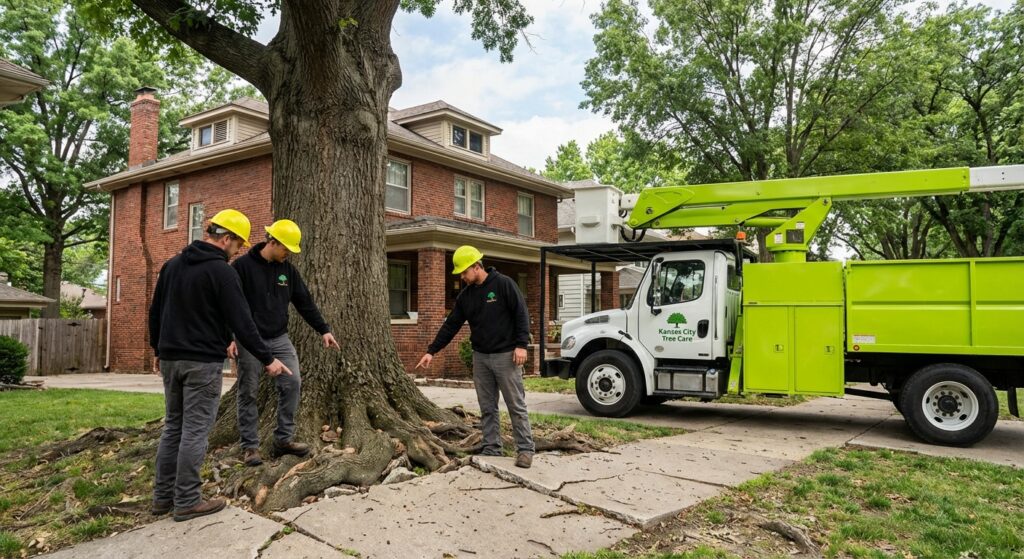
- Root issues. Mushrooms at the base, soft or hollow-sounding roots, or soil that lifts when the tree moves can all point to a weakened anchor.
If your tree shows any of these signs, it’s worth getting a professional set of eyes on it. That’s exactly what a hazardous tree evaluation is for. We assess the whole tree, tell you honestly where it stands, and lay out your options.
And here’s the reassuring truth: most of what we find is fixable. A few targeted cuts or a support system often turns a worrisome tree into a healthy one you can stop thinking about.
How Storm Damage Tree Service in Kansas City Starts With Prevention
When people think about storm damage tree service Kansas City homeowners often picture a crew showing up after the wind has done its worst. That’s a real and important part of what we do. But the best storm damage work happens before the storm ever arrives.
Proactive care is where you get the most value. A small investment in trimming and support now can save you thousands in cleanup, repairs, and replacement later.
We’ve watched two identical-looking maples on the same Prairie Village street weather the same storm completely differently. The one we’d thinned a year earlier lost a few small branches. The neglected one dropped a major limb onto a fence. Same wind, very different outcome.
That’s the whole case for prevention in a nutshell. You can’t control the weather, but you can absolutely control how ready your tree is to meet it.
Good storm damage tree service in Kansas City isn’t just about chainsaws and cleanup. It starts with an arborist who knows which trees in your yard are most likely to give you trouble, and what to do about them before the wind tests them. That’s the difference between reacting to storms and being ready for them.
And readiness pays off in peace of mind. When you know your trees have been checked and reinforced, those green skies don’t carry the same dread. You can watch the storm roll through and trust that your property is in good shape.
Proactive Thinning: Letting the Wind Pass Through
One of the simplest and most effective things we do is crown thinning. It sounds technical, but the idea is easy to picture.
A dense, overgrown canopy acts like a sail. Wind hits that wall of leaves and branches and pushes the whole tree hard. Thinning selectively removes some of the interior growth so the wind passes through instead of slamming into it.
The benefits add up fast:
- Less wind resistance, which means less stress on the trunk and major limbs
- Better light and air movement through the canopy, which keeps the tree healthier
- Removal of the deadwood and weak branches most likely to fail first
For most residential trees in the metro, professional thinning runs $300 to $800, depending on size and access. We see it as some of the best money a homeowner can spend before summer.
Done right, thinning keeps the tree’s natural shape and beauty intact. You shouldn’t be able to tell we were there, except that your tree now moves with the wind instead of fighting it.
Cabling and Bracing: Support for Trees Worth Saving
Sometimes a tree is beautiful, mature, and worth keeping, but it has a structural weak point like that codominant stem we talked about earlier. You don’t have to choose between losing the tree and worrying about it.
That’s where cabling and bracing comes in. These are steel cables and rods we install high in the canopy to support weak unions and reduce strain during storms.
Think of it as a seatbelt for your tree. The cable lets the limbs move naturally in the wind but stops them from splitting apart at the weak point.
We use this approach all the time on heritage oaks and large maples in older neighborhoods like Brookside and Leawood, where mature trees are part of what makes the street special. A support system that runs $400 to $1,200 can add decades of safe life to a tree that would otherwise be on the removal list.
It’s one of our favorite parts of the job, honestly. Saving a great old tree feels a lot better than cutting one down.
Tree Species That Need Extra Attention in the KC Metro
After 35 years in this region, we’ve learned which trees tend to struggle in summer storms. If you have one of these in your yard, a little extra attention goes a long way.
- Silver maple. Fast-growing and gorgeous, but the wood is brittle. These drop more storm limbs than anything else we see across the metro.
- Bradford pear. That tidy shape comes from tight branch angles that split easily. Many KC-area cities now discourage planting them for exactly this reason.
- Cottonwood. Huge, beautiful, and shallow-rooted. Big cottonwoods are prone to dropping large limbs and occasionally uprooting in saturated soil.
Having one of these trees isn’t bad news at all. It just means regular thinning and the occasional support system are good ideas. We’ve kept plenty of silver maples and cottonwoods standing strong for years with steady, sensible care.
A quick story. Last summer we got a call from a homeowner in Shawnee whose Bradford pear had split right down the middle after a windy night. Half the tree was leaning over the patio. We removed the damaged half safely, then planted a sturdier native in its place. By fall, they had a tree they won’t have to worry about every storm season.
That’s the kind of outcome we love. Sometimes the best storm protection is swapping a fragile tree for one built to last.
If you’re not sure what’s growing in your yard, our crew is happy to identify your trees and tell you which ones deserve a closer watch.
What to Do After Storm Damage: Safety First
Even with the best preparation, big storms can still cause damage. If you wake up to a limb on the roof or a tree across the driveway, take a breath. Most of this is very manageable, and a clear head makes everything easier.
Here’s the order we recommend:
- Put safety first. Keep everyone away from the damaged tree until it’s been assessed. Hanging limbs and split trunks can shift without warning.
- Watch for downed power lines. Treat every fallen line as live. Stay well back and call Evergy and 911 right away. Never touch a tree that’s contacting a line.
- Document everything for insurance. Take plenty of photos and video before any cleanup begins. Capture the damage from several angles. This makes your insurance claim far smoother.
- Decide what’s urgent. A limb threatening your home or blocking access needs an emergency response. A branch resting harmlessly in the yard can wait for a scheduled visit.
Once you’re safe, our emergency disaster response team is ready around the clock. We’ll handle the heavy, risky work so you don’t have to climb a ladder or run a chainsaw after a long storm night.
One more tip from experience: resist the urge to tackle a big fallen limb yourself, especially anything tangled in another tree or near a structure. Storm-damaged wood is under tension and can spring or roll in ways that surprise even seasoned crews. Reliable storm damage tree service in Kansas City exists for exactly these moments, so you stay out of harm’s way and the cleanup gets done right the first time.
Emergency vs. Scheduled Service: Which One You Need
One question we hear a lot is whether a situation counts as an emergency. Knowing the difference helps you get the right help at the right time, and it can save you money too.
Call for emergency service when:
- A tree or large limb is on your house, car, or power lines
- A damaged tree is blocking your only way in or out
- A trunk is split or leaning hard toward a structure
Scheduled service works fine when:
- Branches are down in the yard but not threatening anything
- You want a tree assessed for damage that isn’t an immediate hazard
- You’re cleaning up debris and want it hauled away properly
Emergency calls naturally cost more because of the urgency and the after-hours work involved. Most emergency removals in the metro run $500 to $2,000, depending on the size and how tangled things are. Scheduled cleanup is usually quite a bit less.
When you call us, we’ll give you an honest read on which category you’re in. If it can safely wait, we’ll tell you, and you’ll save the premium.
Frequently Asked Questions About Storm-Ready Trees
How much does storm damage tree service in Kansas City cost?
Most storm cleanup and removal jobs in the KC metro run $500 to $2,500, depending on tree size, location, and access. Emergency after-hours work sits at the higher end, while scheduled debris cleanup is more affordable. We always give a clear estimate before any work starts.
When is the best time to get my trees inspected before storm season?
Late spring through early summer is ideal, before the heaviest storm activity rolls in. That gives us time to thin canopies and install any support systems while the weather is calm. A quick inspection now is far easier than cleanup later.
Will my homeowners insurance cover storm tree damage?
It often does, especially when a tree damages a structure like your home, garage, or fence. Coverage varies by policy, so check with your provider. The most important step on your end is to photograph everything before cleanup, which makes the claim much smoother.
Can a leaning tree be saved, or does it have to come down?
Many leaning trees can absolutely be saved. A gradual lean a tree grew into is usually stable, and cabling or bracing can support a tree with a weak union. We only recommend removal when a tree is genuinely beyond saving, and we’ll always explain why.
How often should mature trees be trimmed for storm protection?
For most trees in the KC metro, a professional thinning every three to five years keeps the canopy strong and storm-ready. Fast-growing species like silver maple may benefit from a closer schedule. Our crew can recommend the right rhythm for your specific trees.
Let’s Get Your Trees Ready for KC Summer Storms
You’ve now got a solid game plan for protecting your trees and your home this season. A pre-season inspection, smart thinning, and support where it’s needed will carry most KC-area trees through summer in great shape.
For more than 35 years, our ISA Certified arborists have helped families across the metro stay safe and storm-ready. We’re licensed, insured, and BBB accredited, and we treat every yard like it’s our own. Whether you need a calm pre-season checkup or fast help after a storm, you can count on our experienced Kansas City tree service to do the job right.
We’re always happy to take a look and let you know what we’d recommend, with no pressure and no obligation. Call Kansas City Tree Care at 913-894-4767 for a free estimate.