When Kansas City Gets Hit with Ice, Trees Pay the Price
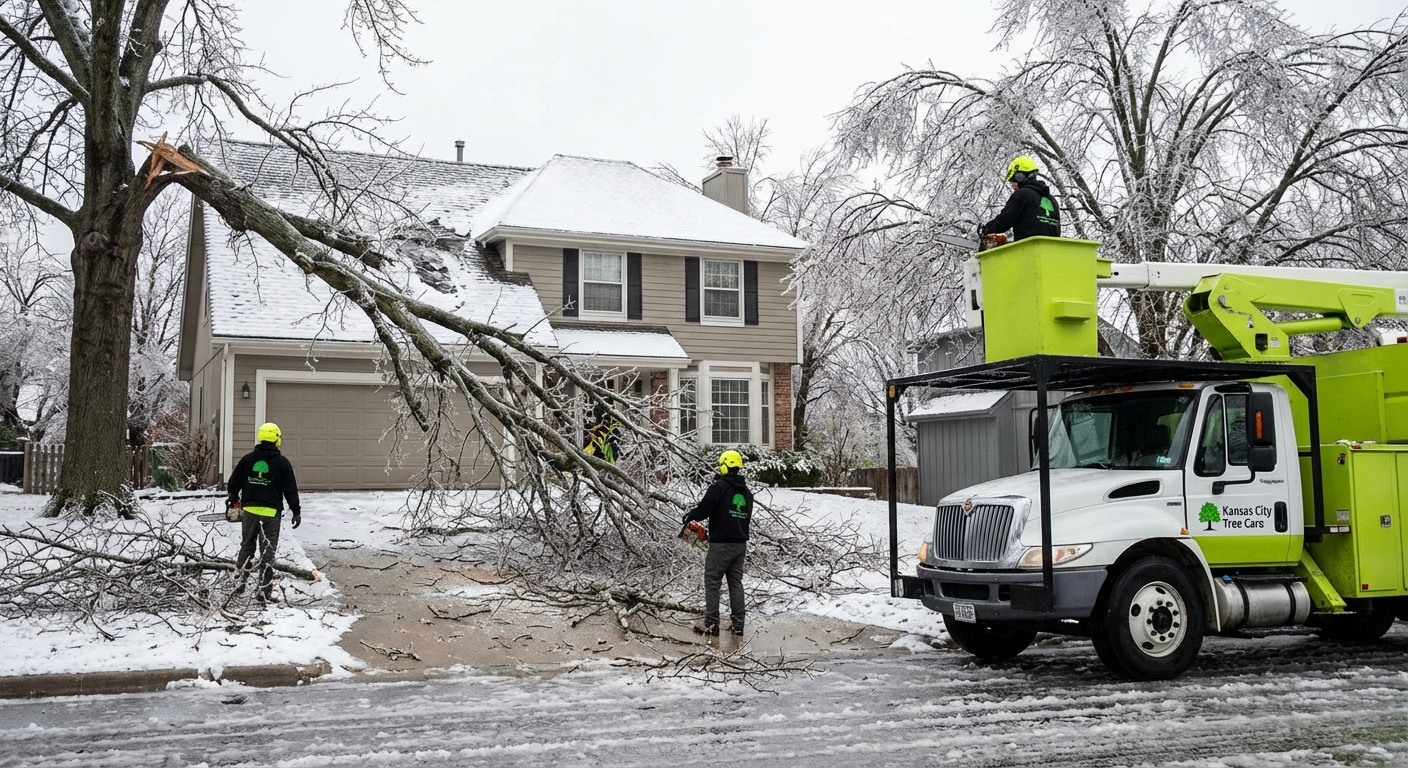
You wake up to the sound of cracking. Not a sharp snap — more like a slow, groaning tear that goes on for three or four seconds before a massive branch crashes into your yard. You look outside and the world is glazed in ice. Power lines are sagging. Your neighbor’s silver maple is split down the middle. And there’s a limb the size of a telephone pole resting on your roof.
If you’ve lived in Kansas City long enough, you’ve been through this. The metro sits squarely in the ice storm corridor of the central United States. When a warm front overrides cold air at ground level, the result is freezing rain that coats every branch, every wire, and every surface with a layer of ice that trees simply aren’t built to hold.
We’ve responded to thousands of ice storm emergency calls over our 35+ years in the KC metro. Here’s what you need to know before, during, and after the next one — because in Kansas City, the question isn’t if, it’s when.
Kansas City’s Ice Storm History and Risk
The KC metro has been hit by major ice storms roughly once every 5-10 years, with smaller ice events happening almost annually. Two storms stand out in recent memory:
January 2002: One of the most destructive ice storms in KC history. Up to an inch and a half of ice accumulated across the metro, snapping trees and power lines for days. Hundreds of thousands of homes lost power — some for over two weeks. The damage to the urban tree canopy was catastrophic. Entire blocks of mature trees were destroyed in neighborhoods across Overland Park, the Northland, and eastern Jackson County.
January 2018: A significant ice event that hit the southern metro harder than the north. Half an inch of ice accumulation brought down limbs and trees across Olathe, Lee’s Summit, and south Overland Park. Power outages affected tens of thousands. Tree crews were booked solid for weeks.
The geography matters. The I-35 corridor through the metro often marks a dividing line during winter storms. Northland neighborhoods (Parkville, Gladstone, Liberty) can get hammered while areas south of the river get rain, or vice versa. Elevation plays a role too — higher ground in south Johnson County sometimes stays just warm enough to avoid the worst accumulation while lower areas along the Missouri and Kansas Rivers glaze over.
The takeaway: if you own a home anywhere in the KC metro, ice storm damage to your trees is a statistical certainty over the life of a mortgage. Preparation isn’t optional.
What to Do When a Tree Falls on Your House
First: stay calm and stay safe. A tree on your roof is terrifying, but panicking makes everything worse.
Immediate steps:
- Get everyone out of the rooms directly below the impact. Even if the roof looks intact, structural damage may not be visible. Move to the opposite side of the house or leave entirely if the damage is severe.
- Call 911 if anyone is injured or if power lines are involved. A downed tree with power lines is a life-threatening situation. Stay at least 35 feet away from any wires and assume they’re energized even if the power appears to be off.
- Call your insurance company. Report the damage as soon as possible. Document everything with photos and video before any cleanup begins. Your adjuster will need to see the damage as it occurred.
- Call a professional tree service. This is not a DIY situation. A large tree on a structure requires rigging, cranes, or specialized equipment to remove safely without causing additional damage to your home.
- Tarp the roof. If the tree has punctured or displaced roofing material and it’s safe to access, covering the opening with a tarp prevents water damage. Many tree services can tarp as part of the emergency response.
What NOT to do: Don’t try to cut the tree yourself. Don’t pull branches off the roof — they may be supporting the tree’s weight and removing them could cause it to shift. Don’t climb on the roof to assess damage while the tree is still there. And don’t wait — water damage from an exposed roof in winter weather compounds fast.
KCMO 311 and Public Tree Responsibility
If the tree that came down is in the public right-of-way — the strip between the sidewalk and the street, or a tree planted by the city in a park or median — it’s the city’s responsibility to remove it.
Kansas City, Missouri: Call 311 or submit a request through the KC 311 Action Center app. The city’s forestry division handles public tree emergencies, but after a major storm, the backlog can be days or weeks long. If a public tree has fallen on your house or is blocking your driveway, emphasize the emergency nature when you report it.
Overland Park: Contact the city’s public works department at 913-895-6000 for trees in the public right-of-way.
Other jurisdictions: Each KC metro city handles public tree emergencies differently. Shawnee, Olathe, Independence, and Liberty all have their own departments. Check your city’s website or call the non-emergency line.
Important distinction: If a public tree falls on your private property (your house, car, fence), the city will typically remove the tree from the public right-of-way but won’t pay for damage to your property. That’s what your homeowners insurance is for. And if a tree on your private property falls into the public right-of-way, you’re responsible for removal.
Emergency vs. Scheduled Removal Costs
This is where ice storms hit your wallet. Emergency tree work costs significantly more than scheduled removal, and there are good reasons for it.
Emergency removal pricing:
- Tree on house (medium, 30-50 feet): $2,500-$5,000
- Tree on house (large, 50-80 feet): $5,000-$10,000+
- Tree blocking driveway/road: $800-$2,500
- Large limb on structure: $1,000-$3,000
- Crane-assisted emergency removal: $7,000-$15,000+
Scheduled (non-emergency) removal pricing for the same trees:
- Medium tree (30-50 feet): $1,000-$2,500
- Large tree (50-80 feet): $2,500-$5,500
- Very large tree (80+ feet): $5,500-$9,000
The premium for emergency work — typically 30-60% above standard rates — reflects the reality of the situation. Crews are working in dangerous conditions (ice, downed wires, unstable trees), often at night or on weekends, with more equipment and more personnel required. The rigging and removal process for a tree resting on a structure is inherently more complex and time-consuming than a straightforward open-yard removal.
This cost difference is the single strongest argument for proactive tree maintenance. A tree that’s been properly pruned and maintained is far less likely to fail in an ice storm. And a tree that should have been removed last summer costs twice as much to remove in January with ice on it.
Insurance Claims for Ice Storm Tree Damage in Missouri and Kansas
Understanding what your insurance does and doesn’t cover before a storm hits saves enormous frustration after.
What’s typically covered:
- Damage to your home, garage, shed, or other covered structures from a fallen tree
- Cost to remove a tree that has fallen on a covered structure (usually up to $500-$1,000 per tree, though some policies are higher)
- Damage to vehicles from fallen trees or limbs (comprehensive auto coverage)
- Temporary living expenses if your home is uninhabitable
What’s typically NOT covered:
- Removing a fallen tree that didn’t hit a covered structure (it just fell in your yard)
- Damage to landscaping, fences, or driveways (these are often excluded or have very low sub-limits)
- Removing a tree that’s damaged but still standing (even if it’s clearly about to fall)
- The cost of replacing the tree itself
Filing tips:
- Document everything with dated photos before any cleanup or removal begins
- Get a written estimate from your tree service — your adjuster needs itemized costs
- Keep all receipts for emergency expenses (tarps, temporary repairs, hotel stays)
- Don’t sign anything from a door-to-door “storm chaser” crew offering immediate service at inflated prices. After major storms, uninsured and unlicensed operators flood the KC metro
Missouri and Kansas both have consumer protection laws regarding storm-related home repairs. If an insurance claim is denied, you have the right to appeal. Having a detailed, professional tree assessment from an ISA certified arborist strengthens your case significantly.
Pre-Winter Preparation: What to Do Before Ice Season
October through early November is the window. Ice storms in KC can start as early as late November and hit as late as March. Here’s what proactive homeowners do:
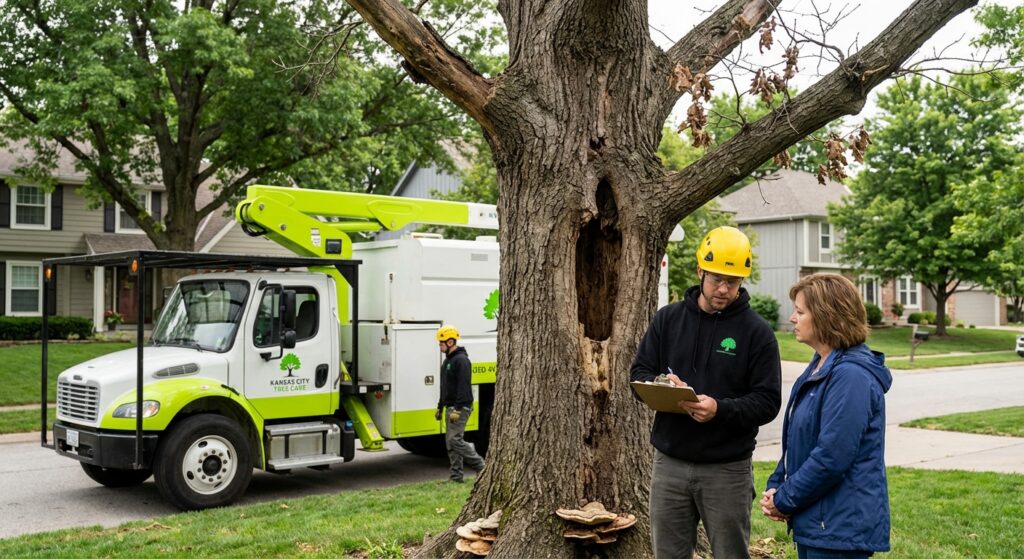
Professional tree inspection. Have every large tree within striking distance of your house, driveway, power lines, or neighbor’s property inspected by a certified arborist. We’re looking for dead branches, weak branch unions (co-dominant stems), internal decay, root problems, and overall structural integrity. Cost: $100-$250 per visit, and it’s the cheapest insurance you can buy.
Pruning for wind and ice resistance. Crown thinning reduces the sail area and ice-loading surface of the canopy. Removing dead branches eliminates the most likely failure points. Addressing co-dominant stems with cabling and bracing can save a tree that would otherwise split. Budget $300-$800 per tree for maintenance pruning.
Remove obvious hazards. That dead tree you’ve been meaning to deal with for two years? Get it down before winter. The dead limb hanging over your bedroom? Same. Every year we get calls from homeowners who knew a tree was a problem and just didn’t get around to it. The storm doesn’t wait.
Know your trees. Walk your property and identify every tree that could reach your house, your neighbor’s house, your cars, or power lines if it fell. Those trees get priority for inspection and maintenance.
Highest-Risk Tree Species for Ice Storm Damage in KC
Not all trees handle ice equally. Species with brittle wood, poor branch structure, or shallow roots are disproportionately vulnerable. Here’s what fails first in a KC ice storm:
Silver maple. The number one ice storm casualty in Kansas City. Weak wood, poor branch angles, fast growth that produces long, heavy limbs. If you have a large silver maple near your house, it’s a matter of when, not if. We’ve written about the warning signs of trees that need removal — silver maples check most of the boxes.
Cottonwood. Second on the list. Massive trees with soft, brittle wood. A large cottonwood with an inch of ice on every branch is carrying tons of extra weight on wood that can’t handle it.
Bradford/Callery pear. These ornamental pears are everywhere in KC subdivisions built in the 1990s-2000s. Their tight, V-shaped branch unions are structurally terrible. Heavy ice causes them to split apart like a peeled banana. We remove more storm-damaged Bradford pears than almost any other ornamental.
Siberian elm. Fast-growing, weak-wooded, and prone to internal decay. Common in older Kansas City neighborhoods and along property lines throughout the metro.
Green ash (dead from EAB). Dead ash trees that haven’t been removed are extremely dangerous in ice storms. The wood is already brittle and dry. Even a light ice accumulation can bring them down. If you have a dead ash on your property, remove it before winter. Period.
Most ice-resistant species: Bur oak, white oak, hickory, honeylocust, and baldcypress. These species have stronger wood, better branch architecture, and deeper root systems that anchor them during ice events. They still lose branches in extreme storms, but they’re far less likely to suffer catastrophic failure.
Frequently Asked Questions
How quickly can you respond to an emergency tree call during an ice storm?
During a major ice event, we prioritize by severity: trees on houses (especially with occupants) first, then trees on cars or blocking access, then trees threatening power lines or public safety. Response time during a major storm can range from same-day for true emergencies to 2-5 days for lower-priority situations. We work extended hours during storm events to reach as many customers as possible.
Should I try to remove ice from my trees myself?
No. Shaking branches or trying to knock ice off can cause more damage than the ice itself. The force of removing ice often breaks branches that might have survived if left alone. Let the ice melt naturally. If branches are sagging but not broken, they’ll usually return to their normal position once the ice is gone.
My tree lost half its branches in an ice storm. Can it survive?
It depends on the species, age, and which branches were lost. Healthy, vigorous trees can recover from losing up to 25-30% of their canopy if the remaining structure is sound. Losing 50% or more is usually fatal for the tree’s long-term prospects — even if it pushes out new growth the following spring, the structural damage and stress leave it vulnerable to disease, insects, and future storms. Have an arborist assess it before investing in cleanup and restoration pruning.
Does the city remove trees that fall in my yard during a storm?
Only if the tree was a public tree (city-owned, in the right-of-way) that fell onto your property. Trees on private property are the homeowner’s responsibility, even during declared emergencies. Some jurisdictions offer storm debris pickup at the curb, but the tree still needs to be cut, moved, and staged by the property owner or their contractor.
How can I tell if a tree is at risk of failing in the next ice storm?
Look for dead branches in the canopy, V-shaped branch unions (especially in the main trunk), visible trunk cracks or cavities, fungal growth at the base, and a lean that has developed or worsened recently. Any of these significantly increases the chance of failure during an ice event. A pre-winter hazardous tree evaluation is the most reliable way to identify at-risk trees before a storm hits.
Don’t Wait for the Next Storm to Find Your Problem Trees
Kansas City’s next major ice storm could be this winter or five winters from now. But the trees on your property that will fail in that storm are standing there right now, with deadwood in the crown, decay in the trunk, and structural weaknesses that a trained eye can spot today. The difference between a $500 pruning job in October and a $5,000 emergency removal in January is preparation.
Kansas City Tree Care provides pre-winter tree assessments, storm preparation pruning, emergency storm response, and full recovery services across the entire KC metro — the Northland, Parkville, Overland Park, Olathe, Shawnee, Lee’s Summit, Independence, Liberty, and every community in between. ISA certified, BBB accredited, licensed and insured, with 35+ years of experience keeping KC safe through the worst weather.
Call us at 913-894-4767 for a free pre-winter tree assessment — or anytime you need emergency storm response.