When a Tree Becomes a Problem Instead of an Asset
That big silver maple in your backyard has been there since before you bought the house. It gives great shade in the summer, the kids love climbing it, and it’s part of what makes the property feel like home. But lately you’ve noticed something — maybe the bark is peeling in weird spots, or there’s a crack running up the trunk you don’t remember seeing before.
Here’s what most KC homeowners don’t realize: by the time a tree looks obviously sick or dangerous, the problem has usually been developing for years. The good news is that trees give warning signs long before they fail. The bad news is that most people don’t know what to look for — until a storm takes it down onto their garage.
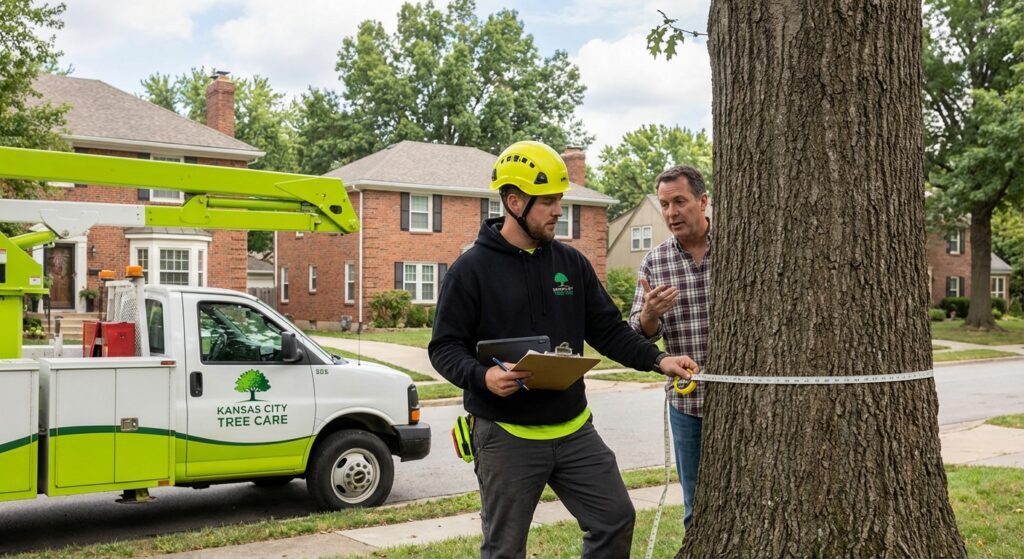
We’ve been evaluating trees across the Kansas City metro for over 15 years. Here are the signs we look for when a homeowner calls us worried about a tree on their property.
Dead or Dying Branches in the Crown
Start by looking up. If more than 25-30% of the branches in the tree’s crown are dead — no leaves in summer, brittle, snapping easily — that’s a red flag. A few dead branches in a large tree are normal. A quarter of the canopy dying back is not.
We see this constantly with pin oaks in Johnson County. Iron chlorosis (caused by KC’s alkaline clay soil) slowly weakens pin oaks from the top down. Other oak tree diseases in Kansas City — including oak wilt — can cause similar crown dieback patterns. The upper branches die first, then the dieback creeps downward year after year. By the time it’s reached the lower canopy, the tree is usually past saving.
Silver maples are another common culprit. Their weak wood means dead branches don’t just hang there — they fall. A dead silver maple limb over your roof or driveway in Overland Park isn’t a cosmetic issue. It’s a ticking clock waiting for the next thunderstorm.
What to do: If you’re seeing significant crown dieback, have a certified arborist evaluate the tree. Sometimes aggressive pruning can save it. Other times, the underlying cause (disease, root damage, soil issues) means removal is the safest option.
Trunk Damage: Cracks, Cavities, and Cankers
The trunk is the tree’s structural backbone. When it’s compromised, the entire tree is at risk of failure — and trunk damage is harder to fix than branch problems.
If you spot cracks or splits but the tree isn’t leaning dangerously, cabling and bracing might stabilize it for years. Our cabling and bracing services have saved trees that homeowners had already written off.
Vertical cracks running up the trunk are a sign of internal stress. If a crack goes more than halfway through the trunk diameter, the tree’s structural integrity is seriously compromised. We’ve seen oaks in Kansas City with cracks that were barely visible on the surface but went 8-10 inches deep when we investigated.
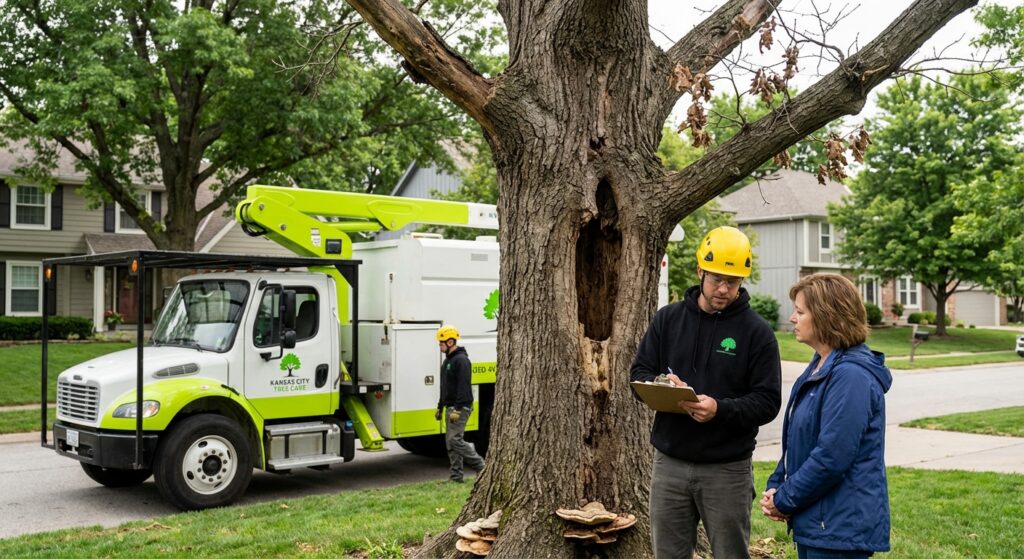
Cavities (holes in the trunk) mean decay. Small cavities in large, otherwise healthy trees aren’t necessarily a death sentence — trees can compartmentalize decay and continue to function. But if the cavity extends through more than a third of the trunk’s cross-section, the tree’s load-bearing capacity is reduced to a dangerous level.
Cankers are sunken, dead areas on the bark where disease has killed the underlying tissue. They weaken the trunk structurally and serve as entry points for further infection. Large cankers on the main trunk — especially on one side — can cause the tree to fail toward the weakened side during high winds.
If you’re in an older neighborhood like Prairie Village, Mission, or Fairway, many of the mature trees are 60-80+ years old. Trunk problems at that age are common and often mean the tree is approaching the end of its safe lifespan.
Root Problems You Can See from the Surface
You can’t see most of a tree’s root system, but there are visible signs that the roots are in trouble:
- Heaving soil on one side of the tree — this means roots on the opposite side have lost their grip. The tree is literally being pulled out of the ground. If you see cracked or lifted soil at the base, the tree could come down in the next major wind event.
- Mushrooms or fungal brackets growing at the base — fungi at the root flare almost always indicate root rot. Armillaria (honey fungus) is particularly common in the KC metro and can kill a tree’s root system before the canopy shows any symptoms.
- Visible root damage from construction, trenching, or grade changes. If roots on one side were cut for a driveway, patio, or utility line, the tree may have lost a critical portion of its support structure. We see this regularly in neighborhoods that have had sewer line replacements.
- Leaning that’s getting worse — all trees lean slightly. But if a tree that used to stand relatively straight is now leaning and the lean is increasing (check by taking a photo and comparing year over year), the roots are failing.
Root problems are the most dangerous because they’re the hardest to detect and they cause the most catastrophic failures. A tree with root rot doesn’t lose a branch — it goes over entirely, root ball and all. That’s 15,000-40,000 pounds of wood coming down at once.
The Emerald Ash Borer Problem in Kansas City
If you have an ash tree on your property, this section is for you. The emerald ash borer (EAB) has killed tens of thousands of ash trees across the Kansas City metro since it was first detected here around 2012. Green ash and white ash — both extremely common in KC neighborhoods — are the primary targets.
Signs your ash tree has EAB:
- D-shaped exit holes (about 1/8 inch wide) in the bark — these are where adult beetles emerged
- S-shaped larval galleries (serpentine tracks) under the bark
- Crown dieback starting at the top and progressing downward
- Excessive sprouting from the trunk and base (the tree’s desperate attempt to survive)
- Bark splitting and woodpecker activity — birds feeding on larvae under the bark
Here’s the critical safety issue: dead ash trees become extremely brittle within 1-2 years. The wood dries out and becomes unpredictable. We’ve had ash trees in Independence and Raytown that snapped during removal because the wood was so degraded it couldn’t support its own weight. Dead ash trees should be removed as soon as possible — every season you wait makes the job more dangerous and more expensive.
If your ash tree is still alive but showing early EAB symptoms, preventive treatment (trunk injection) can save it. But the window closes fast. Once more than 50% of the canopy is affected, treatment is no longer effective. Talk to an arborist before it’s too late. Our hazardous tree evaluation can tell you exactly where your ash stands.
Storm Damage That Weakens Trees Permanently
Kansas City gets hit with serious weather every year. Ice storms, straight-line winds from summer thunderstorms, occasional tornadoes — our trees take a beating. Not every storm-damaged tree needs to come down, but some damage is beyond recovery.
Remove the tree if:
- More than 50% of the crown was lost in the storm
- The main trunk is split (a major fork separated)
- The tree is leaning significantly and wasn’t before
- Large scaffold branches (the main structural limbs) are torn off, leaving gaping wounds
The tree can usually be saved if:
- Only smaller secondary branches were lost
- The damage is on one side but the trunk is intact
- Less than 25% of the crown was affected
The toughest calls are trees that lost 30-50% of their canopy. These might survive, but they’ll be structurally compromised for years and more vulnerable to the next storm. In those cases, we often recommend cabling and bracing as a temporary support while the tree recovers — if recovery is realistic.
After a major storm event in KC, don’t make removal decisions in the first 48 hours unless there’s an immediate safety hazard. Wait until the adrenaline wears off and get a professional assessment. Some trees that look terrible right after a storm actually recover well with proper pruning.
Trees Too Close to Your Home or Structures
This isn’t about disease or damage — it’s about risk management. A perfectly healthy tree that’s 8 feet from your foundation, leaning toward your house, with branches overhanging the roof is still a problem. Species like Bradford pear are structurally prone to failure — learn about Bradford pear removal costs and why arborists recommend replacing them.
Consider removal if:
- Large limbs extend directly over your roof (especially for species with weak wood like silver maple and cottonwood)
- The tree’s trunk is within 10 feet of your foundation and roots are causing visible foundation movement
- The tree has grown into power lines (contact your utility company — KC Power & Light/Evergy handles utility-line trees)
- The canopy is so dense it’s creating moisture problems (moss, algae, roof deterioration) from lack of sunlight and airflow
In older KC neighborhoods — Fairway, Roeland Park, Mission, parts of Overland Park built in the 1950s-60s — many trees were planted too close to houses when they were small and manageable. Sixty years later, that cute little maple is now a 60-foot tree with a 40-foot canopy radius, and the roots are heaving the driveway. Sometimes the responsible choice is removal, followed by replanting a more appropriately sized species.
Multiple Warning Signs Mean Act Now
Any single warning sign warrants monitoring. Multiple warning signs together mean you need to act. A tree with crown dieback AND trunk cavities AND root zone mushrooms isn’t going to get better. It’s a matter of when it fails, not if.
The most dangerous trees are the ones that look mostly OK from a distance but have hidden problems. That’s why we recommend annual inspections for any tree within falling distance of your home, your neighbor’s home, or anywhere people regularly walk or park cars. A 20-minute inspection can catch problems that save you thousands in emergency removal and property damage.
We do tree removal jobs every week across the KC metro where the homeowner says the same thing: “I knew something was wrong, but I kept putting it off.” Don’t be that homeowner.
What to Expect When You Decide to Remove a Tree
If you’ve identified warning signs and decided removal is the right call, here’s the typical process:
1. Get an estimate. A reputable company will come to your property, evaluate the tree, and give you a written quote. In the KC metro, tree removal typically costs $800-$2,500 for standard jobs. Large trees, tight access, or proximity to structures can push costs to $3,000-$5,000+.
2. Check permit requirements. Most Kansas cities (Overland Park, Olathe, Lenexa, Shawnee) don’t require permits for removing trees on private residential property. Some Missouri cities do. If the tree is in a public right-of-way or an HOA-governed property, additional approvals may be needed.
3. Schedule the work. Busy season for tree removal in KC runs from late spring through early fall. Emergency removals happen year-round, but non-emergency jobs can sometimes take 1-3 weeks to schedule during peak periods.
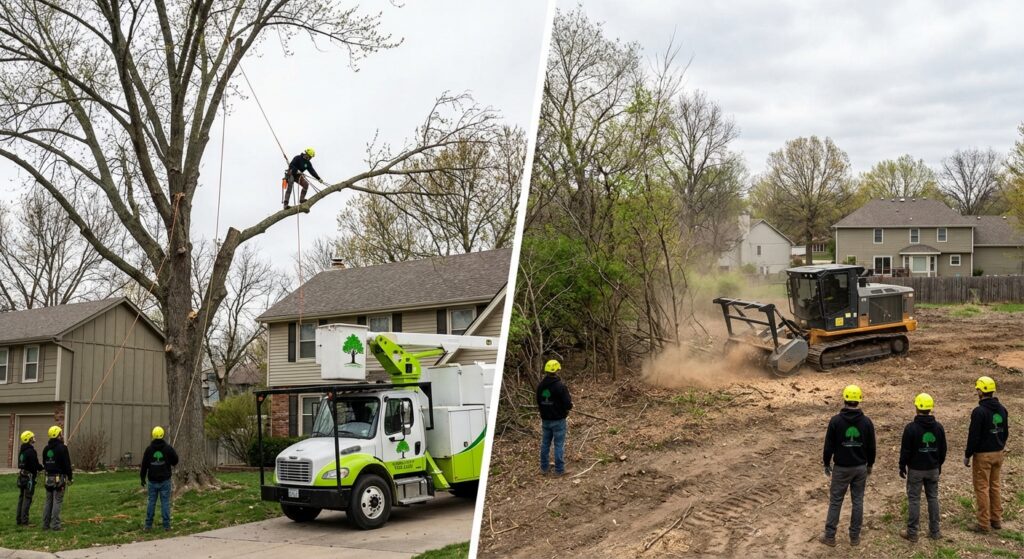
4. Day of removal. The crew arrives, sets up, and takes the tree down in sections from top to bottom. They’ll chip the branches, cut the trunk into manageable sections, and haul everything away. Stump grinding is usually a separate service that can be done the same day or scheduled for later.
Frequently Asked Questions
How much does it cost to remove a tree in Kansas City?
Standard tree removal in the KC metro runs $800-$2,500 depending on tree size, species, location, and accessibility. Large trees near structures that require crane work or extensive rigging can cost $3,000-$5,000+. Stump grinding is typically an additional $150-$400. Always get a written estimate from a licensed, insured company.
We assess trees throughout Prairie Village, Shawnee, and the entire KC metro. Here are the questions homeowners ask most:
Can a leaning tree be saved?
It depends on why it’s leaning. A tree that has always grown at a slight angle is usually fine — it’s structurally adapted to that position. A tree that has recently started leaning (new lean) is a different story. New lean usually means root failure, and that tree should be evaluated immediately. If the root system is intact and the lean is minor, cabling can sometimes stabilize it.
Should I remove a tree with a large cavity?
Not necessarily. Trees can live with cavities for decades if the remaining wood wall is thick enough to support the tree’s weight and wind loads. A general guideline: if the cavity extends through more than one-third of the trunk’s diameter, structural failure risk is elevated. A hazardous tree assessment can determine how much sound wood remains.
When is the best time to remove a tree?
Tree removal can be done any time of year. Winter is often ideal because the ground is harder (less lawn damage from equipment), there’s no leaf cleanup, and many tree companies have better availability. However, if a tree is a safety hazard, don’t wait for the “right” season — get it handled now. Check our guide on the best time for tree work in KC for more seasonal considerations.
How do I know if my ash tree has emerald ash borer?
Look for D-shaped exit holes in the bark (about 1/8 inch wide), crown dieback starting at the top, excessive sprouting from the trunk and base, bark splitting, and heavy woodpecker activity. If your ash tree shows any of these signs, have it evaluated immediately — dead ash trees become dangerously brittle within 1-2 seasons and should be removed promptly.
Don’t Wait Until It’s an Emergency
The difference between a planned tree removal and an emergency tree removal is about $1,000-$3,000 — plus the potential for property damage that could cost far more. If you’ve noticed any of the warning signs in this article, the smartest move is a professional evaluation now, while you still have time to plan.
We evaluate and remove trees throughout the Kansas City metro — Overland Park, Olathe, Shawnee, Lee’s Summit, Independence, Liberty, and all surrounding communities. We’re licensed, insured, and we’ve been doing this for over 15 years.
Call Kansas City Tree Care at 913-894-4767 for a free tree evaluation and estimate.