You’ve got a big tree that needs work, and your inbox is suddenly full of estimates that don’t agree on anything. One company wants $900. Another wants $2,800. A third just knocked on your door with a chainsaw in the truck. Who do you actually trust?
It’s a fair question, and an important one. The right crew protects your home, your family, and your wallet. The wrong one can leave you with damaged property and no way to make it right.
We’ve spent 35 years working trees across the KC metro, from Overland Park to Lee’s Summit, and we’ve cleaned up after plenty of jobs that went sideways. The good news is that picking a great tree service isn’t complicated once you know what to look for.
This guide walks you through exactly how to choose, the questions to ask, and the green flags that separate a true professional from someone passing through town.
Think of it as the same checklist we’d give a friend or family member who asked us how to hire a good tree service kansas city families can count on. None of it is complicated, and all of it protects you.
What to Look for in a Tree Service in Kansas City
A great tree service kansas city homeowners can rely on shares a few traits, and they’re easy to spot once you know them.
The best crews are licensed, fully insured, and certified. They show up when they say they will, give you a clear written estimate, and explain what they’re doing and why.
They also know your area. KC trees face challenges you won’t find everywhere, like ice-loaded silver maples in winter and ash trees hit hard by emerald ash borer. A local crew has handled these exact situations hundreds of times.
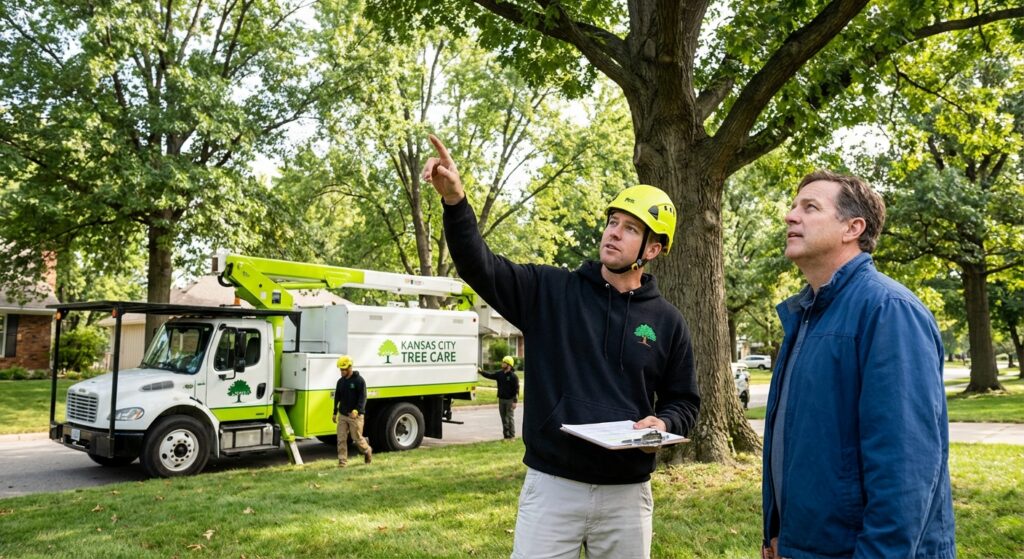
Most of all, a good tree service treats your property like their own. They protect your lawn, your fence, and your flower beds, and they clean up before they leave. If you want to see how that looks in practice, our Kansas City tree service team is happy to walk you through our process.
Below, we’ll break down each thing to check, in the order that matters most.
Verify Licensing and Insurance First
Before anything else, confirm the company is licensed and properly insured. This single step protects you more than any other.
Here’s why it matters so much. Tree work is one of the more demanding trades out there, with climbers high in the canopy and heavy limbs coming down near homes. When the crew is insured, you’re covered if something goes wrong.
Two kinds of insurance protect you directly:
- General liability insurance covers damage to your property, like a limb that lands on your roof or your neighbor’s fence.
- Workers’ compensation insurance covers the crew if a worker is injured on your property, so the medical costs never land on you.
This is the part most homeowners don’t realize until it’s too late. If an uninsured worker gets hurt in your yard, you could be held responsible for their injury. That’s a risk no price discount is worth.
The same goes for property damage. A heavy oak limb that slips during removal can crack a roof or crush a fence in seconds. With proper liability coverage, the company’s policy handles the repair, not your homeowners insurance.
Always ask for a current certificate of insurance, and don’t be shy about it. A reputable company hands it over without hesitation, because they’re proud to be covered. The certificate should list both general liability and workers’ comp, with policy dates that are still active.
We carry full liability and workers’ comp on every job, and we’re glad to send proof before we ever set foot on your property. It’s one of the simplest ways we put a homeowner’s mind at ease.
Why ISA Certification Tells You a Lot
Licensing and insurance keep you protected. Certification tells you the crew actually knows trees.
The gold standard here is ISA certification. The ISA, or International Society of Arboriculture, certifies arborists who pass a rigorous exam and keep their training current.
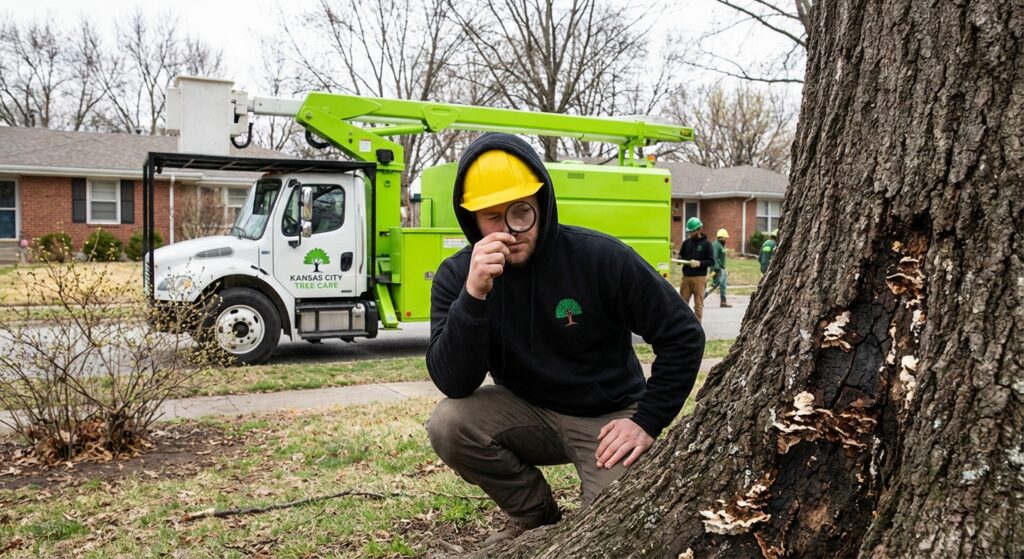
An ISA-certified arborist (a tree expert who has met national standards for tree care) does more than cut. They diagnose what’s really happening with your tree and recommend the smartest fix.
That matters because not every tree needs to come down. Sometimes a good pruning or a cabling system (steel supports that keep a weakened tree stable) saves a tree you love and saves you money too.
We see this often in older neighborhoods like Prairie Village and Brookside, where mature oaks and elms just need expert attention, not removal. A certified eye knows the difference.
If you’re weighing whether a tree can be saved, an ISA-certified arborist consultation gives you an honest answer based on the tree’s actual health, not on what’s easiest to sell.
Check Reviews and BBB Accreditation
Once you know a company is qualified, see how they treat their customers. Reviews and accreditation tell that story fast.
Start with Google reviews and read more than the star rating. Look for comments about cleanup, communication, and whether the crew finished on time and on budget.
Pay attention to how a company responds to less-than-perfect reviews. A thoughtful, professional reply tells you they care about doing right by people.
Volume and consistency matter too. A long track record of steady, positive feedback across many jobs says more than a handful of glowing reviews posted in a single week.
BBB accreditation is another strong signal. A company accredited by the Better Business Bureau has agreed to a standard of honesty and resolves complaints fairly. We’re proud to be BBB accredited, and we’ve earned it the slow, steady way, one happy KC neighbor at a time.
You can also ask for local references. A crew that has worked in Olathe, Shawnee, or Independence for years can point you to homeowners who’ll vouch for them.
Always Get a Written Estimate
A handshake price is easy to forget. A written estimate protects both of you and keeps the job clear from start to finish.
A solid written estimate spells out exactly what you’re paying for. Look for these details:
- The specific trees and the work being done, like removal, trimming, or stump grinding
- Whether cleanup and haul-away are included
- Stump grinding and where the debris goes
- Proof of insurance attached or referenced
- A clear total price, not a vague range
When the estimate is in writing, there are no surprises on the final bill. You know what you’re getting, and the crew knows exactly what’s expected.
This is also where you can compare offers fairly. Two estimates that both include full cleanup and stump grinding are far easier to weigh than a low number that leaves the mess in your yard.
For a real sense of pricing before you compare bids, our guide on what tree removal really costs in the KC area shows you the typical ranges and what drives them.
Spotting Storm-Chasers After KC Storms
KC weather keeps tree crews busy. Ice storms roll through from December to February, and spring brings powerful wind and hail from March into June.
After every big storm, out-of-town crews flood the metro looking for quick work. Many are honest. Some are not, and they count on homeowners being stressed and in a hurry.
Here’s how to tell a true professional from a storm-chaser passing through. Watch for these signs:
- They knock on your door uninvited right after a storm
- They pressure you to decide on the spot
- They ask for a large cash payment up front
- They drive an unmarked truck with out-of-state plates
- They can’t show you proof of local insurance or certification
The smart move is simple. Take a breath, get a written estimate, and verify insurance before any work begins, even when a limb is down.
A storm is stressful, but you have time to choose well. A trusted local crew like ours isn’t going anywhere, and we’d rather you feel confident than rushed.
If a storm has already hit your property, our storm recovery team responds fast and works with your insurance, so the cleanup feels manageable instead of overwhelming.
Why the Cheapest Bid Can Cost You More
A low price is tempting, especially when the work feels urgent. But the cheapest bid often hides the real cost.
When one estimate comes in far below the rest, it usually means something is missing. Most often, it’s insurance, proper equipment, or cleanup.
An uninsured crew can offer a lower number because they’re not paying for the coverage that protects you. That savings disappears the moment a limb lands on your roof and there’s no policy to cover it.
We see the aftermath of these jobs more than we’d like. A homeowner in Raytown once hired the lowest bidder to take down a big pin oak near power lines. The crew nicked an Evergy line, left a torn-up yard, and vanished. Cleaning it up cost far more than a qualified crew would have charged in the first place.
The honest answer is this. You’re not just paying for a tree to come down. You’re paying for it to come down safely, cleanly, and without leaving you on the hook for anything.
A fair, mid-range price from an insured, certified crew is almost always the better value. You pay once, the job is done right, and there’s nothing to fix later.
Think of it the way you’d think about a roofer or an electrician. The lowest number on the page is rarely the one that gives you the most peace of mind.
Questions to Ask Before You Hire
A few good questions tell you almost everything you need to know. Ask these before you sign anything:
- Are you licensed, insured, and able to send a certificate of insurance?
- Do you carry workers’ compensation for your crew?
- Is there an ISA-certified arborist on the job?
- Can I get the full estimate in writing?
- Does the price include cleanup, haul-away, and stump grinding?
- Have you worked in my city before, and can you share references?
A great company welcomes these questions and answers them clearly. If someone gets defensive or dodges them, that tells you plenty.
You should never feel awkward asking. This is your home, and a true professional respects that you want to choose wisely.
When you’re dealing with a tree that worries you, a professional tree risk evaluation takes the guesswork out of it. You get a clear read on whether the tree is truly a hazard and what to do next.
What a Great Crew Does Differently
The best tree services share a way of working that you can feel from the first phone call. It’s in the details.
A great crew shows up on time and ready. They protect your lawn with mats, plan their cuts to avoid your home and garden, and rope down heavy limbs instead of letting them drop.
They understand KC conditions too. Our clay soil holds moisture and can hide root problems, so an experienced crew checks the root flare and the base before deciding how a tree should come down.
They also respect the power lines. With Evergy lines running through so many KC yards, a skilled crew knows when to clear the work themselves and when the utility needs to be involved.
And when the job is done, your yard looks better than they found it. The debris is hauled away, the wood chips are cleared, and the only sign they were there is the work you asked for.
That’s the standard our crew holds on every job, whether it’s a single silver maple in Lenexa or a full storm cleanup in Liberty. It’s how we’ve built 35 years of trust across the metro.
When you put all of this together, choosing a tree service kansas city homeowners can rely on really comes down to one thing. You want a crew that’s qualified, insured, honest about price, and proud of how they leave your yard. Everything in this guide points back to that.
Frequently Asked Questions
How do I verify a tree service is actually insured?
Ask for a current certificate of insurance, and confirm it covers both general liability and workers’ compensation. A reputable company sends it without hesitation. You can also call the insurance provider listed to confirm the policy is active.
What does ISA certification mean for me as a homeowner?
It means the arborist has passed a national exam and keeps their training current. For you, that translates to accurate diagnoses and smarter recommendations, so you only remove a tree when it truly needs to come down. It’s a strong sign you’re hiring real expertise.
How much should tree removal cost in Kansas City?
Most residential tree removals in the KC metro run $800 to $3,500, depending on the tree’s size, location, and access. A large oak near power lines costs more than a small tree in an open yard. A written estimate gives you the exact number for your specific tree.
Are door-to-door tree services after a storm safe to hire?
Some are fine, but many are storm-chasers passing through town. Never feel pressured to decide on the spot. Get a written estimate, verify local insurance, and check reviews first, even when a limb is already down. A trusted local crew will gladly wait while you do.
How quickly can a crew respond after a storm?
A good local company can often reach you the same day for urgent hazards, like a limb on your roof or a tree blocking your driveway. We prioritize storm calls and work with your insurance to keep the process simple. Calling early helps you get on the schedule fast.
Ready to Choose with Confidence?
Now you know exactly what to look for. Confirm licensing and insurance, check for ISA certification and strong reviews, get everything in writing, and trust a fair price over the cheapest bid. With those steps, picking the right crew becomes simple.
For 35 years, our team has cared for trees across 16 cities on both the Kansas and Missouri sides of the metro. We’re ISA certified, BBB accredited, fully licensed and insured, and we treat every property like our own. When you call our Kansas City tree service team, you get straight answers and honest recommendations, never a hard sell.
If you’ve got a tree on your mind, we’re happy to take a look and tell you what we’d recommend, with no pressure and no obligation. Call Kansas City Tree Care at 913-894-4767 for a free estimate.