Your HOA Has Rules About Tree Removal — Here’s How to Work Within Them
You’ve got a dead ash tree in the front yard. Or a silver maple that’s dropping limbs every storm. Or maybe a Bradford pear that’s split down the middle and you’re done with it. The tree needs to go. Simple enough — until your HOA tells you otherwise.
If you live in an Overland Park subdivision with a homeowners association, there’s a good chance you can’t just call a tree service and have it removed. Most HOAs in Johnson County require some form of approval before any tree comes down, and the process can range from a quick email to a months-long bureaucratic exercise.
We’ve worked with homeowners in dozens of Overland Park HOA communities over the past 35 years. Here’s how to navigate the rules, get approval efficiently, and avoid the mistakes that lead to delays, fines, or flat-out denials.
City Authority vs. HOA Authority: Who Actually Controls Your Trees?
This is the first thing homeowners need to understand. Overland Park, as a city, does not require a permit for tree removal on private residential property. If there were no HOA, you could remove any tree on your own land without asking anyone’s permission.
But HOA covenants are private contracts — and they carry legal weight. When you bought your home, you agreed to the CC&Rs (Covenants, Conditions, and Restrictions). Those covenants often include landscape maintenance clauses that give the HOA authority over tree removal, replacement requirements, and even the species you can plant.
So the city won’t stop you. But your HOA can. And ignoring HOA rules can result in fines, mandatory replanting at your expense, or even legal action. It’s not worth the fight when the approval process, done right, usually takes just a few weeks.
Common HOA Tree Restrictions in Overland Park
HOA covenants vary from neighborhood to neighborhood, but across the Blue Valley subdivisions, Cedar Creek, Deer Creek, Hawthorne, and other Overland Park communities, we see the same patterns:
Prior written approval required. This is the most universal restriction. Nearly every Overland Park HOA requires written approval from the architectural review committee (ARC) before removing any tree. Some only require approval for trees in the front yard or common-view areas. Others apply to every tree on the property, front and back.
Replacement requirements. Many HOAs require you to plant a replacement tree when you remove one, especially in the front yard. The replacement often has to meet minimum size requirements — typically a 2-inch caliper tree — and may need to be an approved species from the HOA’s landscape guidelines.
Species restrictions. Some HOAs maintain a list of approved tree species for new plantings and replacements. This is actually a good thing. It prevents homeowners from planting invasive species like Bradford pears or problematic trees like silver maples that cause issues down the road.
Size and quantity limits on removal. A few HOAs restrict how many trees can be removed at one time, or require extra review for trees above a certain size. If you want to clear three large trees for a landscaping project, the review process may be more involved than removing a single dead tree.
Seasonal restrictions. Less common, but some covenants specify that tree removal should occur outside of nesting season (March through August) unless the tree is dead or hazardous. This is more of a best-practice guideline than a hard rule in most communities.
Getting HOA Approval: The Step-by-Step Process
The faster you get your paperwork right, the faster you get approval. Here’s the process that works in most Overland Park HOAs:
Step 1: Read your CC&Rs. Before you do anything else, pull up the landscape section of your HOA covenants. Look specifically for language about tree removal, architectural review, and replacement requirements. This tells you exactly what the board needs to see.
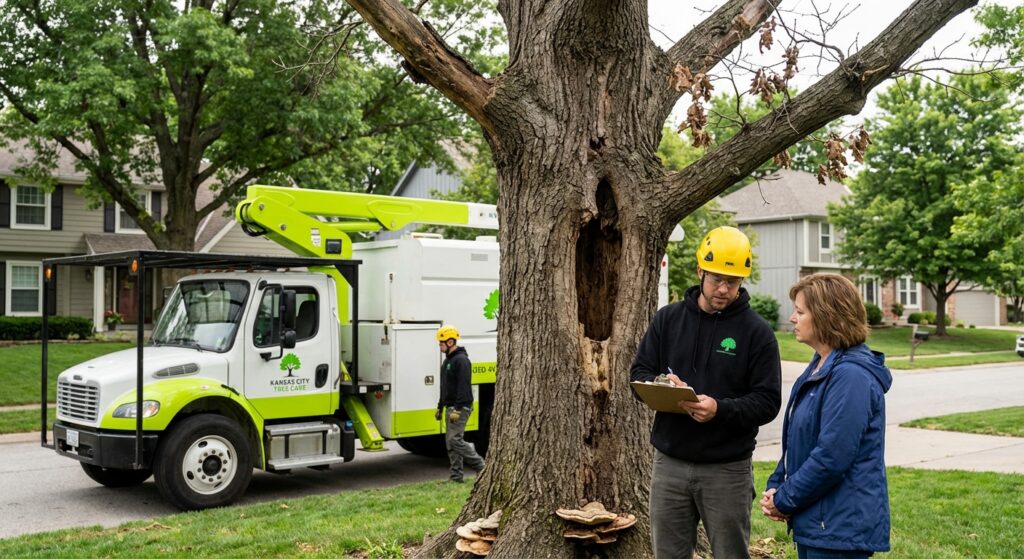
Step 2: Document the tree’s condition. Take clear photos of the tree from multiple angles. If the tree is dead, diseased, or damaged, photograph the specific signs — dead branches, fungal growth, trunk cracks, missing bark, lean. Date the photos.
Step 3: Get an arborist assessment. This is the single most effective thing you can do to speed up approval. A written assessment from an ISA-certified arborist documenting the tree’s condition carries significant weight with HOA boards. It transforms your request from “I don’t want this tree” into “a qualified professional has determined this tree should be removed.”
Step 4: Submit your request. Most HOAs have a standard form — either a paper architectural review form or an online submission portal. Include your photos, the arborist assessment, the reason for removal, and your plan for replacement (if required). Be specific and factual.
Step 5: Follow up. ARC meetings typically happen monthly. If you miss the submission deadline for one meeting, you’ll wait until the next. Ask your HOA management company when the next ARC meeting is scheduled and when materials need to be submitted.
Total timeline from submission to approval: 2-4 weeks for straightforward cases. Complex requests (multiple trees, healthy trees, no clear defect) can take longer.
Heritage Tree Protection in Johnson County
Johnson County doesn’t have a countywide heritage tree ordinance, but several dynamics can make large, mature trees harder to remove — even on private property within an HOA.
Some Overland Park HOAs have their own version of heritage tree protection written into the covenants. Trees above a certain diameter — often 24 or 30 inches DBH (diameter at breast height) — may require extra review or a finding of necessity before removal is approved. The idea is to preserve mature canopy that contributes to the neighborhood’s character and property values.
The Stilwell area south of Overland Park, while technically unincorporated Johnson County, has some of the oldest and most significant trees in the metro. Neighborhoods in that area often have deed restrictions or conservation easements that protect large native trees, particularly oaks and walnuts.
In communities like Leawood and Mission Hills, where property values are among the highest in the metro, HOA boards tend to be particularly protective of mature landscape trees. This doesn’t mean you can’t remove a tree, but the approval process may include a site visit by the ARC and a more detailed review of your replacement plan.
The strongest case for removing a protected tree is always safety. A certified arborist’s assessment documenting structural failure risk, disease progression, or root compromise gives the board the justification they need to approve removal regardless of the tree’s size or age.
What to Do When the HOA Says No
It happens. You submit your request, and the architectural review committee denies it. Before you get frustrated, understand why it happened and what your options are.
Common reasons for denial:
- Insufficient documentation — the board wants more evidence that removal is necessary
- No arborist assessment — homeowner opinion alone isn’t enough for many boards
- Healthy tree, aesthetic preference — you want the tree gone because you don’t like it, but the tree is healthy and the HOA values canopy preservation
- Missing replacement plan — the covenants require a replacement and you didn’t include one
How to appeal or resubmit:
- Ask the board for specific reasons for the denial in writing
- Address each reason directly in a revised submission
- If you didn’t include an arborist assessment the first time, get one now. This single document resolves most denials
- Propose a specific replacement plan — species, size, location — to show you’re invested in maintaining the landscape
- If the HOA’s management company is unresponsive, attend the next board meeting in person. Direct communication with board members often resolves issues that get stuck in email chains
In our experience, very few tree removal requests get permanently denied when the homeowner provides professional documentation and a reasonable replacement plan. Board members are homeowners too — they understand that trees die, get damaged, and sometimes just need to go.
Replacement Requirements: What HOAs Typically Expect
When your HOA requires a replacement tree, they’re usually looking for:
- Minimum size: 2-inch caliper (diameter measured 6 inches above ground) is the most common minimum. Some HOAs require 2.5 or 3-inch caliper, which costs more but establishes faster
- Approved species: Check your HOA’s approved plant list. If there isn’t one, native and well-adapted species are always safe choices — bur oak, chinkapin oak, Kentucky coffeetree, baldcypress, or red maple
- Front yard placement: If the removed tree was in the front yard, the replacement usually needs to go in the front yard too
- Installation timeline: Most HOAs give you 60-90 days to plant the replacement. Some allow deferral to the next planting season if removal happens in summer or winter
Replacement tree costs in the Overland Park area: a 2-inch caliper tree installed runs $400-$800, including the tree, delivery, planting, mulching, and a basic warranty. A 3-inch caliper tree runs $700-$1,200 installed. We can recommend reputable nurseries and landscapers who work in Johnson County regularly.
Dead or Hazardous Trees: How to Expedite HOA Approval
A dead tree leaning toward your house doesn’t care about your HOA’s meeting schedule. When you need fast approval for a safety issue, here’s how to expedite:
Get an emergency arborist assessment. We can provide same-day or next-day written assessments for trees that pose an immediate hazard. The assessment documents the specific danger — structural failure risk, proximity to structures, lean progression, dead limb overhang. This becomes your evidence.
Contact the HOA president or management company directly. Don’t wait for the next ARC meeting. Call or email with the arborist assessment attached and request emergency approval. Most HOA boards have a provision for emergency action between regular meetings. Board presidents can often authorize single-item approvals.
Document the urgency. If the tree is actively shedding branches, leaning progressively, or has visible trunk cracks, take timestamped photos and video. Send these along with the arborist assessment.
Know your liability leverage. If a documented hazardous tree falls and causes damage after the HOA delayed or denied removal, the HOA may share in the liability. Board members understand this. A professional hazard assessment documenting the risk — combined with a formal request — creates a clear paper trail.
In true emergencies — a tree fell on the house, a major split opened during a storm, a tree is actively falling — you don’t need HOA permission. Safety takes priority. Remove the tree, document everything, and notify the HOA after the fact. Our storm recovery team handles these situations regularly.
Working with an Arborist to Satisfy HOA Requirements
The single best thing you can do to smooth the HOA approval process is involve a certified arborist from the start. Here’s what we provide for HOA submissions:
- Written tree assessment — professional evaluation of the tree’s health, structure, and risk level. Includes species identification, DBH measurement, condition rating, and specific recommendations
- Photo documentation — high-quality photos with annotations pointing out defects, disease signs, structural issues, or storm damage
- Risk rating — using ISA tree risk assessment methodology, we assign a risk rating that quantifies the hazard level. HOA boards respond to objective ratings better than subjective opinions
- Replacement recommendations — species and placement suggestions tailored to the site conditions, soil type, and existing landscape. This shows the board you’re planning ahead
We’ve submitted arborist assessments for HOA approval in communities across Overland Park, Olathe, Shawnee, and Lee’s Summit. The approval rate when a professional assessment is included is significantly higher than homeowner-only submissions. Board members trust certified arborists because the assessment is based on science, not opinion.
Frequently Asked Questions
Can my HOA fine me for removing a tree without approval?
Yes. Most Overland Park HOAs can assess fines for covenant violations, and unauthorized tree removal is a common trigger. Fines typically range from $100-$500 depending on the community, and can include a mandatory replacement requirement at your expense. Some HOAs escalate daily fines until the violation is resolved. Always get approval first — the process takes 2-4 weeks, which is far less painful than a fine and mandatory replanting.
What if my HOA doesn’t respond to my removal request?
Give the ARC a reasonable timeframe — typically 30 days from submission. If you haven’t heard back, follow up in writing (email creates a paper trail). If the HOA still doesn’t respond within 45-60 days, most covenants have a deemed-approval provision: if the board fails to act within the specified review period, the request is considered approved. Check your CC&Rs for the specific timeline. If there’s no deemed-approval clause, attend the next board meeting in person.
Does the HOA cover the cost of removing trees in common areas?
Trees in common areas — medians, entrance landscaping, HOA-owned green spaces — are the HOA’s responsibility. Your dues fund maintenance and removal of common-area trees. If a common-area tree is dead or hazardous and the HOA isn’t acting, put your concern in writing to the board. The HOA has a duty to maintain safe common areas, and documented negligence creates liability exposure.
Can I remove a tree if it’s damaging my foundation or driveway?
Root damage to structures is generally a strong basis for removal approval, even in strict HOAs. Document the damage with photos, get a foundation assessment if applicable, and include the arborist’s evaluation of root impact. Boards are unlikely to deny removal when there’s documented structural damage — the liability risk is too high.
My neighbor’s tree is dropping branches into my yard. Can I make the HOA handle it?
The HOA can get involved if the neighbor’s tree violates maintenance standards or poses a documented hazard. Start by talking to your neighbor directly. If that doesn’t work, submit a written complaint to the HOA with photos. Under Kansas law, you can trim branches that overhang your property back to the property line at your own expense, but you can’t damage the tree or enter your neighbor’s property.
The HOA Process Doesn’t Have to Be a Headache
We understand the frustration. You’re paying a tree service, you’re paying HOA dues, and now you have to ask permission to take care of your own property. But the system works when you approach it with good documentation and a professional assessment.
Kansas City Tree Care has been helping homeowners across the KC metro for over 35 years. We’re ISA certified, BBB accredited, and fully licensed and insured. We provide the arborist assessments, photo documentation, and replacement recommendations that make HOA approval straightforward — so you can focus on your property, not the paperwork.
Call Kansas City Tree Care at 913-894-4767 for a free tree evaluation and HOA-ready assessment. We’ll help you get the documentation you need to move forward — no hassle, no obligation.