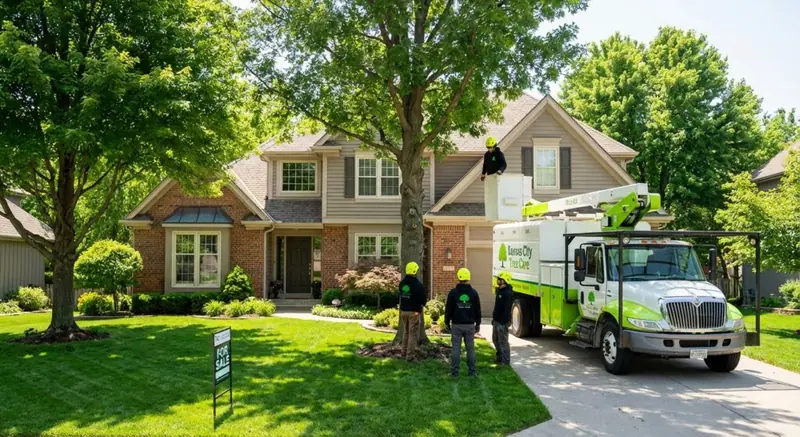
Tree Trimming Services: Why It’s Important for Your Property in Kansas City
In this guide (11 sections)
- Your Trees Are Either Adding Value or Taking It Away
- How Trees Affect Property Value in Kansas City
- Tree Trimming Prevents Expensive Property Damage
- The Insurance Factor Most Homeowners Miss
- What Happens When You Don’t Trim: Real KC Examples
- How Regular Trimming Saves Money Long-Term
- What a Proper Tree Trimming Service Includes
- Timing Your Trimming for Maximum Value
- Frequently Asked Questions
- Stop Deferring – Start Maintaining
- Related Reading
Your Trees Are Either Adding Value or Taking It Away
Here’s something most KC homeowners don’t think about: your trees are appraised just like your house. A mature, healthy oak tree in your front yard can add $10,000-$15,000 to your property value. A dead ash tree leaning toward your roof can take even more off – not just in appraisal value, but in the insurance claims and emergency removal costs that come when it finally falls.
We’ve been doing tree work across the Kansas City metro for over 30 years, and we’ve watched properties on the same street sell for $20,000-$40,000 apart. Same square footage, same schools, same builder. The difference? One had a well-maintained landscape with healthy, properly trimmed trees. The other had overgrown canopies, dead limbs hanging over the roof, and a stump from a tree that was removed five years ago and never ground down.
Tree trimming isn’t cosmetic. It’s maintenance that protects your property value, prevents expensive damage, and keeps your trees alive longer. Here’s exactly how – with real numbers from the KC market.
Our tree trimming and pruning services help homeowners across the metro protect their investment – because well-maintained trees consistently add to property value, while neglected ones take away.
How Trees Affect Property Value in Kansas City
Multiple studies by the USDA Forest Service and various university extension programs have quantified what arborists have known for decades: trees significantly impact property value. Here’s what the data shows:
Mature trees increase home values by 7-19%. A home appraised at $350,000 in Overland Park with mature, healthy trees is worth $24,500-$66,500 more than an identical home on a treeless lot. That’s not an opinion – that’s appraisal data.
Street trees increase neighborhood values. Properties on tree-lined streets in Johnson County sell faster and for more money than properties on streets without canopy coverage. The shade, the aesthetics, the reduced noise – buyers pay a measurable premium for established tree canopy.
Dead and hazardous trees reduce value. Home inspectors flag dead, leaning, and poorly maintained trees in their reports. Buyers either walk away, demand removal before closing, or negotiate the price down to cover the cost. A single dead tree that costs $1,500 to remove can reduce offer prices by $3,000-$5,000 because buyers factor in the hassle and risk.
Curb appeal is a buyer’s first impression. Real estate agents across the KC metro will tell you – landscaping is the first thing buyers notice. Overgrown trees with dead branches, suckers growing from the base, and limbs scraping the roof signal deferred maintenance. Buyers wonder: if they didn’t take care of the trees, what else did they neglect?
Tree Trimming Prevents Expensive Property Damage
This is where the real math gets clear. Regular tree trimming costs a fraction of the damage that untrimmed trees cause. Here’s what we see every year across the KC metro:
Roof damage from overhanging branches. Branches that rest on or scrape against your roof damage shingles, strip granules, and create entry points for water. Over time, this leads to leaks, rot, and repairs that cost $2,000-$8,000. Trimming those branches back costs $300-$600. The math is obvious.
Gutter damage and drainage issues. Trees that overhang the roofline drop leaves, seeds, and debris into gutters constantly. Clogged gutters cause water to back up under shingles, overflow against the foundation, and create ice dams in winter. The trimming that prevents this is cheaper than a single gutter repair or foundation waterproofing project.
Storm damage from unthinned canopies. This is the big one in KC. Summer thunderstorms regularly produce 60-80 mph straight-line winds. A properly thinned canopy lets wind pass through. An overgrown, dense canopy catches wind like a sail, and branches – or entire trees – come down. We’ve removed more silver maple limbs from roofs in Overland Park and Shawnee than we can count. Every single one could have been prevented with regular thinning.
Foundation damage from unmanaged roots. Large trees too close to structures can send roots under foundations, driveways, and sidewalks. KC’s clay soil makes this worse – the clay expands and contracts with moisture changes, and tree roots amplify the effect. Proper trimming and root management keeps this in check. Ignoring it leads to cracked foundations and heaved concrete that costs thousands to repair.
Power line interference. Trees growing into power lines cause outages, create fire hazards, and attract utility company attention. Evergy will trim their easement – aggressively and without regard for your tree’s appearance. Proactive trimming on your schedule gives you better results than waiting for the utility company to hack their way through your tree’s canopy.
The Insurance Factor Most Homeowners Miss
Your homeowner’s insurance covers tree damage from storms and wind – usually. But there’s a catch that most KC homeowners don’t know about until they file a claim:
If the damage was preventable, your claim can be denied or reduced. Insurance companies are increasingly scrutinizing tree damage claims. If a dead tree falls on your house, the adjuster may argue that you knew (or should have known) the tree was dead and failed to remove it. That’s negligence, and it can affect your coverage.
Trees that fall in your yard and don’t hit anything are typically not covered. If a storm brings down a tree and it lands on your lawn, you’re paying for removal out of pocket. Standard policies only cover removal when the tree damages a covered structure. This is another reason proactive removal of hazardous trees – at scheduled rates – beats waiting for the emergency.
Some insurers offer discounts for tree maintenance. While not universal, some insurance companies factor your property’s tree management into their risk assessment. A well-maintained landscape with no dead trees or hanging branches represents lower risk – and lower premiums.
Getting a hazardous tree evaluation creates a paper trail. If an arborist evaluates your trees and documents that they’re healthy, you have evidence of due diligence if something goes wrong. If the evaluation identifies a problem, you have clear guidance on what to address – and a timeline for addressing it.
What Happens When You Don’t Trim: Real KC Examples
We don’t need hypotheticals. Here’s what we actually see on jobs across the KC metro:
Neglected trees eventually become overgrown and cause property damage that far exceeds the cost of regular maintenance. And if you’re not sure how often your trees need attention, check our guide on how often to trim trees in Kansas City.
The silver maple that hasn’t been touched in 15 years. Long, heavy branches extending 20+ feet from the trunk, interior completely grown in, no light penetration. First big summer thunderstorm drops three major limbs – one on the roof, one on the fence, one on the neighbor’s car. Total cost: $4,500 in emergency removal, $6,000 in roof repair, $2,200 for the fence, and a homeowner’s insurance claim that raised premiums for three years. The cost to trim that tree every 3 years? About $500-$700 per visit.
The dead ash that stayed up two years too long. Homeowner knew the tree was dead from EAB but kept putting off removal because it wasn’t actively causing problems. February ice storm added weight the brittle wood couldn’t handle. It snapped at the trunk and landed across the driveway and into the garage door. Emergency removal in February ice: $3,200. Scheduled removal when it was first identified as dead: $1,400.
The pin oak with progressive chlorosis. Crown dieback had been worsening for five years. Upper branches died and became deadwood. Homeowner kept trimming out the dead wood every couple of years instead of addressing the root cause. Eventually the tree was 60% dead and needed removal – at which point it was adjacent to power lines and required a crane. Total cost over the years: $2,000+ in repeated deadwood removal plus $4,800 for final crane removal. If addressed early with soil treatment or replaced when chlorosis first became severe, the total cost would have been under $2,000.
How Regular Trimming Saves Money Long-Term
Here’s the simple math on tree maintenance in the KC market:
Cost of regular trimming: Most medium to large trees cost $400-$800 per trim. On a 3-5 year cycle, that’s $80-$270 per year per tree. For a Leawood or Overland Park property with five large trees, you’re looking at $400-$1,350 per year in tree maintenance.
Cost of skipping trimming: One emergency removal after a storm runs $1,500-$5,000+. Roof repair from a fallen limb: $2,000-$8,000. Foundation repair from unchecked root growth: $5,000-$15,000. Property value reduction from dead or hazardous trees: $10,000-$40,000. Insurance premium increases after a claim: $500-$1,500 per year for 3-5 years.
Regular trimming is the cheapest insurance your trees can have. It’s also the only thing that actually prevents these problems. Insurance pays after the damage. Trimming prevents the damage from happening.
What a Proper Tree Trimming Service Includes
When you hire a professional tree service for trimming, here’s what should be included:
On-site assessment. The crew leader or arborist walks the property, identifies every tree to be trimmed, and assesses specific issues – dead wood, structural problems, clearance needs, disease symptoms.
Species-appropriate pruning. Different trees need different approaches. Oaks get dormant-season pruning only. Silver maples get aggressive thinning. Young trees get structural training cuts. Mature trees get conservative maintenance. A crew that treats every tree the same isn’t doing the job right.
Proper cut technique. Every cut at the branch collar – the slightly swollen area where the branch meets the trunk. No stubs, no flush cuts, no torn bark. Proper cuts heal cleanly. Bad cuts create decay points that shorten the tree’s life.
Complete cleanup. All debris chipped, branches removed, lawn raked. Some companies cut the branches and leave the cleanup to you – that’s not professional tree work.
Post-trim walk-through. Before the crew leaves, walk the property with them. Check that everything you discussed was done, ask about anything that looks concerning, and get their recommendation on timing for the next trim.
Timing Your Trimming for Maximum Value
When you trim matters almost as much as whether you trim. Here’s the seasonal breakdown for KC:
Late winter (February-March): The best time for most species. Trees are dormant, structural issues are visible without leaves, disease risk is lowest, and spring growth quickly fills in pruning gaps. This is when we do the majority of our trimming work across the metro. Read our full seasonal timing guide.
Before storm season (April-May): If you didn’t get winter trimming done, a light thinning before severe weather season still provides meaningful storm protection. Focus on dead wood removal and reducing heavy end-weight on long branches. Learn how to prepare your trees for storms.
After storms (anytime): Storm damage cleanup happens whenever it needs to happen. Don’t leave broken branches hanging – they can fall at any time and cause secondary damage.
Before selling your home: If you’re listing your property, get your trees trimmed 4-6 weeks before photos are taken. The difference in curb appeal is immediate and measurable. Real estate agents consistently rank tree and landscape maintenance as one of the highest-ROI pre-sale investments.
Frequently Asked Questions
How much does tree trimming cost in the Kansas City area?
Small trees (under 25 feet) run $150-$400, medium trees (25-50 feet) cost $300-$800, and large trees (50-75+ feet) range from $600-$1,500+. Properties with multiple trees get volume discounts. Always get an in-person estimate – phone quotes without seeing the trees aren’t reliable.
We help homeowners protect their property value across Leawood, Overland Park, and the KC metro:
Do well-maintained trees really increase property value?
Yes – by 7-19% according to USDA Forest Service research. For a $350,000 home in Johnson County, that’s $24,500-$66,500 in added value. The key is “well-maintained.” Dead, hazardous, and overgrown trees reduce value instead of adding to it.
How often should I have my trees trimmed?
Most mature trees need trimming every 3-5 years. Fast-growing, weak-wooded species like silver maples and cottonwoods need attention every 2-3 years. Young trees benefit from structural pruning every 2-3 years during their first decade. Large established trees (30+ years) can go 5-7 years between trims if they’re healthy.
Will tree trimming help prevent storm damage?
It’s the single most effective preventive measure. A properly thinned canopy lets wind pass through instead of catching it. Regular removal of dead and weak branches eliminates the pieces most likely to break off. We’ve seen the difference consistently across thousands of jobs – maintained trees survive storms that destroy neglected ones on the same street.
Should I trim trees before selling my home?
Absolutely. It’s one of the highest-ROI investments before listing. Get trimming done 4-6 weeks before listing photos so the trees look clean and healthy. Also remove any dead trees and grind stumps. Buyers notice deferred tree maintenance immediately, and it colors their perception of the entire property.
Stop Deferring – Start Maintaining
Every year you skip tree maintenance, the problems compound. Dead branches multiply. Structural weaknesses worsen. Storm risk increases. Property value erodes. And the eventual cost – whether it’s emergency removal, property damage, or a reduced sale price – is always higher than the trimming would have been.
We provide professional tree trimming across the entire Kansas City metro – Overland Park, Olathe, Shawnee, Leawood, Lee’s Summit, Independence, and all surrounding communities. Licensed, insured, ISA certified, and 30+ years of experience in this market.
Call Kansas City Tree Care at 913-894-4767 for a free trimming estimate.
Related Reading

About Kansas City Tree Care
Kansas City Tree Care was founded in 1996 by Zach Johnson, who has worked in the tree trade since 1990. Our crews cover 16 cities across the Kansas City metro from our office at 1505 Merriam Lane in Kansas City, KS.