Why Leawood Trees Need a Different Level of Care
Leawood is one of the most established, heavily treed neighborhoods in the entire Kansas City metro. Drive down any street between 95th and 135th — State Line to Nall — and you’re under a full canopy. Mature oaks, silver maples, honeylocusts, and ash trees that were planted when these neighborhoods were developed in the 1960s, 70s, and 80s.
That’s the appeal. It’s also the challenge. Trees that are 40-60+ years old need professional care — not the kind of trimming that a guy with a truck and a chainsaw provides, but actual arborist-level assessment and maintenance. And Leawood specifically has tree preservation codes and HOA requirements that most other JoCo cities don’t.
We’ve been providing tree care services in Leawood for over 15 years. Here’s what Leawood homeowners need to know about keeping their trees healthy, safe, and compliant with local rules.
Check out our dedicated Leawood tree care page for service details, or browse all of our tree care services available across the metro.
The Trees That Define Leawood — and Their Problems
Every tree species has a lifespan and a set of problems that come with age. In Leawood, the most common trees we work on tell you everything about the neighborhood’s history:
Pin oaks. The single most common street and yard tree in Leawood. They were planted by the thousands when these subdivisions were built. The problem? KC’s alkaline clay soil causes iron chlorosis — that yellowing of leaves with green veins you see every summer. It starts at the top and works downward over years. We see pin oaks in Leawood that are slowly dying from the crown down, and most homeowners don’t realize it until the dieback is severe. Some can be treated with soil amendments or trunk injections. Others are past saving and need removal before they become hazardous.
Silver maples. Fast-growing, great shade, terrible wood strength. Silver maples in Leawood are among the most common emergency calls we get after storms. Their branches grow long and heavy, and their wood is naturally weak — especially at narrow branch unions. A well-maintained silver maple that gets thinned every 2-3 years handles storms fine. One that hasn’t been touched in a decade is a windshield or roof waiting to happen.
Ash trees (green and white). If you have ash trees on your property, you already know about the emerald ash borer. EAB has killed tens of thousands of ash trees across the KC metro since it was first detected here around 2012. Dead ash becomes extremely brittle within 1-2 years — the wood dries out and becomes unpredictable during removal. If your ash tree is still alive but showing crown dieback, you have a narrow window for treatment. Learn about the emerald ash borer treatment options available in Overland Park before that window closes. If it’s dead, it needs to come down soon. Every season you wait makes the removal more dangerous and expensive.
Red and bur oaks. These are the prize trees in Leawood — massive, long-lived, and structurally sound when healthy. The main concern is oak wilt, a lethal fungal disease that’s present in Missouri and spreading into Kansas. The rule is simple: only prune oaks during dormancy (November through March). No summer trimming, period. We’ve seen homeowners in Leawood hire cheap crews that trim oaks in July — that’s how you lose a tree that took 80 years to grow.
Honeylocusts and hackberries. These are the low-maintenance workhorses of Leawood landscapes. They tolerate KC’s clay soil, handle drought, and don’t have major disease issues. They still need periodic trimming for structure and clearance, but they’re generally the least problematic trees on a property. For homeowners looking to boost tree health proactively, our tree fertilization guide for Overland Park covers the best practices for the KC metro’s soil conditions.
Leawood’s Tree Preservation Code — What You Need to Know
Leawood has one of the more comprehensive tree preservation codes in Johnson County. This catches homeowners off guard, especially if they’ve lived in Overland Park or Olathe where private tree removal is essentially unregulated.
Here’s what Leawood requires:
Routine tree removal on your own property generally doesn’t require a permit. If you have a dead, diseased, or hazardous tree in your yard and you’re not doing any construction, you can hire a tree service and have it removed. No permit needed.
Construction triggers tree preservation requirements. This is the key difference in Leawood. If you’re adding a room, building a pool, expanding a driveway, or doing any work that requires a building permit, tree preservation rules kick in. You’ll need to submit a site plan showing existing trees, identify which trees will be affected, and potentially pay mitigation fees or plant replacement trees for any significant trees removed during construction.
HOA rules add another layer. Many Leawood subdivisions — Hallbrook, Leawood South, Tuscany Reserve, Mission Hills Country Club area — have HOAs with strict landscape covenants. Some require architectural committee approval before removing any tree, regardless of city regulations. The approval process typically takes 2-4 weeks. If you’re in an HOA, check your CC&Rs before scheduling any removal work.
Right-of-way trees belong to the city. That tree between the sidewalk and the curb? You don’t own it. Contact Leawood’s Community Development department before doing anything to a right-of-way tree. Removing one without permission can result in fines and replacement requirements.
We handle tree removal permits and regulations across every city in the KC metro. When we give you a quote in Leawood, we’ll let you know upfront if any approvals are needed for your specific situation.
Tree Trimming in Leawood: What Good Maintenance Looks Like
The majority of tree work we do in Leawood isn’t emergency removal — it’s scheduled maintenance. Proactive trimming and pruning is what keeps mature trees healthy and prevents the emergency calls.
Here’s what proper trimming involves:
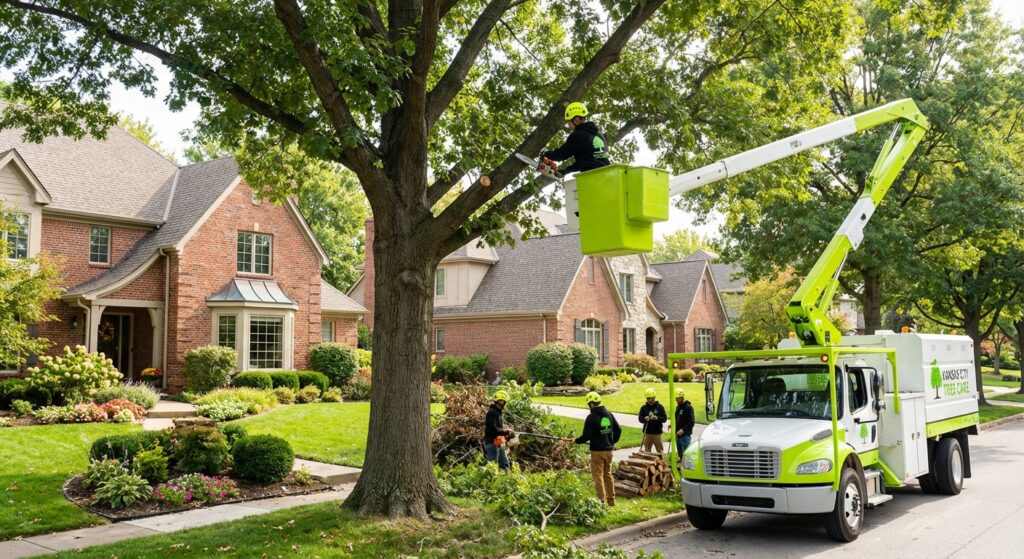
Crown thinning. Selectively removing interior branches to improve airflow and light penetration. This reduces wind resistance during storms — the single most effective thing you can do to prevent storm damage. Done properly, you shouldn’t be able to tell the tree was trimmed from 30 feet away. The natural shape is preserved.
Crown raising. Removing lower branches for clearance. Most KC metro cities require 8 feet of clearance over sidewalks and 14 feet over streets. In Leawood, where many trees have grown unchecked for decades, low-hanging branches often block sight lines at intersections and scrape vehicle roofs in driveways.
Deadwood removal. Taking out dead, dying, and diseased branches. This is the single most cost-effective maintenance you can do. Dead branches don’t just look bad — they fall, and they fall unpredictably. A dead silver maple limb over your driveway on 119th Street isn’t cosmetic. It’s a liability.
Structural pruning. Correcting co-dominant leaders, reducing heavy lateral branches, and addressing included bark (bark trapped between two branches, creating a weak joint). This is especially critical for younger trees that will grow into problems if left uncorrected.
What we never do: Topping. Any company that recommends cutting main branches back to stubs should be crossed off your list immediately. Topping destroys tree structure, causes rapid weak regrowth, and creates decay entry points. It’s the most destructive thing you can do to a tree, and we see the aftermath of it regularly in older Leawood neighborhoods.
How often should Leawood homeowners trim their trees?
It depends on species and age. General guidelines for Leawood:
- Young trees (under 10 years): Every 2-3 years for structural training
- Mature trees (10-30 years): Every 3-5 years for maintenance
- Large established trees (30+ years): Every 5-7 years unless there are specific problems
- Silver maples and cottonwoods: Every 2-3 years — their fast growth and weak wood demands more frequent attention
Multiple trees on the same property always get a better per-tree rate. We see a lot of Leawood homeowners with 5-10 mature trees on their lots — doing them all at once saves significantly compared to one at a time over several years.
Storm Damage and Emergency Tree Service in Leawood
Leawood sits right in the path of every major weather pattern that hits the KC metro. Summer straight-line winds, winter ice storms, and the occasional tornado-producing supercell. With the density of mature trees in Leawood, storm damage is inevitable — the question is whether you’re dealing with it proactively or reactively.
The most common emergency calls we get from Leawood:
- Silver maple branches on roofs after summer thunderstorms
- Entire trees uprooted in saturated clay soil after extended rain + wind
- Ice-loaded branches crashing on driveways and fences during winter storms
- Dead ash trees falling with minimal wind — the wood is so brittle it just gives way
We provide 24/7 emergency tree service across the KC metro. During normal conditions, we can be on-site in Leawood within 1-3 hours. During major storm events affecting the entire metro, response times extend due to demand — trees on occupied structures and power line situations are always prioritized.
What emergency tree removal costs in Leawood:
- Tree on the ground, no structure contact: $1,000-$3,000
- Tree on a structure (house, garage, fence): $2,000-$5,000+
- Crane-assisted removal in tight spaces: $4,000-$8,000+
Insurance typically covers removal if the tree damages a covered structure. If a tree falls in your yard and doesn’t hit anything, that’s usually out-of-pocket. This is why proactive trimming and hazardous tree evaluation matters — it’s always cheaper than the emergency call.
Tree Removal in Leawood: When It’s Time
Nobody wants to lose a mature tree — especially in Leawood where the tree canopy is such a defining feature of the neighborhood. But there are situations where removal is the responsible choice:
- Dead trees. Especially dead ash. They’re not going to recover, and every storm season they stand is another chance for them to fall on something — or someone.
- Severe structural defects. Major trunk cracks, extensive cavity decay, root system failure. If the tree can’t support its own weight in a storm, it needs to go.
- Proximity risk. A healthy tree 8 feet from your foundation with roots heaving the driveway is still a problem. Sometimes the tree was planted too close to the house 50 years ago and has simply outgrown the space.
- Storm damage beyond recovery. If more than 50% of the crown was lost or the main trunk split, the tree typically can’t be saved.
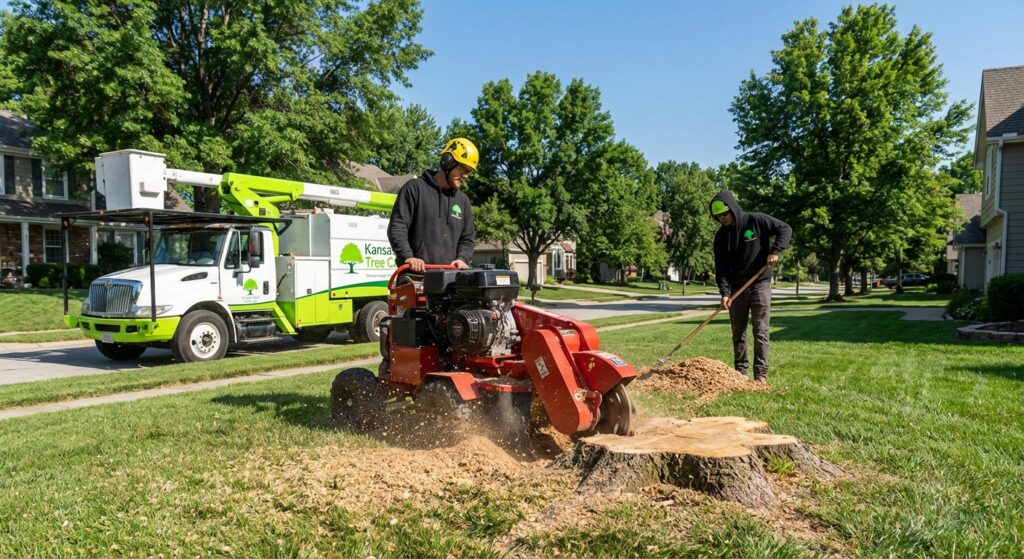
Standard tree removal in Leawood runs $800-$2,500 for most jobs. Large trees near structures that require crane work or extensive rigging can cost $3,000-$5,000+. Stump grinding is typically an additional $150-$400.
How to Choose a Tree Service in Leawood
Leawood homeowners tend to care about quality — this isn’t a “cheapest bid wins” market. But that doesn’t mean you should overpay either. Here’s what to look for:
Insurance. Non-negotiable. General liability and workers’ compensation. If a worker is hurt on your property and they don’t have workers’ comp, you’re liable. Ask for a certificate of insurance — legitimate companies provide it without hesitation.
ISA certification. An ISA Certified Arborist has passed rigorous testing on tree biology, care, and safety. Not every crew member needs to be certified, but the company should have at least one certified arborist who oversees the work.
Local reputation. A company that’s been working in the KC metro for 10+ years has a track record you can verify. Check Google reviews, ask for references in your neighborhood, and see if they’re familiar with Leawood’s specific tree preservation requirements.
Detailed estimates. A professional tree service comes to your property, walks the trees, and provides a written estimate specifying exactly what work will be done. If someone quotes you over the phone without seeing the trees, get a second opinion.
No topping. Ask directly: “Do you top trees?” If the answer is anything other than an immediate “no,” walk away. Topping is the clearest indicator of an unqualified tree crew.
Clear pricing. Know what’s included — will they chip all branches? Haul trunk sections? Rake the lawn? Leave wood chips? Grind the stump? Get all of this in writing before work starts.
Cabling and Bracing: Saving Trees Worth Keeping
Some trees in Leawood are worth significant investment to preserve. Large oaks, mature specimen trees, and trees that define a property’s character can sometimes be saved with cabling and bracing instead of removal.
Cabling involves installing flexible steel cables between major branches to reduce the strain on weak unions. Bracing uses threaded rods through split or cracked sections to hold them together. This isn’t a permanent fix for a dying tree — it’s structural support for a healthy tree with a mechanical weakness.
The best candidates for cabling in Leawood are large oaks with co-dominant stems (two trunks of equal size growing from the same point). These V-shaped unions often have included bark — a structural weakness that can split apart under wind or ice load. A cable system installed in the upper canopy can prevent that split and give the tree decades of additional safe life.
Cabling and bracing typically costs $400-$1,200 depending on the tree size and number of cables needed. Compare that to $2,000-$5,000 for removing a large tree, and the math is clear when the tree is worth saving.
Frequently Asked Questions
How much does tree trimming cost in Leawood?
Small trees (under 25 feet) run $150-$400, medium trees (25-50 feet) cost $300-$800, and large trees (50-75+ feet) range from $600-$1,500+. Multiple trees on the same property get volume discounts. Leawood properties with 5-10 mature trees can typically get all of them done for less per tree than spacing them out individually.
We serve Leawood and surrounding areas including Overland Park and Prairie Village:
Do I need a permit to remove a tree in Leawood?
For routine removal of a dead, diseased, or hazardous tree on your own property — no permit needed. If the removal is connected to a construction project that requires a building permit, tree preservation requirements may apply. If you’re in an HOA, check your covenants first — many Leawood HOAs require architectural committee approval before removing any tree.
What’s the best time of year to trim trees in Leawood?
Late winter — February through early March — is ideal for most species. The trees are dormant, disease risk is lowest, and spring growth quickly fills in pruning gaps. Oaks must only be trimmed during dormancy (November-March) to prevent oak wilt. Dead branches can be safely removed any time of year. Read our full guide on the best time for tree trimming in KC.
How do I know if my tree is hazardous?
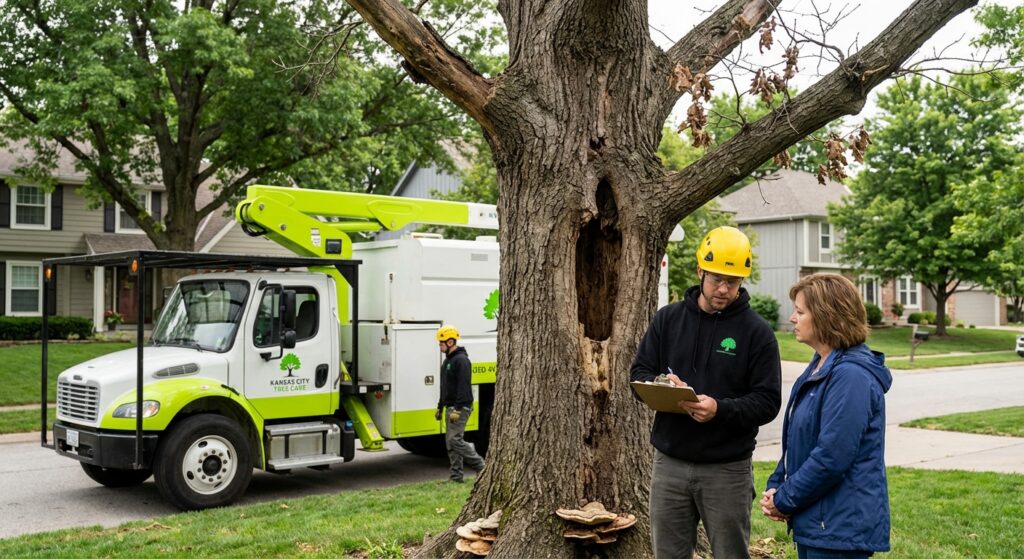
Warning signs include dead branches in the upper canopy (more than 25% of the crown), trunk cracks or cavities, mushrooms or fungal brackets growing at the base, a lean that’s getting worse over time, and root zone soil that’s heaving or cracking. Multiple warning signs together mean you should get a professional hazardous tree evaluation immediately. Learn more about signs your tree may need removal.
Can you save a tree that’s been damaged in a storm?
It depends on the extent of the damage. If less than 25% of the crown was lost and the trunk is intact, the tree can usually be saved with proper cleanup pruning. If more than 50% of the crown is gone or the main trunk split, removal is typically the best option. Trees that lost 30-50% of their canopy are judgment calls — sometimes cabling can stabilize them while they recover.
Your Trees Are an Investment — Protect Them
Leawood’s mature tree canopy is one of the things that makes it one of the most desirable neighborhoods in the KC metro. Protecting that canopy takes professional care — regular trimming, prompt removal of hazards, and the knowledge to tell the difference between a tree that needs help and one that needs to come down.
We provide full-service tree care across Leawood and the entire Kansas City metro — Overland Park, Olathe, Shawnee, Prairie Village, Mission, and all surrounding communities. Licensed, insured, ISA certified, and 15+ years in the KC market.
Call Kansas City Tree Care at 913-894-4767 for a free estimate on any tree service in Leawood.