Your KC Oak Might Be Sick — Here’s How to Tell
You planted that red oak twenty years ago, or maybe it was already there when you moved into your Brookside bungalow. Either way, it’s been the anchor of your yard — shade in July, color in October, the tree the neighborhood recognizes your house by. So when the leaves start looking wrong, it gets your attention fast.
Oaks are some of the toughest trees in the Kansas City metro. They handle our heat, our cold, and our unpredictable weather better than most species. But they’re not bulletproof. KC’s alkaline clay soil, humid summers, and wet spring seasons create conditions where several serious oak diseases thrive. And the worst ones can kill a mature oak in a single season if you don’t catch them early.
We’ve been diagnosing and treating oak diseases across the KC metro for over 35 years. Here’s what we see most often, what each disease actually looks like, and what your real options are for saving the tree.
Common Oak Diseases in the Kansas City Metro
Not all oak diseases are created equal. Some are cosmetic annoyances that your tree will shrug off by midsummer. Others are death sentences. Knowing the difference is the whole game.
The Kansas City area is home to several oak species — red oaks, white oaks, pin oaks, bur oaks, and the occasional Shumard or chinkapin oak. Each species has different vulnerabilities. Pin oaks struggle with our alkaline soil (that’s a separate issue — iron chlorosis — covered in our tree disease overview). Red oaks are extremely vulnerable to oak wilt. White oaks and bur oaks are generally the hardiest, but even they can fall to bacterial infections and fungal pathogens.
Here are the oak-specific diseases we treat most frequently in Johnson County, Jackson County, and across the metro.
Oak Wilt: The Most Serious Threat to KC Oaks
If there’s one oak disease every Kansas City homeowner should know about, it’s oak wilt. This fungal disease, caused by Ceratocystis fagacearum, plugs the tree’s vascular system — the internal plumbing that moves water from roots to leaves. Once the system is blocked, the tree wilts and dies. In red oaks, that process can happen in as little as 4-6 weeks.
Oak wilt has been confirmed in Missouri and is present in the greater KC region. It spreads two ways:
- Sap-feeding beetles — Nitidulid beetles pick up fungal spores from infected trees and carry them to fresh wounds on healthy oaks. They’re most active from April through October, which is exactly why you should never prune oaks during the growing season in Kansas City.
- Root grafts — Oaks of the same species growing within 50-75 feet of each other often share root connections underground. The fungus travels through these root grafts from an infected tree to its neighbors. One sick red oak in a Waldo yard can take out every red oak on the block.
Symptoms in red oaks:
- Rapid wilting and browning from the outer crown inward
- Leaves falling while still partially green — a hallmark sign
- Entire branches dying within days
- Complete tree death within 4-12 weeks
Symptoms in white oaks:
- Slower decline over 1-5 years
- Scattered branch dieback throughout the crown
- Leaf browning on individual limbs, not the whole tree at once
The speed difference matters. With red oaks, by the time you notice something’s wrong, the tree is usually beyond saving. White oaks give you more time to act.
Treatment costs: Preventive fungicide injection (propiconazole) runs $300-$600 per tree depending on size. This protects healthy oaks in areas where oak wilt has been confirmed nearby. It won’t cure a red oak that’s already symptomatic — that tree needs to come down, and root graft barriers (trenching between infected and healthy trees) should be installed immediately. Trenching runs $500-$1,500 depending on distance and terrain. A certified arborist can assess your specific situation and tell you which oaks are salvageable.
Bacterial Leaf Scorch on KC Oaks
Bacterial leaf scorch (BLS) is caused by Xylella fastidiosa, a bacterium that clogs the tree’s water-conducting vessels. It’s becoming more common across the KC metro, and oaks — particularly pin oaks and red oaks — are among its favorite targets.
You’ll first notice BLS in mid to late summer. Leaf margins turn brown and crispy, working inward from the edges. It looks a lot like drought stress or heat scorch, which is why most homeowners ignore it the first year. The difference is a narrow band of yellow or reddish tissue between the green center and the brown margin — that’s the BLS calling card.
The bad news: BLS has no cure. The bacterium is spread by xylem-feeding insects like leafhoppers and spittlebugs, and once it’s established in the tree’s vascular system, it’s permanent. Symptoms return every summer and get progressively worse.
The manageable news: antibiotic trunk injections (oxytetracycline) can suppress bacterial populations and slow the decline significantly. Combined with proper watering, mulching, and stress reduction, a BLS-infected oak can remain functional for 10-15 years beyond initial diagnosis. Treatment runs $200-$450 per injection cycle, typically done annually or every other year.
We see BLS most often in the established neighborhoods around the Plaza, Hyde Park, and Brookside — areas with mature oaks that are 50-80+ years old. At that age, the trees are already under stress from soil compaction, root damage from utilities, and decades of Kansas City weather. BLS pushes them past their tipping point faster.
Anthracnose: KC’s Spring Fungal Problem
Every spring in Kansas City, our phones ring with homeowners convinced their oak is dying. The leaves are curling, browning, dropping — in May. It looks terrible. Nine times out of ten, it’s anthracnose.
Anthracnose is a group of fungal diseases that thrive during cool, wet spring weather. And KC delivers exactly those conditions — our April and May storms create the perfect incubation chamber. White oaks and bur oaks are the most susceptible species locally.
What it looks like:
- Brown or black irregular blotches on leaves, often following leaf veins
- Curling, distorted new growth
- Early leaf drop in May and June
- Dead spots on young twigs
The good news: Anthracnose on oaks is almost never fatal. Once summer heat and drier conditions arrive (usually by mid-June in KC), the fungus becomes inactive and the tree pushes out a second flush of healthy leaves. By July, most trees look completely normal again.
When to worry: If your oak gets severe anthracnose multiple years in a row, the repeated stress and defoliation can weaken it over time. Trees that are already struggling with other issues — compacted soil, iron chlorosis, root damage — may not bounce back as easily. In those cases, preventive fungicide applications in early spring ($150-$350) can reduce severity. But for a healthy oak that catches anthracnose during one particularly wet spring, the best treatment is patience.
We get the most anthracnose calls from homeowners in Brookside, Waldo, and the older neighborhoods around Hyde Park — areas with large, mature white oaks and bur oaks growing in tight canopy cover that stays damp longer in spring. The combination of shade, restricted airflow, and our April rains is exactly what anthracnose fungi thrive on. Thinning the canopy through proper seasonal pruning improves air circulation and can meaningfully reduce anthracnose severity.
Signs You Need a Professional Diagnosis
Some oak problems are obvious. A tree dropping all its leaves in June is hard to miss. But many diseases start subtly, and the early signs are easy to confuse with normal seasonal changes or environmental stress.
Call a tree care professional for an evaluation if you see any of these:
- Leaves browning from edges inward during summer (not fall) — could be BLS, oak wilt, or drought stress. The treatment for each is completely different.
- Rapid wilting of an entire section of canopy — oak wilt until proven otherwise. Don’t wait.
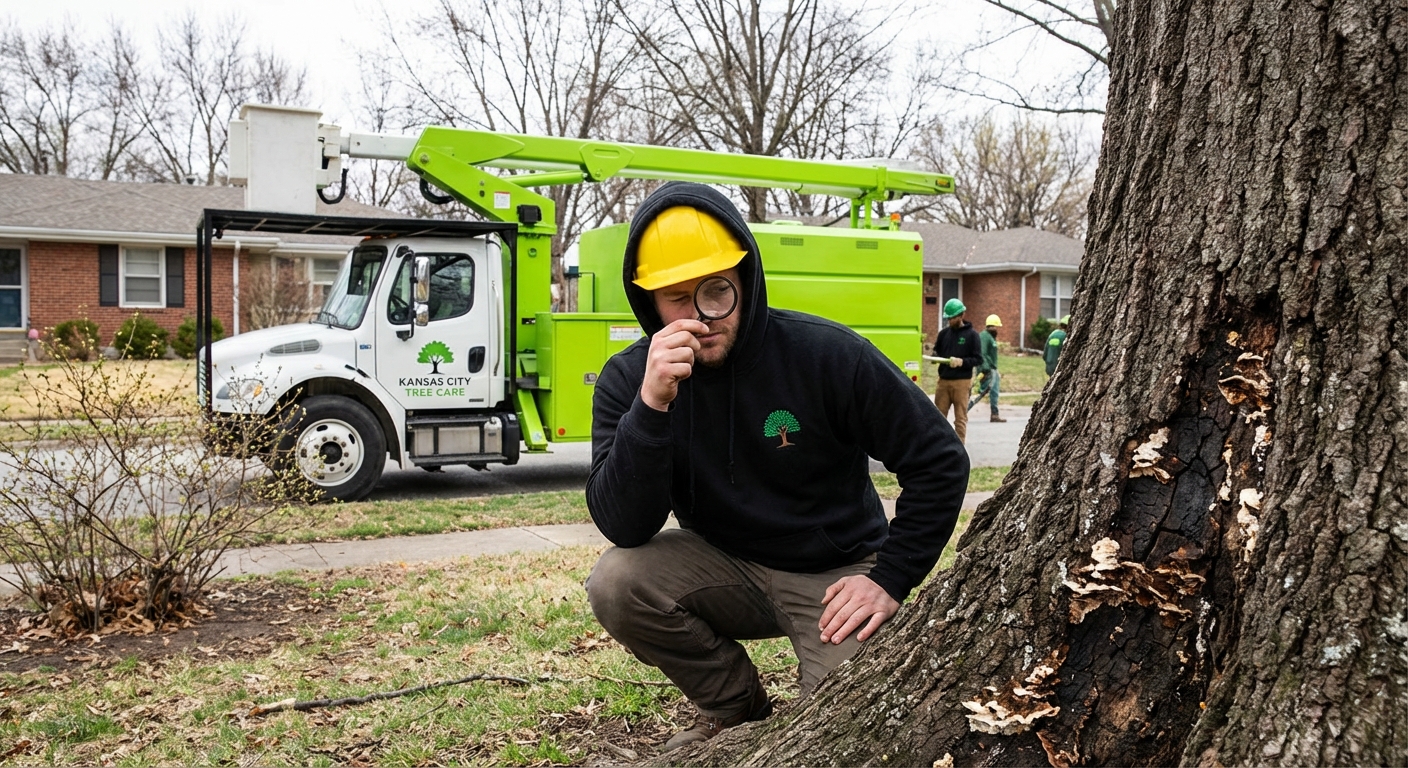
- Fungal fruiting bodies (mushrooms, brackets, shelf fungi) on the trunk or at the base — this means internal decay, and the structural implications are serious.
- Oozing or weeping bark — bacterial wetwood or slime flux. Usually not fatal but can indicate deeper problems.
- Progressive crown thinning over 2-3 years — something systemic is going on. Could be root rot, BLS, chronic stress, or boring insects.
- Bark peeling or cracking in unusual patterns — sunscald, cankers, or hypoxylon (a secondary fungus that colonizes stressed oaks).
A proper diagnosis requires looking at the whole picture — species, location, soil conditions, recent weather, symptoms pattern, and sometimes lab testing. Our crew evaluates oaks across Overland Park, Olathe, Shawnee, and the entire KC metro. Getting the diagnosis right matters because the wrong treatment wastes money and time your tree may not have.
Treatment Options for Diseased Oaks
Once you know what you’re dealing with, treatment falls into a few categories:
Fungicide injection: Used for oak wilt prevention and some other fungal diseases. A micro-infusion system delivers fungicide directly into the tree’s vascular system. Most effective when applied preventively to healthy trees near confirmed infections. Cost: $300-$600 depending on tree diameter. Lasts 2-3 years per treatment.
Antibiotic injection: Used for bacterial leaf scorch. Oxytetracycline is injected into the trunk to suppress bacterial populations. Doesn’t cure the disease but significantly slows progression. Cost: $200-$450 per treatment cycle.
Soil management: For oaks struggling in KC’s alkaline clay, amending the root zone with sulfur, organic matter, and proper mulching can improve nutrient availability and reduce stress. This isn’t a disease treatment per se, but a healthier tree fights off disease better. Cost: $150-$400 depending on area treated.
Pruning: Removing infected branches can slow the spread of certain diseases and improve air circulation through the canopy (which reduces fungal pressure). But pruning oaks must follow strict timing rules — dormant season only (November through March) unless it’s emergency deadwood removal. Proper pruning technique matters enormously with oaks.
Removal: When the disease is too advanced, the tree is structurally compromised, or it poses a threat to neighboring healthy oaks (oak wilt spreading via root grafts), removal is the right call. A 60-foot red oak with confirmed oak wilt isn’t going to recover. Removing it quickly and properly — including stump treatment to prevent root graft transmission — protects the rest of your oaks.
Preventing Oak Disease Year-Round in Kansas City
Prevention is cheaper than treatment, and treatment is cheaper than removal. Here’s what every KC oak owner should be doing:
Dormant season pruning only (November-March). This is the single most important rule for oak care in Kansas City. Pruning during the growing season exposes fresh wounds that attract sap-feeding beetles — the primary vector for oak wilt. We won’t prune a healthy oak between April and October, and neither should anyone else. If storm damage forces an emergency cut during summer, seal the wound with pruning paint immediately.
Proper mulching. A 3-4 inch ring of mulch extending to the drip line (or as far as practical) insulates roots, retains moisture, and slowly improves soil conditions. Keep mulch 4-6 inches away from the trunk — piling it against the bark creates moisture conditions that promote fungal infections.
Water during drought. Kansas City summers regularly deliver 2-3 week dry stretches with temperatures above 95F. Mature oaks are drought-tolerant but not drought-proof. Deep watering once a week during extended dry periods reduces stress and keeps the tree’s defenses up.
Don’t move firewood. Oak wilt fungal mats form under the bark of infected trees. Moving firewood from infected areas to your property is one of the fastest ways to introduce oak wilt to a new location. Buy local, burn local.
Annual inspection. Have your oaks looked at once a year by someone who knows what they’re looking for. Catching a problem in year one gives you options. Catching it in year five gives you a removal estimate.
Frequently Asked Questions
Can oak wilt be treated once a tree shows symptoms?
It depends on the species. Red oaks that are actively wilting are almost always past the point of treatment — the disease moves too fast. White oaks with early symptoms can sometimes be saved with fungicide injection, since they decline more slowly. The best approach is preventive injection of healthy oaks near confirmed oak wilt sites.
Why do my oak leaves look scorched every August?
The most common causes in Kansas City are bacterial leaf scorch, drought stress, and heat damage. BLS creates a distinct yellow-red band between the green and brown tissue on the leaf. Drought stress tends to affect the whole tree more uniformly. An arborist can tell the difference with a visual inspection, and lab testing can confirm BLS if needed.
Is anthracnose dangerous to my oak tree?
In most cases, no. Anthracnose is a cosmetic problem that looks alarming but resolves on its own once KC’s summer heat kicks in. Healthy oaks recover fully. The exception is trees already weakened by other problems — repeated anthracnose on a stressed oak can push it into decline over several years.
When is the right time to prune oak trees in Kansas City?
November through March — period. Pruning during dormancy minimizes the risk of oak wilt transmission because the sap-feeding beetles that spread the disease are inactive in cold weather. The only exception is removing dead or hazardous limbs that pose an immediate safety threat, and even then, fresh wounds should be sealed immediately.
How much does it cost to diagnose and treat a sick oak?
A professional diagnosis typically runs $100-$250 depending on whether lab testing is needed. Treatment costs vary widely: anthracnose management is $150-$350, BLS antibiotic injections are $200-$450, and oak wilt preventive treatment is $300-$600. Compared to the $2,000-$5,000+ cost of removing a large dead oak, early treatment is a solid investment.
Should I worry about oak wilt spreading to oaks in my neighbor’s yard?
Yes. If your infected oak and your neighbor’s oaks are the same species and grow within 50-75 feet of each other, root grafts likely connect them underground. The oak wilt fungus can travel through those root grafts and infect neighboring trees. Trenching to sever root connections is the primary defense. The sooner it’s done after a confirmed case, the better the chance of protecting surrounding oaks.
Protect Your Oaks Before It’s Too Late
Kansas City’s oaks are worth fighting for. A mature oak adds $10,000-$30,000 to your property value, provides measurable cooling in summer, and takes 30-50 years to replace. The diseases that threaten them — oak wilt, bacterial leaf scorch, anthracnose — are all manageable when caught early. The homeowners who lose their oaks are almost always the ones who waited too long to call.
Our crew diagnoses and treats oak diseases across the entire KC metro — Overland Park, Olathe, Leawood, Prairie Village, Independence, Liberty, Lee’s Summit, and every community in between. ISA certified, BBB accredited, licensed and insured, with 35+ years of experience keeping KC trees healthy.
Call Kansas City Tree Care at 913-894-4767 for a free oak health evaluation.