There’s No One-Size-Fits-All Answer — But There Are Clear Guidelines
We get this question more than almost any other: “How often should I trim my trees?” And the honest answer is that it depends on the tree — its species, age, location, and condition. A young pin oak in a front yard needs attention every 2-3 years. A mature bur oak in an open lot might not need anything for 7 years. A silver maple near your house? Every 2 years if you want to stay ahead of storm damage.
Here’s the breakdown for Kansas City homeowners, based on what we actually see working across the metro for over 15 years.
Young Trees (First 10 Years): Every 2-3 Years
This is the most important trimming phase in a tree’s life — and the most commonly skipped. Structural pruning during the first 5-10 years establishes the branch architecture the tree carries for decades.
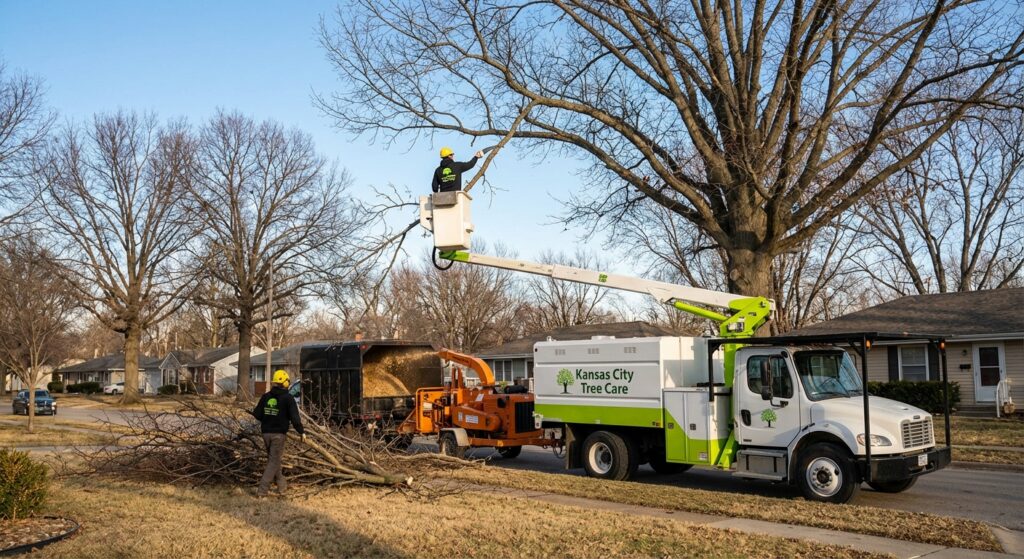
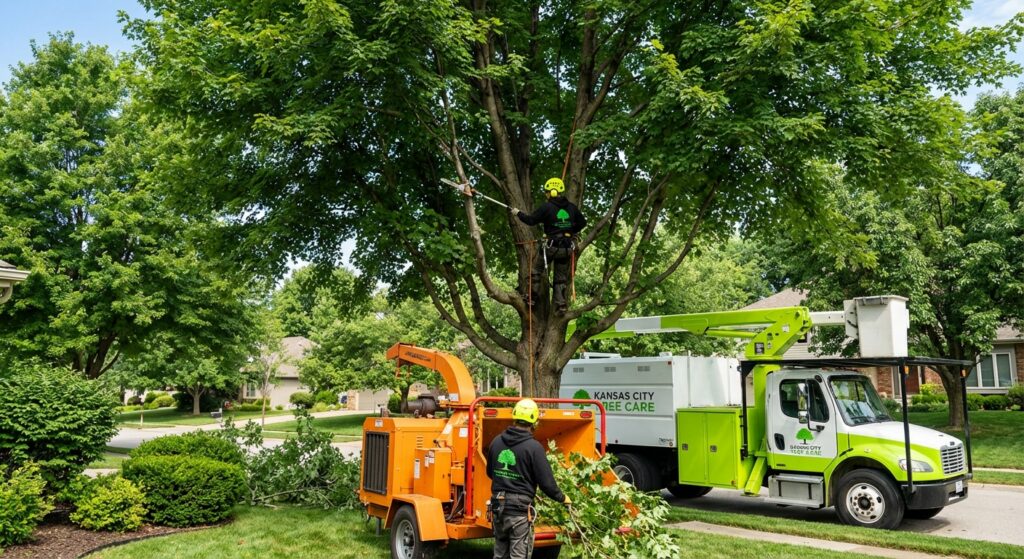
Our tree trimming and pruning team has been working across the metro for over 15 years — and the right schedule depends on the species, age, and location of each tree.
What we’re doing with young tree pruning:
- Selecting a central leader — one dominant trunk rather than competing co-dominant stems. Failing to do this is how you end up with a silver maple that splits in half 30 years later.
- Removing crossing branches — branches that rub against each other create wounds and bark damage
- Establishing branch spacing — ensuring main scaffold branches are well-spaced around the trunk, not clustered
- Correcting tight branch unions — addressing V-shaped crotches early when they’re easy to fix
Young tree pruning is fast, inexpensive ($100-$250 per tree), and prevents thousands of dollars in structural problems later. Most of the “problem tree” calls we get in Overland Park and Olathe are for 40-50 year old trees that were never properly trained when young.
If you recently planted a tree, start structural pruning in year 2-3. Don’t wait until it’s too big to easily manage.
Maturing Trees (10-30 Years): Every 3-5 Years
Once a tree has a well-established structure, the focus shifts to maintenance:
- Deadwood removal — dead branches accumulate every year and should be cleaned out regularly
- Crown thinning — selectively removing interior branches to improve airflow and reduce wind load
- Clearance pruning — maintaining height over sidewalks (8 feet), driveways and streets (14 feet), and roof lines
- Correcting developing problems — branches growing toward the house, competing leaders that escaped early pruning
At this stage, trees are growing vigorously and filling in quickly. Annual pruning isn’t necessary for most species, but waiting more than 5 years means more work (and higher cost) when you do get around to it.
Large, Mature Trees (30+ Years): Every 5-7 Years
Older trees grow more slowly and need less frequent pruning. The focus is on risk management and tree health rather than shaping:
- Deadwood removal — the primary maintenance task for mature trees
- Weight reduction — shortening overextended branches to reduce leverage and storm risk
- Crown cleaning — removing broken, rubbing, and weakly attached branches
- Hazard assessment — checking for structural defects, decay, and root problems during the pruning visit
One critical rule for mature trees: never remove more than 15-20% of the canopy at once. Older trees have less energy reserve and recover from pruning more slowly. Aggressive pruning on a mature tree can trigger decline, not improvement. Less is more after 30 years.
Species-Specific Trimming Schedules for the KC Metro
Because not all trees grow at the same rate or have the same structural tendencies:
Silver maple — every 2-3 years. Fast growth, weak wood, and a tendency toward co-dominant stems make silver maples the highest-maintenance shade tree in Kansas City. Regular thinning keeps weight manageable and significantly reduces storm damage risk. We see more storm-failed silver maples than any other species in Johnson County.
Pin oak — every 3-4 years. Dense, layered canopy that catches wind. Also prone to iron chlorosis in KC’s alkaline soil, which causes progressive dieback that needs to be managed. Prune during dormancy only (November-March) to prevent oak wilt.
Hackberry — every 3-5 years. Tough, adaptable trees that tolerate KC conditions well. Moderate growth rate and decent structure mean they’re less maintenance than maples but still benefit from periodic thinning and deadwood removal.
Cottonwood — every 2-3 years. Massive, fast-growing trees with weak wood. If you have a large cottonwood near a structure, keep it thin. These trees produce enormous branches that break easily in wind. Some homeowners choose to remove cottonwoods rather than commit to the ongoing maintenance they require near buildings.
Red/bur oak — every 5-7 years. Strong wood, slow growth, excellent natural structure. These are the lowest-maintenance large trees in the KC area. Remove deadwood when you see it and do a full pruning every 5-7 years. Dormant season only.
Honeylocust — every 4-5 years. Naturally open canopy, moderate growth rate, generally low-maintenance. Light thinning and deadwood removal on a 4-5 year cycle is sufficient.
Eastern redcedar — rarely. These native evergreens need little to no maintenance unless they’re interfering with structures or creating fire risk near homes.
Signs Your Trees Need Trimming Now
Regardless of your regular schedule, trim immediately if you notice:
If branches are touching your roof or hanging over your driveway, read our guide on how overgrown trees damage your property. And make sure to avoid the common DIY trimming mistakes that cause more harm than good.
- Dead branches over your house, driveway, or walkways — these are ticking clocks
- Branches touching your roof — they create moisture traps, pest entry points, and will damage shingles in wind
- Branches in power lines — contact Evergy for utility line clearance
- Obstructed sight lines at intersections or driveways — this is a safety issue and many KC metro cities require clearance maintenance
- Branches rubbing against each other — the friction wounds become disease entry points
- Dense canopy before storm season — if you can’t see sky through the branches, the tree will catch wind like a sail
- Storm damage — broken branches that weren’t fully removed need proper cuts before they tear further
What Trimming Costs in Kansas City — And How to Save
Typical tree trimming costs in the KC metro:
- Small trees (under 25 feet): $150-$400
- Medium trees (25-50 feet): $300-$800
- Large trees (50-75+ feet): $600-$1,500+
How to save money on trimming:
- Do multiple trees at once. Per-tree cost drops significantly when the crew is already on-site. We see homeowners in Leawood and Prairie Village with 5-8 mature trees save 30-40% by doing them all in one visit.
- Schedule during the off-season. Late fall and winter (November-February) is when most tree companies have better availability and some offer lower rates. This is also the best time to trim most species.
- Stay on schedule. Deferred maintenance always costs more. A tree that should have been trimmed every 3 years but went 7 years has more deadwood, more overgrowth, and takes longer to prune. Keeping up with regular maintenance is cheaper per year than catching up.
- Don’t over-trim. More pruning isn’t better pruning. A proper maintenance trim removes 10-20% of the canopy. If someone is proposing to take off 30-40%, you’re paying for more work than the tree needs — and it may harm the tree.
How Weather Patterns in KC Affect Your Trimming Schedule
Kansas City’s weather isn’t gentle on trees. Understanding local conditions helps you time trimming for maximum protection.
Ice storms (December through February) cause more tree damage in the KC metro than any other weather event. Heavy ice accumulates on branches, and dense canopies hold more ice than thinned ones. Trees trimmed within the last 2-3 years handle ice events dramatically better than neglected trees. We see the proof every winter — the aftermath photos from Independence and Raytown neighborhoods always show untrimmed trees snapped apart next to maintained trees that came through with minimal damage.
Spring thunderstorms (March through June) bring high winds and occasionally tornadoes. Thinned canopies let wind pass through rather than catching it. A thick-canopied silver maple acts like a parachute in a 60 mph gust — and that’s when entire trees uproot or major limbs tear away.
Summer drought stress (July through August) weakens trees, especially in KC’s heavy clay soil that dries and cracks. Trees under drought stress are more vulnerable to branch dieback. Trimming during active drought isn’t ideal — it removes foliage the tree needs for cooling and moisture management. Plan major pruning for dormant season instead.
The practical takeaway: schedule your trimming in late fall or winter (October through February) so trees are prepared before KC’s most damaging weather events. This also happens to be when most species should be pruned — dormant-season pruning promotes faster wound closure and reduces disease transmission.
Creating a Multi-Year Tree Care Plan
Most KC homeowners have 3-8 trees on their property, each at different ages and stages. Rather than trying to do everything at once, set up a rotation.
Year 1: Trim the highest-priority trees — those closest to your house, over your driveway, or showing obvious deadwood. These present the most immediate risk.
Year 2: Trim the mid-priority trees — front yard specimens, trees near fences or property lines, any with structural issues developing.
Year 3: Address the remaining trees — backyard trees in open areas, healthy trees that just need routine maintenance.
Then cycle back to the first group. This rotation spreads the cost over three years rather than hitting you with one large bill, and ensures every tree gets attention on a reasonable schedule. Our crew in Overland Park manages dozens of properties this way — homeowners budget $400-$800 per year instead of $1,500-$2,500 every 5 years.
We’re happy to walk your property and build a prioritized trimming plan at no charge. Call 913-894-4767 to schedule a free assessment.
When DIY Trimming Makes Sense — And When to Call a Pro
Not every trimming job requires a professional crew. Small ornamental trees, young trees under 15 feet, and shrubs are reasonable DIY projects if you have the right tools — a sharp hand pruner, loppers, and a pruning saw. Stick to branches under 3 inches in diameter and work from the ground.
Call a professional when:
- The tree requires a ladder or climbing. Falls from ladders account for hundreds of tree-trimming injuries every year in the U.S. Our climbers are trained and harnessed — it’s not worth the risk for a homeowner.
- Branches are near power lines. Contact Evergy directly for utility line clearance. Never attempt to trim near energized lines.
- The tree has dead branches over a structure. Dead wood is unpredictable. A branch that looks stable can drop without warning when disturbed. Professional rigging controls the drop.
- You need more than basic deadwood removal. Crown thinning, structural pruning, and weight reduction require training to do correctly. Improper cuts create entry points for disease and decay.
- The tree is valuable or irreplaceable. A 50-year-old bur oak in your front yard is worth thousands in property value. One bad pruning job can permanently disfigure or even kill it. That’s not the place to practice.
For most KC homeowners with mature trees on their property, professional trimming is a better investment. The cost of a proper trim — $300-$800 per tree — is a fraction of the cost to remove a tree that declined from poor pruning or to repair damage from a branch failure that proper trimming would have prevented.
Frequently Asked Questions
How often should I trim my silver maple?
Every 2-3 years. Silver maples grow fast, produce weak wood, and develop heavy canopies that are prone to storm failure. Regular thinning keeps weight manageable and significantly reduces the risk of branch or stem breakage during Kansas City’s frequent thunderstorms and ice events.
We provide regular trimming services in Shawnee, Lenexa, and throughout the KC metro:
Can I hurt my tree by trimming too often?
Yes, if you’re removing too much each time. The tree needs its foliage to produce energy. Annual heavy pruning can deplete energy reserves and stunt growth. However, light maintenance — deadwood removal, minor clearance adjustments — can be done annually without harm. The key is volume: never remove more than 20-25% of live canopy in a single session.
What happens if I never trim my trees?
Dead branches accumulate, the canopy becomes dense, crossing branches create wounds, and structural problems develop uncorrected. The tree becomes progressively more vulnerable to storm damage with each passing year. We’ve seen homeowners pay $3,000-$5,000 for emergency storm cleanup on trees that would have cost $500 to properly maintain.
Do newly planted trees need trimming?
Not immediately — let a newly planted tree establish for 1-2 years before any pruning beyond removing damaged or crossing branches. Then begin structural pruning every 2-3 years to develop good architecture. Early structural pruning is the single best investment in a tree’s long-term health and safety.
Should I trim my trees before winter or before summer in KC?
Before winter is generally better for the KC metro. Late winter pruning (February-March) prepares trees for vigorous spring growth and allows the tree to seal wounds quickly. Thinning before ice storm season (October-November) reduces the weight that ice can accumulate on branches. Summer pruning is fine for deadwood and light corrective work.
Get on a Maintenance Schedule
The cheapest tree work is the work that prevents problems. Regular trimming on an appropriate schedule for each tree costs a fraction of emergency storm cleanup, structural failure repair, or removal of a tree that declined from neglect.
We maintain trees throughout the Kansas City metro — Overland Park, Olathe, Shawnee, Lenexa, Lee’s Summit, Independence, and all surrounding communities. Licensed, insured, ISA certified, and 15+ years in the KC market.
Call Kansas City Tree Care at 913-894-4767 for a free trimming estimate.