The Rules Aren’t Complicated — But Most KC Homeowners Don’t Know Them
Tree trimming in Kansas City isn’t a free-for-all. Between city ordinances, utility easements, property line laws, HOA restrictions, and arboricultural best practices, there are real rules that govern what you can and can’t do with the trees on your property. Ignore them and you could be looking at fines, liability, or damage to trees that are a lot harder to replace than you think.
Here’s a practical guide to the tree trimming rules and guidelines that apply to homeowners in the KC metro.
City Clearance Requirements
Most Kansas City metro cities require property owners to maintain tree clearance along streets and sidewalks. The specific numbers:
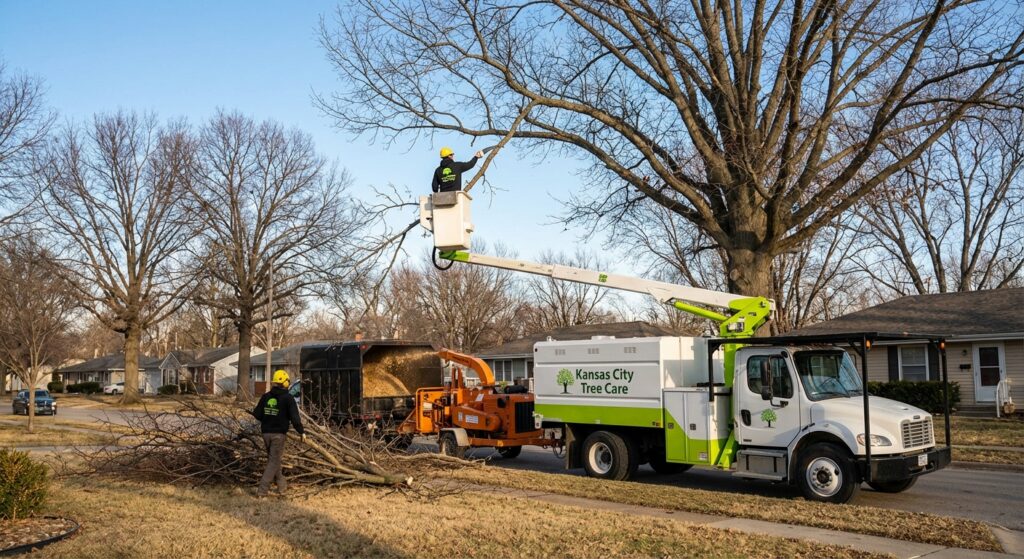
Our tree trimming and pruning service deals with local regulations constantly — and the rules vary more than most homeowners expect from one city to the next.
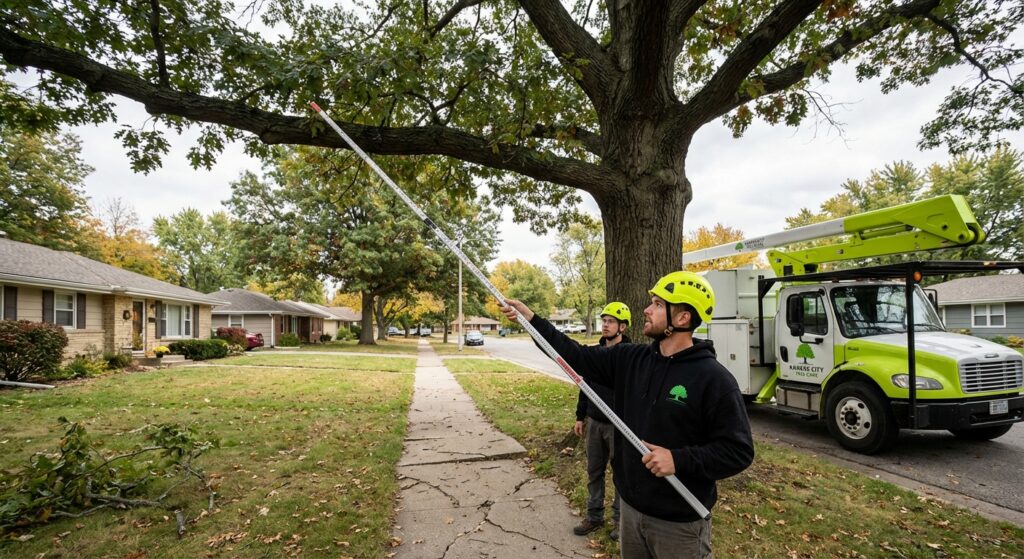
Over sidewalks: 8 feet minimum clearance in most KC metro cities. This means no branches hanging lower than 8 feet above sidewalks adjacent to your property. If branches obstruct pedestrian traffic, your city can issue a notice requiring you to trim — and if you don’t comply within the specified timeframe, the city can hire a crew and bill you for it.
Over streets: 14 feet minimum clearance. This applies to any tree branches hanging over the street from your property. The standard ensures delivery trucks, emergency vehicles, and city equipment can pass without obstruction.
Sight triangles at intersections: Many cities require vegetation below 8 feet to be cleared within a sight triangle at intersections and driveways. If your tree or hedge blocks sight lines for drivers, you may receive a notice to trim. This is a safety regulation and cities enforce it actively.
Fire hydrants: Some cities require clearance around fire hydrants. Trees blocking hydrant access can result in trimming orders.
These requirements apply to all trees on your property that affect public spaces — not just street trees. If a tree in your front yard has branches hanging 6 feet above the sidewalk, that’s your responsibility to correct regardless of whether it’s a “city tree” or your tree.
Right-of-Way Trees: Who Owns What
The strip between the sidewalk and the curb is almost always public right-of-way in KC metro cities. Trees planted there belong to the city, even though they feel like they’re “yours.”
What this means:
- You cannot remove a right-of-way tree without city permission
- You can trim branches on right-of-way trees that overhang your property — but you can’t top them, remove major branches, or damage them
- The city is responsible for maintaining right-of-way trees, but in practice, most cities have limited budgets and long response times
- If a right-of-way tree damages your property (roots, branches), contact your city’s public works or forestry department
Cities like Overland Park, Olathe, and Shawnee have established urban forestry programs that manage right-of-way trees. Smaller cities may handle tree requests through general public works.
Property Line Rules: Your Tree, Your Neighbor’s Tree
This is where most tree disputes happen in KC neighborhoods. Here are the legal basics for Kansas and Missouri:
Your tree, their branches over their property: Your neighbor has the legal right to trim your tree’s branches back to the property line at their own expense. They cannot come onto your property to do this, and they cannot damage the tree in a way that kills it. They can only trim to the property line — not beyond.
Their tree, branches over your property: You have the same rights. You can trim back to the property line at your expense. Many homeowners in the KC metro hire a tree service to do this properly rather than risk improper cuts that look terrible or damage the tree.
Tree straddling the property line: If the trunk is on both properties, the tree is jointly owned. Neither party should remove or significantly alter the tree without agreement from the other. This situation is more common than you’d think in older KC neighborhoods where property lines run through established trees.
Falling debris: Leaves, seeds, fruit, and normal tree debris falling from a neighbor’s tree onto your property aren’t the tree owner’s problem — that’s considered an act of nature. However, dead branches that fall and cause damage can create liability if the owner knew the tree was hazardous and failed to act.
The best approach to neighbor tree issues is always conversation first. Most conflicts resolve amicably when both parties understand the rules and act reasonably.
HOA Tree Regulations
If you live in an HOA community — and a large percentage of Johnson County neighborhoods are HOA-governed — there are likely additional tree rules in your CC&Rs:
- Removal restrictions: Many HOAs require written approval before removing any tree, even on your own lot. Some require replacement planting.
- Species restrictions: Some HOAs specify approved tree species for new plantings and may prohibit species they consider “undesirable.”
- Maintenance standards: HOAs may require property owners to maintain trees to a certain appearance standard. Dead trees, severely overgrown trees, and trees blocking common areas may trigger violation notices.
- Height restrictions: Unusual but present in some communities — maximum tree heights, especially near lots with views.
If you’re unsure about your HOA’s tree policies, request a copy of the CC&Rs and landscaping guidelines before starting any tree work. Getting a tree removed and then receiving an HOA fine and replanting order is an expensive mistake. A professional arborist assessment can provide documentation supporting removal if the tree is hazardous.
Utility Easement Rules
Utility companies hold easements that give them the right to maintain clearance along their infrastructure:
Evergy (electric): Maintains a vegetation management program that trims trees along power lines on a regular cycle. They can trim trees within their easement without your permission, though they typically notify you first. Their trimming may not match your aesthetic preferences — they’re focused on line clearance, not tree health.
Gas and water: Underground utility easements generally don’t restrict tree trimming but do restrict digging and planting within the easement. Call 811 before any tree work that involves ground disturbance (like stump grinding).
Telecommunications: Cable and fiber optic lines are generally lower priority than electric. Contact your provider if trees are interfering with their lines.
Arboricultural Best Practices: The Professional Standard
Beyond legal requirements, there are industry standards that define proper tree trimming. These come from the ISA (International Society of Arboriculture) and ANSI A300 (the national tree care standard):
- No topping. Cutting main branches back to stubs is recognized as destructive and improper. Any company that recommends topping is not following professional standards.
- Proper cut location. All cuts at the branch collar — no flush cuts (too close to trunk), no stub cuts (too far from trunk).
- Maximum removal per session. No more than 25% of live canopy in a single year. More aggressive pruning stresses the tree and triggers weak regrowth.
- No lion-tailing. Stripping interior branches and leaving foliage only at tips creates structural problems, not improvement.
- Seasonal timing. Oaks during dormancy only (oak wilt prevention). Spring bloomers after flowering. Most deciduous trees in late winter.
You have the right to trim your own trees however you want (within legal limits), but following professional standards protects your trees’ health, safety, and value. Improper trimming can damage trees in ways that are expensive to correct. Read our guide on common DIY trimming mistakes.
When a Permit Is Required
Tree trimming on private property in most KC metro cities doesn’t require a permit. However, permits or approval may be needed for:
- Tree removal — some cities require permits for removing trees over a certain size (see our tree removal permit guide)
- Work in historic districts — significant landscape alterations may require review
- Work near utility lines — coordinate with utility companies rather than attempting yourself
- Construction-related tree work — if tied to a building project that requires permits
When in doubt, a quick call to your city’s planning department or public works office will clarify whether your specific situation requires any approval.
Common Trimming Violations and How to Avoid Them
Homeowners in the KC metro sometimes get cited or fined for tree trimming issues they didn’t know about. Here are the most common ones — and how to stay on the right side of the rules.
Topping. Cutting the top off a tree to reduce its height. This is the single most destructive thing you can do to a tree, and several KC-area cities specifically prohibit it for protected species. Topping removes 50-100% of the leaf-bearing crown, starves the tree, triggers rapid weak regrowth (water sprouts), and dramatically increases the tree’s failure risk within 5-10 years. If your tree is “too tall,” the correct approach is crown reduction — selectively shortening branches back to lateral limbs. Our certified arborists can reduce a tree’s height and spread by 15-20% without the damage topping causes.
Removing protected trees without a permit. In cities like Olathe, Overland Park, and Leawood, certain tree species or sizes require permits before removal. Heritage trees — typically defined as 24-36 inches in diameter or larger — may have additional protections. Check with your city’s public works or planning department before any removal. We handle permit applications for our clients and know which jurisdictions require them.
Encroaching on public right-of-way. Most KC metro cities require property owners to maintain tree clearance over sidewalks (minimum 8 feet) and streets (minimum 14 feet). If your trees don’t meet these clearances, the city may send a notice requiring trimming within 30-60 days. If you don’t comply, some cities will hire a contractor, do the work, and bill you — often at a premium over what you’d pay directly.
Trimming during nesting season. Under the federal Migratory Bird Treaty Act, it’s illegal to destroy active bird nests. If trimming during spring and summer (March through August), crews must inspect for nesting activity before starting. A responsible crew checks for nests as part of their pre-climb inspection. If active nests are found, that section of the tree must wait until the young have fledged — typically 2-4 weeks.
Hiring a Qualified Trimming Crew — What to Verify
The difference between a good trim and a damaging one comes down to who’s holding the chainsaw. Here’s what to verify before hiring anyone to cut on your trees.
ISA certification. The International Society of Arboriculture certifies arborists through testing on tree biology, pruning standards, safety, and risk assessment. An ISA-certified arborist on the crew means your trees are being pruned according to science-based standards, not just cut until they “look smaller.”
Insurance documentation. Ask for a current Certificate of Insurance showing general liability and workers’ compensation. Call the insurance company to verify it’s active — expired policies are common among budget operators. If a crew member falls from your tree and they don’t have workers’ comp, your homeowner’s insurance may be on the hook.
Written estimate with scope. A professional estimate specifies which trees, what type of pruning (crown thinning, deadwood removal, clearance, crown reduction), and the total cost. “Trim the trees — $800” isn’t sufficient. You should know exactly what’s happening to each tree.
No topping, lions-tailing, or excessive removal. If a crew proposes removing more than 20-25% of live canopy, or “shaping” the tree into a ball or mushroom, find a different crew. These are damaging practices that create long-term problems. At Kansas City Tree Care, we follow ANSI A300 pruning standards on every job — the same standards used by municipalities, utilities, and professional arborists nationwide.
Frequently Asked Questions
Can my city force me to trim my trees?
Yes, if your trees violate clearance requirements (typically 8 feet over sidewalks, 14 feet over streets) or create safety hazards. The city will issue a notice with a compliance deadline. If you don’t comply, most cities can hire a contractor to do the work and bill you for it, often at a premium over market rates.
Rules differ across the metro — Leawood and Prairie Village have some of the strictest tree ordinances in the KC area:
Can I trim my neighbor’s tree branches that hang over my yard?
Yes, in both Kansas and Missouri. You can trim branches back to the property line at your own expense. You cannot go onto their property, and you cannot damage the tree in a way that kills it. For best results, hire a professional to make proper cuts — bad cuts on your neighbor’s tree can create conflict and damage the tree.
What are the penalties for improperly removing or damaging a tree?
For right-of-way trees removed without permission, fines range from $200-$1,000+ per tree plus replacement costs (often 2:1 or 3:1 ratio). For trees on neighboring property, you could be liable for the appraised value of the tree — which for a large, mature shade tree can be $5,000-$15,000+ using standard appraisal methods.
Do KC area cities have heritage tree ordinances?
Some do, though they’re less common than in other metro areas. Leawood has tree preservation requirements tied to development. Some Missouri-side cities protect trees over a certain diameter. Check your specific city’s code. Most Johnson County cities have minimal tree regulations for existing residential properties.
My HOA won’t let me remove a dead tree. What do I do?
Get a written hazardous tree assessment from a certified arborist documenting that the tree is dead and poses a safety risk. Submit this to your HOA board with a formal request for removal. Dead and hazardous trees are almost always exempt from HOA tree preservation requirements. If the HOA still refuses, they’re creating potential liability for themselves if the tree causes damage.
Know the Rules Before You Start Cutting
Most tree trimming in the KC metro is straightforward — no permits needed, no special approvals required. But knowing the clearance requirements, property line rules, HOA restrictions, and professional standards protects you from fines, liability, and damaging trees you’d rather keep.
We handle tree trimming throughout the Kansas City metro — Overland Park, Olathe, Shawnee, Lenexa, Lee’s Summit, Independence, Liberty, and all surrounding communities. We know the local rules because we work in these cities every day.
Call Kansas City Tree Care at 913-894-4767 for a free trimming estimate.