That Beautiful Shade Tree Is Costing You More Than You Think
There’s a difference between a mature tree and an overgrown tree. A mature tree adds $1,000-$10,000 to your property value, provides energy-saving shade, and looks great. An overgrown tree — one that hasn’t been maintained and has grown beyond what the site can support — is actively damaging your property and costing you money.
We see this constantly across the KC metro. Homeowners love their trees (and they should), but many don’t realize that the massive silver maple pressing against the house or the hackberry growing into the power lines is creating problems that compound every year it goes unaddressed.
Here’s how overgrown trees damage property in Kansas City and what you can do about each issue.
Our tree trimming services deal with overgrown tree problems every day — from branches scraping roofs to root systems cracking foundations across the metro.
Roof and Structural Damage
Branches resting on or rubbing against your roof create several problems simultaneously:
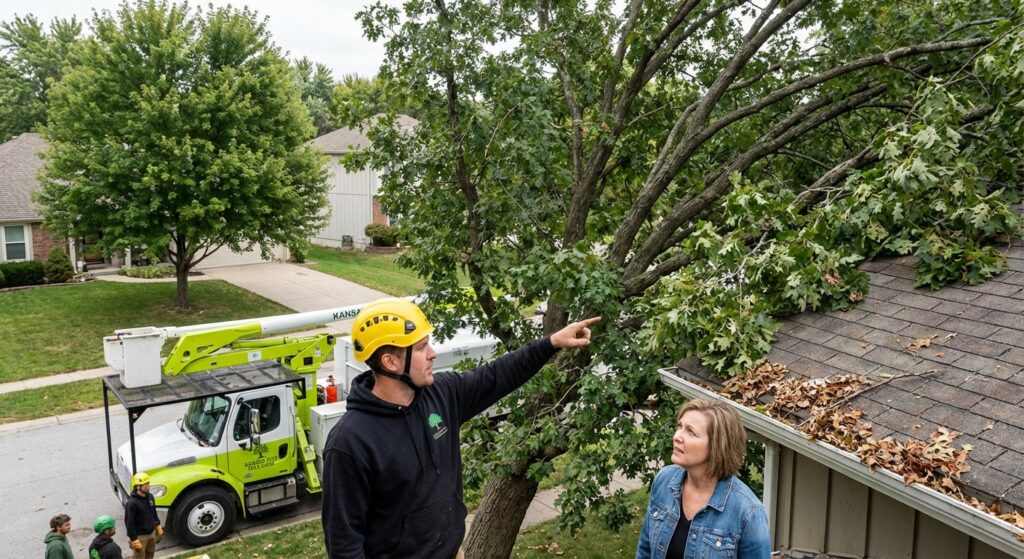
Shingle damage. Branches scraping across shingles in wind abrade the protective granule coating. Over a few seasons, this creates bare spots where water penetrates. We’ve seen this on houses in Overland Park and Leawood where overgrown pin oak branches wore through multiple shingle layers.
Moisture trapping. Dense canopy directly over a roof prevents sunlight and airflow from drying the surface. This creates ideal conditions for moss, algae, and lichen growth — all of which hold moisture against the shingles and accelerate deterioration. In KC’s humid summers, shaded roof sections can stay damp for days.
Gutter blockage. Overhanging branches drop leaves, twigs, seeds, and debris directly into gutters. Clogged gutters cause water to back up under roof edges, overflow against fascia boards, and dump water against your foundation — creating a whole cascade of secondary problems.
Pest highway. Branches touching your house are bridges for squirrels, raccoons, and insects to access your roof, attic, and soffits. Once rodents find an entry point, you’ve got a pest control problem on top of a tree problem.
What to do: Maintain a minimum of 10 feet of clearance between branch tips and your roof. For species with aggressive growth (silver maple, cottonwood), plan on maintaining this clearance every 2-3 years. Crown raising and clearance pruning is one of the most common services we provide in the KC metro.
Foundation and Root Damage
Tree roots follow water — and in Kansas City’s clay soil, the moisture dynamics between trees and foundations create real problems.
Clay soil shrinkage. Large trees near foundations extract significant water from the soil. KC’s expansive clay soil shrinks when dry and swells when wet. A large tree pulling water from one side of your foundation causes uneven soil moisture — the tree side shrinks and settles while the opposite side stays put. This differential settlement cracks foundations, sticks doors, and creates uneven floors.
Root intrusion. Tree roots seeking water are one of the most common causes of property damage in the KC metro — our guide explains how tree roots cause foundation damage in Kansas City and what you can do about it. Roots grow toward water sources. Sewer lines, French drains, and foundation weeping tiles are all targets. Silver maple roots are notorious for infiltrating sewer lines throughout the KC metro. A root-clogged sewer line costs $200-$800 to clear — and it’ll clog again unless the root source is addressed.
Heaving. Surface roots from fast-growing trees push up sidewalks, driveways, and patios. In older KC neighborhoods where trees were planted 50-60 years ago, root heaving has buckled sidewalks and cracked driveways throughout Prairie Village, Mission, Fairway, and Roeland Park.
What to do: If a tree trunk is within 15-20 feet of your foundation and you’re seeing foundation issues, have both an arborist and a foundation specialist evaluate the situation. Options include root barriers (installed between the tree and foundation), selective root pruning, or in severe cases, tree removal. The tree may not be the only factor, but it’s often a contributing one.
Power Line Interference
Overgrown trees growing into power lines are more than a nuisance — they’re a safety hazard and a potential fire risk.
Service drops. The line from the utility pole to your house (service drop) is your responsibility to maintain clearance around. Trees growing into your service drop can cause power outages, electrical arcing, and fire. In Kansas City, Evergy recommends maintaining 10 feet of clearance around all utility lines.
Utility lines on poles. Trees growing into main utility lines along the street are Evergy’s responsibility. They have a vegetation management program that cycles through neighborhoods on a regular schedule. If you can’t wait for their cycle, call Evergy directly — they’ll send a crew to clear their lines at no charge.
What to do: For your service drop, hire a professional tree service. For main utility lines, contact Evergy. Never attempt to trim near power lines yourself. Even the service drop carries enough current to be lethal.
Storm Damage Risk
An overgrown tree is a storm damage machine. Dense, unpruned canopies catch wind instead of letting it pass through. Dead branches accumulated over years of deferred maintenance become projectiles. Heavy, unthinned branches leverage against weak attachment points.
Regular trimming prevents storm damage before it starts. Check how often you should trim your trees and learn the local tree trimming rules in KC before scheduling work.
The math is simple: a properly maintained tree survives storms that destroy neglected trees of the same species. We see this after every major wind event in KC — on the same street, maintained trees stand while unmaintained neighbors of the same species and size are in pieces.
KC’s weather makes this especially relevant. Summer straight-line winds of 60-80 mph, ice storms every 2-3 years, and spring severe weather all test tree structure. An overgrown tree fails these tests.
What to do: Crown thinning reduces wind resistance by 30-40%. Combined with deadwood removal and reduction of overextended branches, a single maintenance pruning can dramatically reduce storm damage risk. Budget for this before storm season — not after. Read our full guide on preparing trees for Kansas City storms.
Property Value Impact
Well-maintained trees add value. Overgrown, neglected trees subtract it.
When a potential buyer drives up to a house in Overland Park, Leawood, or Prairie Village and sees massive trees pressing against the house, roots heaving the driveway, and dense canopy blocking all light — they see expensive problems, not beautiful landscaping. Appraisers factor tree condition into property assessments.
The typical cost to bring an overgrown yard back to proper maintenance is $1,500-$5,000 depending on the number of trees and severity. For homes with $400,000-$800,000+ values in Johnson County, this is one of the highest-ROI landscape investments you can make before listing.
Neighbor Relations and Legal Issues
Overgrown trees don’t respect property lines. When your tree’s branches extend over your neighbor’s yard, shed, car, or garden:
- Your neighbor has the right to trim branches back to the property line at their own expense (in both Kansas and Missouri)
- If your tree drops a branch on your neighbor’s property and there was no prior knowledge of the defect, your liability is generally limited (it’s considered an “act of nature”)
- If your tree was obviously dead, diseased, or hazardous and you failed to maintain it, you can be held liable for resulting damage
- Leaves, seeds, and normal debris falling from your tree onto a neighbor’s property aren’t your legal problem — that’s nature
The best approach is proactive maintenance and good communication. For a detailed breakdown of your rights and responsibilities, read our guide to property line tree disputes in Overland Park. Keep your trees trimmed so they aren’t encroaching on neighboring properties. If a neighbor expresses concern about one of your trees, take it seriously — a professional hazardous tree evaluation protects you legally and keeps the relationship intact.
The “Overgrown to Managed” Process
If your trees have gone years without maintenance, here’s how we bring them back to a healthy, manageable state:
Year 1: Priority work — remove all deadwood, clear branches from structures and power lines, thin the most overgrown trees by 20-25%. Remove any trees that are too far gone (dead, severely damaged, structurally unsound).
Year 2: Secondary pruning — continue thinning and structural correction on trees that were partially addressed in year 1. Address root issues, install cabling on trees with structural defects worth preserving.
Year 3+: Regular maintenance cycle — the trees are now in a manageable state. Continue on a 3-5 year trimming cycle to keep them there.
We don’t try to fix 10 years of neglect in one session. Heavy pruning stresses trees more than gradual correction. The phased approach costs more over the full term but produces healthier trees that last.
Frequently Asked Questions
How close can a tree be to my house?
As a general guideline, small trees (under 25 feet mature height) should be at least 10 feet from your foundation, medium trees (25-50 feet) at least 15-20 feet, and large trees (50+ feet) at least 20-30 feet. These distances prevent most root-foundation conflicts and provide room for branch growth without structural contact. Existing mature trees closer than these distances need regular clearance pruning.
We handle overgrown tree issues across Overland Park, Fairway, and every neighborhood in the KC metro:
Will cutting roots damage my tree?
Cutting roots within the tree’s drip line can damage and potentially kill the tree, depending on the percentage of roots affected. A general guideline: don’t cut roots larger than 2 inches in diameter within a distance of 3x the trunk diameter from the trunk. For example, a tree with a 20-inch trunk shouldn’t have roots cut within 5 feet of the trunk. An arborist can advise on specific situations.
My neighbor’s tree is overgrown into my yard. Can I make them trim it?
In Kansas and Missouri, you can trim branches back to the property line at your own expense. You cannot force your neighbor to trim their tree unless it violates a specific local ordinance or is demonstrably hazardous. For hazardous trees, contact your city’s code enforcement. For HOA communities, the CC&Rs may provide additional leverage.
How much does it cost to deal with an overgrown tree?
A single overgrown tree typically costs $400-$1,500 to bring back to proper form, depending on size and condition. Multiple trees on a property can range from $1,500-$5,000 for the first year of catch-up work, with lower annual maintenance costs thereafter. Removal of a tree that’s too far gone runs $800-$3,000 for residential trees.
Can overgrown trees cause insurance problems?
Some insurers inspect properties and may flag overgrown trees as hazards. If a tree causes damage that could have been prevented with maintenance (dead branches on the roof, trees growing into wiring), your claim could face scrutiny. Maintaining your trees and having documentation of regular professional maintenance protects you if you ever need to file a claim.
Don’t Let Your Trees Become Liabilities
The line between an asset and a liability is maintenance. A maintained tree adds beauty, shade, and value. A neglected tree damages your roof, threatens your foundation, blocks your power lines, and risks your safety in every storm.
We manage overgrown trees throughout the Kansas City metro — Overland Park, Olathe, Shawnee, Lenexa, Lee’s Summit, Independence, Liberty, and all surrounding communities. Licensed, insured, ISA certified.
Call Kansas City Tree Care at 913-894-4767 for a free property assessment.