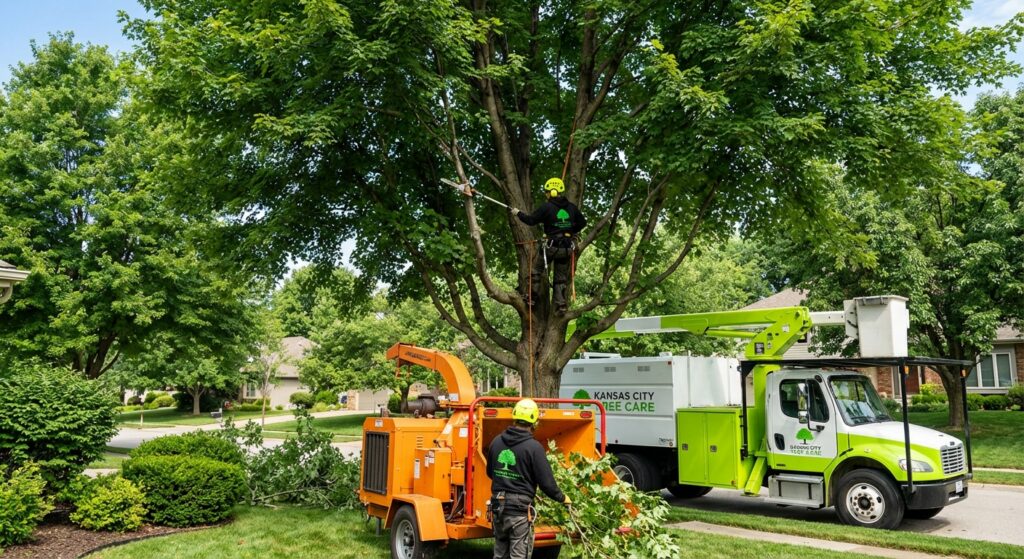
Timing Matters More Than Most KC Homeowners Think
Every spring, our phone rings with the same question: “When should I have my trees trimmed?” The short answer is that it depends on the species and what you’re trying to accomplish. But here’s what that actually means for your situation.
We’ve been trimming trees across the Kansas City metro for over 15 years — Overland Park, Olathe, Shawnee, Lee’s Summit, you name it. And the single biggest mistake we see homeowners make isn’t hiring the wrong company or skipping trimming altogether. It’s trimming at the wrong time of year, which can stress the tree, invite disease, or waste money on work that needs to be redone in a few months.
Let’s break down exactly when to trim every major tree species in the KC area, why timing matters, and when it doesn’t.
Our tree trimming and pruning services run year-round, but timing your trim right saves you money and keeps your trees healthier long-term.
Late Winter Is the Best Time for Most Trees in Kansas City
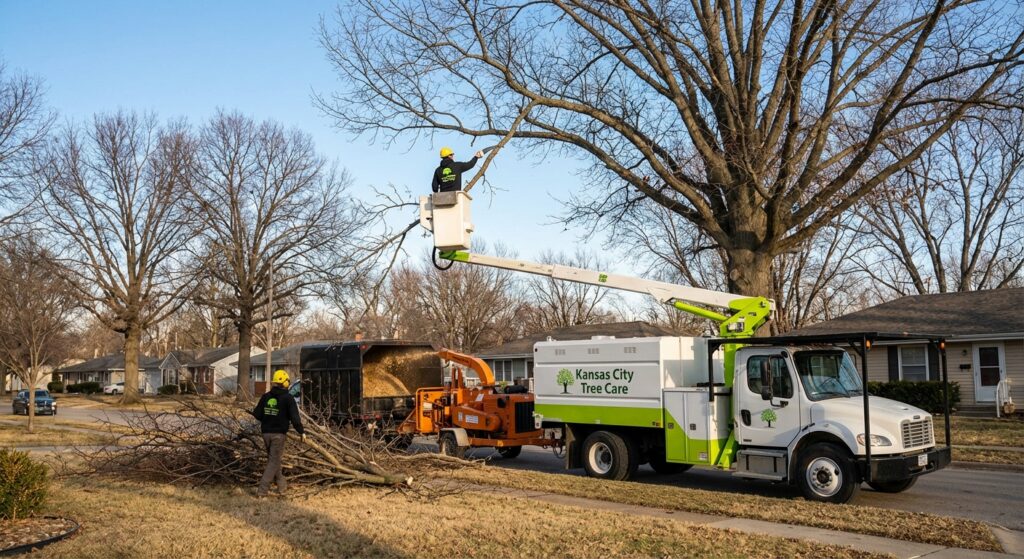
For the majority of deciduous trees in the KC metro — oaks, maples, elms, hackberries, honeylocusts — late winter (February through early March) is the ideal trimming window. Here’s why:
- The tree is dormant. No active growth means less stress from pruning. The tree can direct its energy into healing the cut sites when spring growth kicks in.
- You can see the structure. Without leaves, every branch is visible. This is huge for identifying crossing branches, dead wood, and structural problems that are hidden during summer.
- Disease risk is lowest. Most fungal pathogens and insect pests are inactive in winter. Pruning wounds have time to begin sealing before the warm-weather disease season starts.
- Spring growth covers the cuts. New growth in April and May quickly fills in gaps left by pruning, so the tree looks full again within a single growing season.
In Kansas City specifically, this means scheduling your tree trimming between mid-February and late March. We start booking winter trimming jobs in January, and the schedule fills up fast — especially in neighborhoods with mature trees like Prairie Village, Fairway, and Leawood.
Oak Trees: Dormant Season Only
If you have oaks — and in the KC metro, that’s a lot of homeowners — timing isn’t just a best practice. It’s critical.
Oak wilt is a lethal fungal disease that’s present in Missouri and spreading. The fungus enters through fresh pruning wounds and is transmitted by sap-feeding beetles that are active from April through October. Once a red oak gets oak wilt, it can die within weeks. White oaks are more resistant but still susceptible.
The rule: Only prune oaks during dormancy — November through March. No exceptions. Not “just one little branch” in June. Not storm cleanup in July (unless the branch is an immediate safety hazard, in which case seal the wound immediately with pruning sealer).
Pin oaks are the most common oak species in Johnson County. They’re everywhere — streets, yards, parks. They’re also the species most affected by iron chlorosis in KC’s alkaline clay soil. If your pin oak has yellowing leaves with green veins, that’s chlorosis. Trimming won’t fix the underlying soil chemistry issue, but dormant-season pruning to remove dead wood keeps the tree looking better and reduces weight on stressed branches.
Red oaks — common in the wooded areas of Lee’s Summit, Liberty, and Independence — are the highest-risk species for oak wilt. If you have red oaks, dormant pruning is absolutely non-negotiable.
When Summer Trimming Makes Sense
Late winter is ideal, but that doesn’t mean summer trimming is always wrong. There are specific situations where trimming during the growing season is the right call:
Dead wood removal. Dead branches can be removed any time of year because the wood is already dead — there’s no stress to the tree and no wound for disease to enter. If you’ve got dead limbs hanging over your roof or driveway, don’t wait until February. Get them down now.
Visibility pruning. Sometimes you can’t see the problem until the tree is fully leafed out. Branches blocking sight lines at intersections, rubbing against your house, or interfering with power lines are easier to identify in summer. Light corrective pruning for these issues is fine.
Storm damage. After a summer thunderstorm tears through with 60-70 mph straight-line winds (and KC gets several of these every year), you’re not going to wait until winter to deal with broken branches. Storm damage cleanup happens when it happens. Just make sure broken branches are properly cut back to the branch collar — don’t leave stubs.
Fruit trees. Apple, pear, and cherry trees benefit from summer pruning to control size and improve fruit production. A light summer pruning after harvest (August-September) helps manage growth without stimulating excessive new shoots.
Spring Trimming: Proceed with Caution
Early spring — March through May — is the trickiest time to trim in Kansas City. Trees are breaking dormancy, sap is flowing, and energy reserves are being directed toward new growth. Heavy pruning during this period can sap (literally) the tree’s resources right when it needs them most.
Spring-blooming trees like redbuds, dogwoods, and crabapples are a special case. If you trim them in late winter, you’ll cut off all the flower buds. Trim spring bloomers right after they finish flowering — typically late April or May in the KC area. This gives the tree the rest of the growing season to set next year’s buds.
Summer-blooming trees and shrubs (crepe myrtles, Rose of Sharon) should be trimmed in late winter or early spring before new growth starts. Their flower buds form on new wood, so early pruning doesn’t affect blooming.
The bottom line: avoid major structural pruning in spring unless there’s a safety reason. Light cosmetic work and deadwood removal are fine year-round.
How Often Should You Trim Trees in Kansas City?
This depends on the tree’s age, species, and location. General guidelines for the KC metro:
Young trees (first 5-10 years): Structural pruning every 2-3 years. This is the most important trimming you’ll ever do for a tree. Establishing good branch architecture when the tree is young prevents expensive problems later. Most of the “dangerous tree” calls we get in Overland Park and Olathe are for 40-50 year old trees that were never properly trained when young.
Mature trees (10-30 years): Every 3-5 years for maintenance pruning. Focus on deadwood removal, crossing branches, and maintaining clearance from structures and power lines.
Large, established trees (30+ years): Every 5-7 years, unless there are specific problems. Over-pruning mature trees does more harm than good. Never remove more than 25% of a mature tree’s canopy in a single year — this applies regardless of species.
Silver maples and cottonwoods: These fast-growing, weak-wooded species common throughout the KC metro need more frequent attention — every 2-3 years. Their rapid growth produces long, heavy branches that are prone to breakage in storms. Regular thinning keeps weight manageable and reduces storm damage risk significantly.
What Proper Tree Trimming Actually Involves
Not all trimming is created equal. Here’s what a proper trimming job includes versus what to avoid:
Good trimming practices:
- Crown thinning — selectively removing interior branches to improve light penetration and airflow. This reduces wind resistance (lower storm damage risk) and improves tree health. Done properly, you shouldn’t be able to tell the tree was trimmed from a distance.
- Crown raising — removing lower branches to provide clearance for pedestrians, vehicles, structures, and sight lines. Most cities in the KC metro require 8 feet of clearance over sidewalks and 14 feet over streets.
- Deadwood removal — taking out dead, dying, and diseased branches. This is the single most cost-effective maintenance you can do for a tree.
- Structural pruning — correcting competing leaders, reducing heavy lateral branches, and addressing included bark (bark growing between two branches, creating a weak attachment). This is especially critical for young trees.
What to avoid:
- Topping — cutting main branches back to stubs. This is the most destructive thing you can do to a tree. It causes rapid, weak regrowth, creates entry points for decay, and destroys the tree’s natural structure. Any company that recommends topping should be avoided. Period.
- Lion-tailing — stripping all interior branches and leaving foliage only at branch tips. This creates a sail effect that actually increases storm damage risk and stresses the tree.
- Removing more than 25% of the canopy at once — this can send the tree into shock, especially during the growing season.
Tree Trimming Costs in the Kansas City Area
Real numbers for the KC market:
Small trees (under 25 feet): $150-$400. Examples: ornamental pears, crabapples, small redbuds.
Medium trees (25-50 feet): $300-$800. Examples: most silver maples, hackberries, young oaks.
Large trees (50-75+ feet): $600-$1,500+. Examples: mature oaks, large cottonwoods, tall pin oaks.
Factors that affect price: tree height, canopy spread, number of trees, accessibility (fenced backyard vs. open front yard), proximity to structures or power lines, and amount of deadwood.
Multiple trees on the same property always get a better per-tree rate. We see a lot of homeowners in Leawood and Prairie Village who have 5-8 mature trees on their lots — doing them all at once is significantly cheaper per tree than doing them one at a time over several years.
A reputable tree service will always provide a free on-site estimate. If someone quotes you over the phone without seeing the trees, get a second opinion.
Kansas City Weather and Your Trimming Schedule
KC weather makes trimming timing even more important than in milder climates:
Ice storms — KC averages a significant ice event every 2-3 years. The last thing you want going into December is a tree with heavy, unpruned branches loaded with ice. Pre-winter trimming (October-November) reduces ice load by thinning the canopy and removing weak branches before they become projectiles.
Straight-line winds — Summer thunderstorms regularly produce 60-80 mph winds across the metro. A well-thinned canopy lets wind pass through rather than catching it like a sail. This is the number one reason we recommend regular trimming for large trees — it’s cheaper than storm damage cleanup.
Late spring freezes — KC can get hard freezes into mid-April. Trees that were pruned aggressively in early spring and have started putting out new growth are especially vulnerable to late freeze damage. This is another reason to aim for February-March pruning rather than April.
Frequently Asked Questions
What time of year should I trim my oak trees in Kansas City?
Only during dormancy — November through March. This prevents oak wilt, a lethal fungal disease that enters through fresh pruning wounds when sap-feeding beetles are active (April-October). Pin oaks, red oaks, and bur oaks throughout the KC metro should never be pruned during the growing season unless it’s an emergency requiring immediate wound sealing.
We trim trees year-round across Leawood, Lenexa, and every city in the KC metro. Here’s what homeowners ask most:
How much does tree trimming cost in the KC area?
Small trees (under 25 feet) run $150-$400, medium trees (25-50 feet) cost $300-$800, and large trees (50-75+ feet) range from $600-$1,500+. Multiple trees get volume discounts. Always get an in-person estimate from a licensed, insured company.
Can I trim my trees myself?
Small branches you can reach from the ground with a hand pruner or pole saw — sure. Anything that requires a ladder, a chainsaw, or climbing should be left to professionals. Falls from ladders during DIY tree work send thousands of people to the ER every year. And improper cuts (stubs, flush cuts, tears) cause decay that shortens the tree’s life. Read more about common DIY tree trimming mistakes.
Should I seal pruning wounds with tree paint?
No. Research has shown that wound sealers and tree paint actually slow healing and can trap moisture, promoting decay. Trees seal their own wounds through a natural process called compartmentalization. The only exception is fresh cuts on oak trees during the growing season (emergency pruning), where wound sealer prevents sap-feeding beetle access.
How do I know if my tree trimmer is doing a good job?
After a proper trim, you should barely be able to tell the tree was pruned from 30 feet away. The natural shape should be preserved. All cuts should be made at the branch collar (the slightly swollen area where the branch meets the trunk). There should be no stubs, no torn bark, and no branches stripped of interior growth. If the tree looks butchered or dramatically smaller, that’s not trimming — that’s damage.
Get Your Trees on a Schedule
The best approach to tree trimming in KC isn’t waiting until there’s a problem — it’s getting on a regular maintenance schedule. Proactive trimming costs less than reactive storm cleanup, prevents property damage, keeps your trees healthy, and maintains property value.
We trim trees throughout the Kansas City metro — Johnson County, Jackson County, Clay County, and Cass County. We’re licensed, insured, ISA certified, and we’ve been doing this for over 15 years.
Call Kansas City Tree Care at 913-894-4767 for a free trimming estimate.