Your Spring Tree Care Walkthrough for Kansas City, KS
Every April, we get the same call from homeowners across Wyandotte and Johnson County. The snow’s gone, the daffodils are up, and something about that oak in the backyard just looks off. A few dead branches. A patch of bark that wasn’t like that last fall. Maybe the leaves are coming in unevenly, or not at all.
The good news is, spring is the best possible time to catch those little warning signs. Most tree issues in Kansas City, KS are manageable when you find them in April or May — before heat stress, storm damage, and pest pressure stack up through summer.
Our crew at Kansas City Tree Care has been walking properties in KC for over 35 years. Here’s the exact checklist we use when we do a spring assessment, adapted so you can work through it yourself on a Saturday morning. If anything on the list raises a flag, that’s when you call us in.
Start With a Bud and Leaf-Out Check
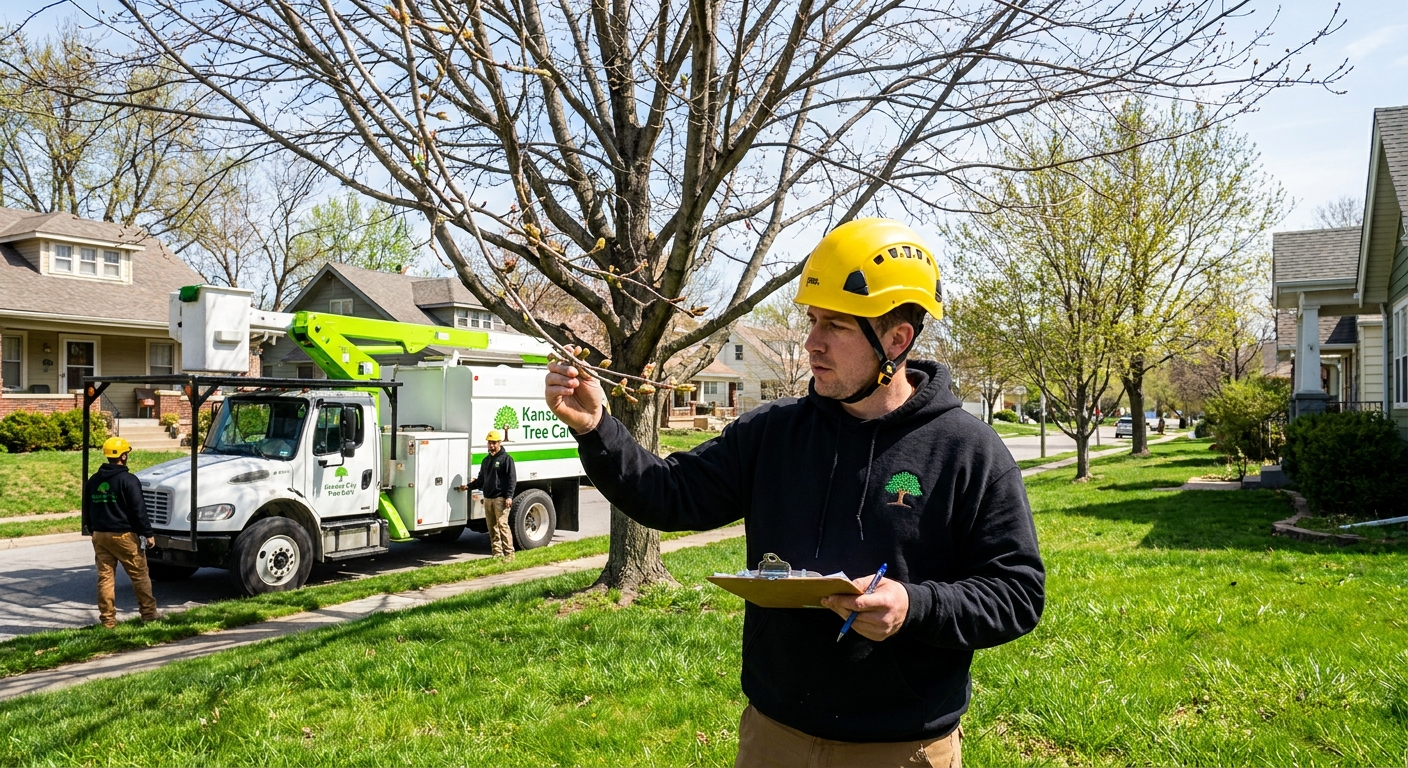
The first thing to look at is whether your trees are actually waking up the way they should. In Kansas City, KS, most species start breaking bud between late March and mid-April. By the first week of May, you should see significant leaf-out on healthy trees.
Walk around each tree and compare branches on different sides. Healthy trees leaf out evenly and fully. A few things that should get your attention:
- One side leafing out and the other staying bare — often a sign of root damage or vascular disease on the bare side
- Delayed bud break by more than 2-3 weeks compared to neighboring trees of the same species
- Leaves emerging small, curled, or yellowed — can point to stress, nutrient deficiency, or early disease
- Dead branch tips with no buds at all — winter dieback that needs to come out
We see delayed leaf-out constantly on pin oaks in Kansas City, KS. Our alkaline clay soil ties up iron, which causes iron chlorosis — yellow leaves with green veins. Catching it in April means you have time to treat it before the heat of summer compounds the stress.
Inspect the Bark and Trunk
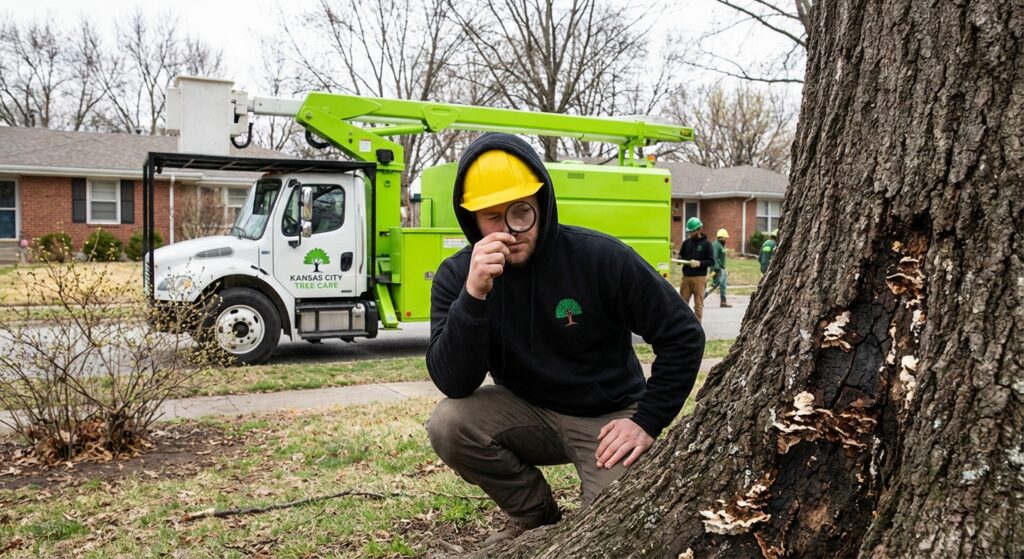
Bark tells the story of the last 12 months. Spring is when you can see it clearly, before the leaf canopy blocks your view. Walk a slow circle around each major tree and look at the trunk from the root flare all the way up as far as you can see.
Look for:
- Vertical cracks or splits — can indicate frost damage, lightning, or structural weakness
- Peeling or loose bark on species that don’t naturally shed (most oaks, maples, ash)
- Small D-shaped exit holes — classic signature of emerald ash borer on ash trees
- Sap bleeding or dark staining — often a sign of borers or bacterial infection
- Mushrooms or conks at the base — a strong indicator of internal decay
- Girdling roots wrapping around the trunk at soil level
Bark issues are one of those things where a photo goes a long way. If you see something that looks off but aren’t sure, snap a picture and text it to us. We can usually tell you within an hour whether it needs immediate attention.
Remove Deadwood Before It Comes Down on Its Own
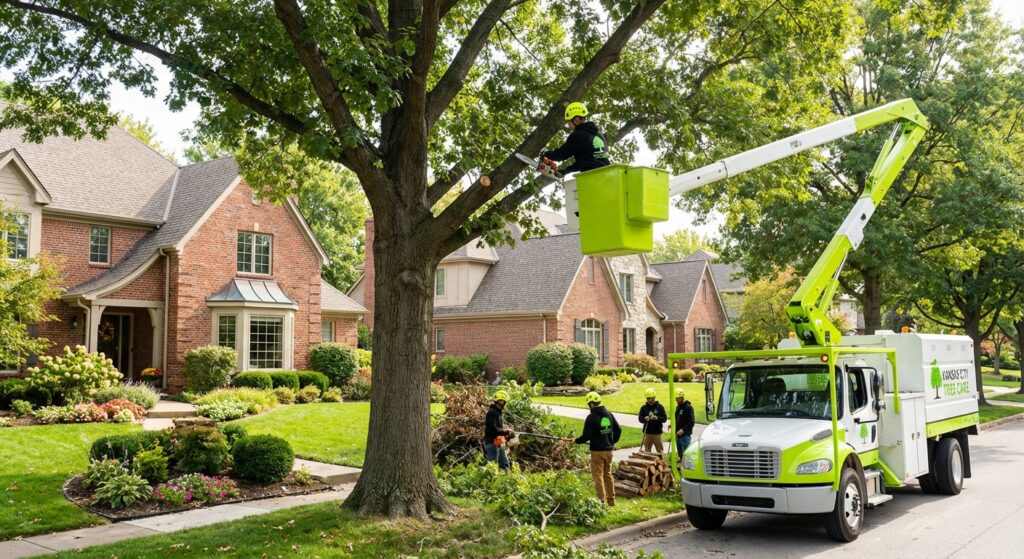
Every winter, Kansas City, KS deals with ice, wet snow, and wind. By April, there’s always deadwood hanging in the canopy. Sometimes it’s a few twigs. Sometimes it’s a 4-inch limb hanging 30 feet up, waiting for the next storm to drop it on your deck.
Small deadwood — pencil-sized to maybe thumb-sized, within easy reach — you can prune yourself with hand pruners or a pole saw. Cut just outside the branch collar (the raised ring where the branch meets the trunk). Don’t leave stubs, and don’t cut flush.
Anything bigger than about 2 inches in diameter, or anything more than 10-12 feet off the ground, is when we recommend bringing in a professional. Professional tree trimming in April and May typically runs $350-$900 for a mid-sized yard tree, depending on size, reach, and how much work is needed.
The reason we push spring deadwood removal hard is timing. KC’s severe weather season runs late April through June. Every dead branch still in the canopy is a projectile waiting for the next thunderstorm. Getting it out early is the cheapest insurance you can buy.
Refresh Your Mulch — the Right Way
Mulch is one of the most underrated tools for tree health, and it’s also one of the most commonly misused. Every spring we see the same mistake across Kansas City, KS: mulch volcanoes piled 6-10 inches deep right up against the trunk.
That’s actually damaging. Mulch against the trunk holds moisture against the bark, invites fungal decay, encourages girdling roots, and creates hiding spots for borers and rodents. We’ve removed young maples in Kansas City, KS that died entirely because of mulch volcanoes around the base.
Here’s the rule we give every customer:
- 2-3 inches deep — no more
- Pulled back 3-4 inches from the trunk — the root flare should always be visible
- Spread out to the drip line if possible — that’s where the feeder roots live
- Use natural hardwood mulch — avoid dyed mulches and rubber mulch
A good mulch ring around a mature tree costs $40-$80 in bagged mulch from a local garden center, or $150-$300 delivered and installed if you’d rather have a crew handle it along with other spring work.
Consider Deep Root Fertilization for Stressed Trees
Kansas City, KS has tough soil for trees. Heavy clay, high pH, and compaction from decades of development mean many urban trees live in a constant state of low-grade nutrient stress. Spring is the window when fertilization actually helps, because trees are putting energy into new growth.
Deep root fertilization is different from sprinkling fertilizer on the lawn. A certified arborist injects a liquid nutrient mix 6-12 inches into the soil around the drip line, using a probe that also aerates the root zone. The tree gets nutrients where it can use them, and the compaction around the roots gets relieved at the same time.
We recommend it for:
- Trees showing yellowing leaves (chlorosis) — especially pin oaks and river birches
- Young trees (first 3-5 years after planting) that are still establishing
- Mature trees recovering from storm damage or construction disturbance
- Any tree growing in a small hell strip or surrounded by pavement
Cost for deep root fertilization in Kansas City, KS typically runs $100-$250 per tree, depending on size. Most homeowners do it every 2-3 years on stressed trees. Healthy trees in good soil don’t need it.
Kick Off Your Watering Schedule
Most homeowners think about watering trees in July when everything’s brown. By then, you’re already behind. The watering schedule that keeps trees healthy through a KC summer actually starts in May, while the soil still has some spring moisture.
For established trees, deep watering once every 10-14 days through May is usually enough. That means running a slow hose or soaker at the drip line for 30-45 minutes, letting the water soak 8-12 inches into the soil.
For newly planted trees (first 2-3 years), the schedule is much more aggressive — deep watering every 3-5 days starting in May. If you’ve got a tree you planted in the last couple years, check out our guide on watering new trees in Kansas City summer heat for the full schedule.
Clay soil adds a wrinkle. It holds water longer than sandy soil, but it also compacts and sheds water when dry. Watering slowly is critical — a blast from the hose mostly runs off. A soaker hose on a timer is hands-down the easiest way to keep KC clay soil happy.
Watch the Oak Wilt Window: April 15 to July 15
This one’s critical for anyone with oak trees in Kansas City, KS. Oak wilt is a vascular disease spread by sap-feeding beetles that are most active from mid-April through mid-July. The beetles are attracted to fresh wounds on oak trees — and once they carry the fungus into a healthy oak, the tree usually dies within one season.
The rule we follow, and the one the Kansas Forest Service recommends: do not prune oak trees between April 15 and July 15. If a storm damages an oak during that window and pruning can’t wait, the wound should be sealed with tree paint immediately — the only time we use tree paint at all.
Oak wilt has been confirmed in Wyandotte, Johnson, and Leavenworth Counties. Red oak group trees (pin oak, red oak, shumard oak, scarlet oak) are most vulnerable and usually die quickly once infected. White oaks (bur oak, white oak, swamp white oak) are more resistant but can still be damaged.
If you need oak work done, schedule it for early April or wait until mid-July. For any oak showing sudden wilting, bronzing leaves, or rapid defoliation between May and August, call for a hazardous tree evaluation immediately. Quick action on a neighboring oak can sometimes save it from the same fate.
Check Young Tree Stakes and Guy Wires
If you planted a tree in the last 2-3 years, spring is when you check the support hardware. Stakes, straps, and guy wires should come off as soon as the tree can stand on its own — usually after one or two growing seasons.
Left on too long, staking material does real damage:
- Straps grow into the bark and girdle the trunk
- Tight staking prevents the trunk from developing natural taper and strength
- Metal wires cut through bark and create entry points for borers and disease
Walk out to each young tree and gently push the trunk. If it flexes naturally and springs back, it’s ready to come off its stakes. If there’s visible bark damage where a strap has been sitting, clean it up and leave the strap off permanently. A tree bark wound from a forgotten stake can take years to heal, and it’s a weak point for storm damage down the road.
Scout for Early Pest and Disease Signs
April and May are when the big three pests in Kansas City, KS start showing up. Catching them early makes treatment easier and cheaper.
Emerald ash borer (EAB): If you have an ash tree, check for thinning in the upper canopy, D-shaped exit holes in the bark, and heavy woodpecker activity. EAB is present throughout the KC metro, and treatment is only effective if the tree has more than 50% of its live canopy remaining.
Bagworms: On evergreens (especially arborvitae, juniper, and spruce), look for small spindle-shaped bags hanging from branches. May is when they hatch and begin feeding. Treatment timing is narrow but effective.
Tent caterpillars and webworms: Silk tents in the crotches of branches, usually on cherry, crabapple, and wild plum. Easy to prune out early in the season before they defoliate the tree.
For any of these, our ISA certified arborists can confirm identification and recommend a treatment plan. Most pest issues caught in April or May are manageable with targeted treatment rather than removal.
Plan Any Major Work Before Summer Hits
One thing we tell every homeowner: if you know a tree needs to come down, or needs significant structural pruning, spring is the best time to schedule it. By June, our calendar is packed with storm response work, and lead times can stretch to 4-6 weeks.
April and May are the sweet spot for:
- Removing a tree you’ve been putting off
- Structural pruning on a young tree to build good form
- Cabling and bracing on a valuable tree with a weak union
- Stump grinding on stumps from last year’s removals
Booking ahead also means better pricing. The worst storms of the year haven’t hit yet, so crews aren’t slammed. For routine work scheduled in April, you’ll often get a faster response and lower cost than the same job booked in July. If you’re looking for reliable tree service in Kansas City, getting on the calendar early is the smartest thing you can do in spring.
Frequently Asked Questions
When is the best time to prune trees in Kansas City, KS?
Late winter (February to early March) is ideal for most species — trees are dormant, disease pressure is low, and cuts heal fast once spring growth starts. April is still a good window for most trees except oaks, which should not be pruned between April 15 and July 15 because of oak wilt risk. Light cleanup pruning can be done anytime.
How much does a spring tree assessment cost in Kansas City, KS?
Our basic property walkthrough and tree health assessment is free — we come out, look at your trees, and give you a written recommendation. A detailed arborist report for insurance, real estate, or legal purposes runs $150-$350 depending on the number of trees and level of documentation needed.
Should I fertilize all my trees every spring?
No — healthy mature trees in decent soil usually don’t need fertilizer, and over-fertilizing can actually push too much tender growth that’s vulnerable to pests and storm damage. Fertilization is most useful for young trees (first 3-5 years), stressed trees showing chlorosis, and trees recovering from storm or construction damage. A soil test or arborist assessment will tell you whether your trees actually need it.
Is it okay to plant a new tree in April in Kansas City, KS?
Yes — mid-March through late May is an excellent planting window for most species in Kansas City, KS. The ground is workable, the soil has moisture, and trees have a full growing season to establish before summer heat. Avoid planting in July and August, when heat stress makes establishment much harder.
Do I need a permit to remove a tree in Kansas City, KS?
For trees on your own private property in Kansas City, KS, you generally don’t need a permit. Trees in the right-of-way (between the sidewalk and street) are usually city-owned and require coordination with Kansas City, KS Parks and Recreation before removal. We handle the permit process for any work in the right-of-way.
What if I find a damaged tree after a spring storm?
For immediate hazards — trees on structures, power lines, or blocking roads — call our 24/7 emergency tree service right away. For non-emergency storm damage (broken limbs, leaning trees, split trunks), get photos for insurance before any cleanup and schedule a hazardous tree evaluation within a few days. Most spring storm damage can be cleaned up safely within a week.
A Little Spring Work Pays Off All Year
Spring is the one time of year when a couple of hours walking your property can prevent months of problems. Catching a cracked limb, a mulch volcano, or an early borer hit in April is cheaper and easier than dealing with the consequences in August.
We’ve been providing Kansas City tree service for over 35 years, and our crew is ISA certified, BBB accredited, and fully licensed and insured. Whether you want a free walkthrough, a round of spring pruning, or a full care plan for a property full of mature trees, we’re happy to take a look and tell you what we’d actually recommend.
Call Kansas City Tree Care at 913-894-4767 for a free estimate. No pressure, no obligation — just straight answers from a crew that knows Kansas City, KS trees.