The Single Most Important Job for a Young Tree in Kansas City
You spent $400 on a nice serviceberry last spring. Maybe $700 on a bur oak. Now it’s the end of July, Kansas City is three weeks into a 95-degree heat stretch, and the leaves on your young tree are drooping and crispy at the edges. What do you do?
Here’s the honest answer: the tree is telling you exactly what it needs. Water — but not the way most homeowners think. A daily sprinkler spray isn’t helping, and a garden hose for two minutes isn’t either. Young trees in Kansas City need deep, slow, infrequent watering, and the difference between doing it right and doing it wrong is usually the difference between a thriving tree and a $600 replacement.
Our crew at Kansas City Tree Care has planted and cared for thousands of young trees across the metro. This is the exact watering guide we give every customer who plants a new tree, tuned for our clay soil, our summer heat, and our erratic spring-to-fall moisture patterns.
Why Young Trees Need So Much More Water
A freshly planted tree in Kansas City has lost most of its root system during the nursery process. Even a well-grown ball-and-burlap tree retains only 5-15% of its original roots after digging and transplanting. That tiny root mass has to support the entire canopy above ground.
For the first 2-3 years, the tree is rebuilding its root system from scratch while also trying to keep its leaves alive. Every dry spell sets it back. Every prolonged drought — and Kansas City gets plenty of those — can kill it.
Established trees (5+ years after planting) have root systems extending well beyond the drip line and can usually pull moisture from deep soil reserves. Young trees can’t. Their roots are still within a 2-3 foot radius of the trunk, living in the original root ball plus a little bit of surrounding soil. Until that root system spreads out, you are the tree’s weather backup.
Deep Watering vs. Sprinkler Spray: The Big Mistake
The number one mistake we see on young trees in Kansas City is treating them like grass. A sprinkler running for 15 minutes every morning keeps the top half-inch of soil damp. It does almost nothing for tree roots, which need water 8-12 inches deep.
Worse, shallow watering trains roots to grow near the surface, where they’re the first to dry out in a heat wave. You end up with a tree that needs constant watering because its own root system is vulnerable.
Deep watering means running a slow stream of water at the base of the tree long enough for moisture to soak 8-12 inches into the soil. In Kansas City clay, that typically takes 30-60 minutes per watering session with a slow-running hose or soaker.
The math is simple. You want to deliver:
- 5 gallons per watering for a 1-inch caliper tree (small nursery stock)
- 10 gallons per watering for a 2-inch caliper tree
- 15 gallons per watering for a 2.5-3 inch caliper tree
- 20+ gallons per watering for larger balled-and-burlapped trees
That’s per watering session, not per day. Deep and slow is the rule. If you’re curious about first-season care in general, our guide to best trees to plant in Kansas City this spring covers species selection alongside establishment care.
Watering Frequency for Kansas City Summer
Here’s the watering schedule we recommend for newly planted trees in Kansas City, KS. Adjust up for extreme heat, down for rainy stretches.
Year 1 (first 12 months after planting):
- May: every 5 days
- June: every 3-4 days
- July: every 2-3 days
- August: every 2-3 days
- September: every 4-5 days
Year 2:
- May: every 7-10 days
- June: every 5-7 days
- July-August: every 4-6 days
- September: every 7-10 days
Year 3:
- Once a week during dry stretches — otherwise let nature handle it, except during prolonged drought
Skip or reduce watering when you’ve gotten 1 inch or more of rain in a 3-day window. Over-watering a young tree is as dangerous as under-watering. Clay soil holds moisture long after the surface looks dry.
The Tuna Can Test and Other Simple Measurement Tricks
You don’t need a soil moisture meter or any fancy gear to water trees correctly. A few simple tricks work perfectly well.
The tuna can test: Place an empty tuna can (about 1 inch tall) near the tree while you water with a hose or sprinkler. When the can is full, you’ve delivered about 1 inch of water over that spot — usually enough for one deep watering session when it soaks into clay soil.
The screwdriver test: After watering, push a long screwdriver or garden stake straight down into the soil near the drip line. If it slides in easily to 8-10 inches, you’ve watered deeply enough. If it stops at 2-3 inches, the water is still sitting on the surface and hasn’t penetrated.
The finger test: Dig a small hole 4-6 inches deep near the root ball. If the soil at the bottom is damp but not muddy, moisture is right. If it’s bone-dry, you need to water. If it’s sopping wet, you’re overwatering.
We use the screwdriver test on every job site. It’s cheap, fast, and more accurate than any meter you’d buy for under $50.
Three Watering Methods That Actually Work
Depending on your setup and how much you want to fuss with watering, any of these three methods work well for young trees in Kansas City, KS.
Method 1: Soaker hose loop
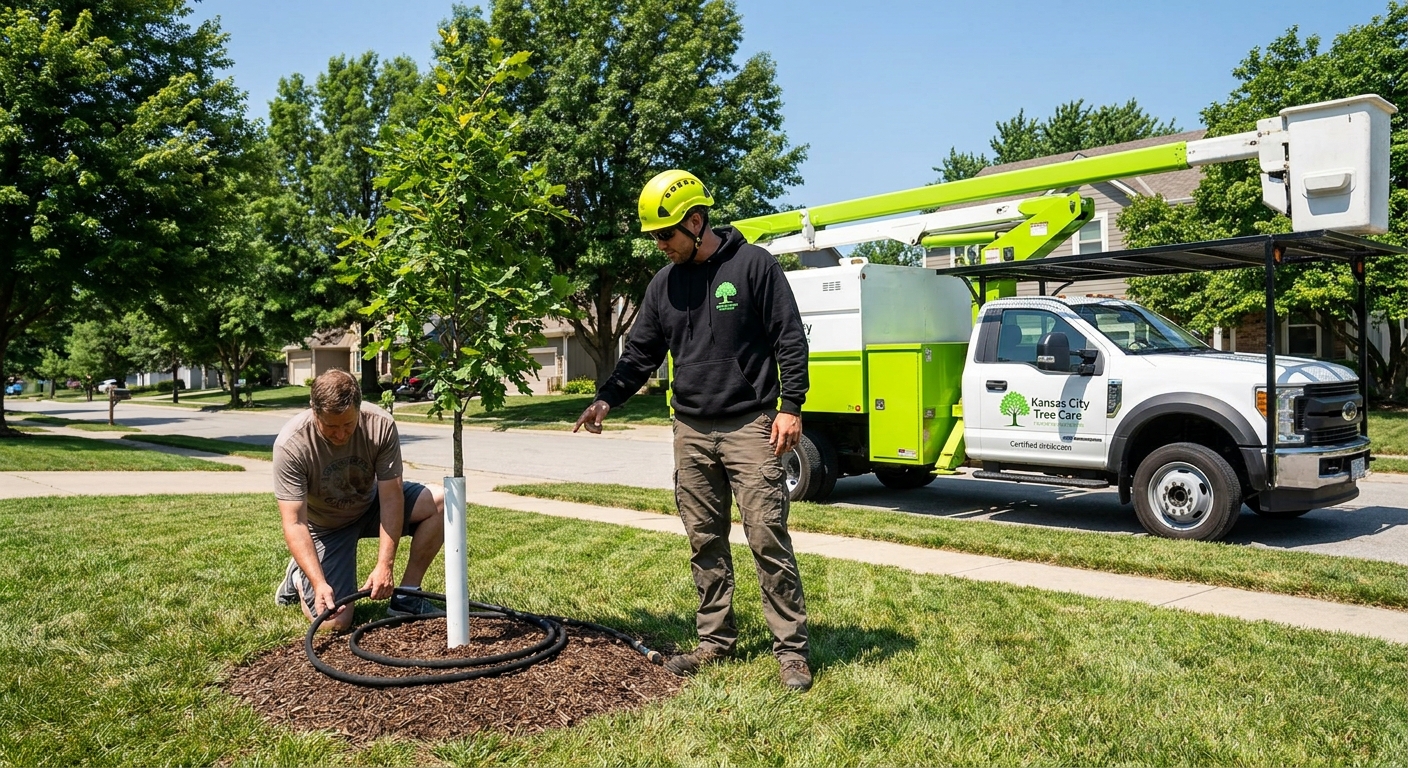
- Coil a soaker hose around the tree in a spiral, starting 6 inches from the trunk and extending out to the drip line
- Run on low pressure for 30-45 minutes per watering
- Best for: people who want set-it-and-forget-it, and for properties with multiple young trees
- Cost: $15-$30 per soaker hose
Method 2: Tree watering bag (Ooze Tube, Treegator)
- Bag wraps around the trunk and releases 15-20 gallons over 5-9 hours
- Refill every 3-5 days during summer
- Best for: newly planted trees in the first year, especially if you travel or forget
- Cost: $25-$45 per bag; reusable for 3-5 years
Method 3: 5-gallon bucket drip method
- Drill 2-3 small holes (1/8 inch) in the bottom of a 5-gallon bucket
- Place next to the tree, fill with water, let it drip slowly over 30-60 minutes
- Repeat 2-3 times per session for larger trees
- Best for: budget setups, single young trees, renters who don’t want to invest in hoses
- Cost: essentially free if you have a bucket
Whichever method you use, place a 2-3 inch mulch ring around the tree extending out to the drip line, pulled back 3-4 inches from the trunk. Mulch retains moisture, moderates soil temperature, and cuts your watering frequency by 30-40% in peak summer.
Signs of Overwatering vs. Drought Stress
Both overwatered and under-watered trees look stressed. Here’s how to tell them apart — the treatment is completely different.
Signs of drought stress:
- Leaves curling or folding along the midrib
- Leaf edges turning crispy brown (marginal scorch)
- Leaves wilting in the afternoon but recovering overnight
- Yellowing and early leaf drop
- Top of soil bone-dry, deeper soil also dry on the screwdriver test
Signs of overwatering:
- Yellowing leaves that stay soft (not crispy)
- Leaves dropping while still green
- Mushrooms or fungus growing at the base
- Soil stays soggy for more than 24-48 hours after watering
- Foul, sour smell from wet soil at the root zone
- Leaves wilting even though soil is saturated (a sign of root rot)
Overwatering is especially common in Kansas City’s clay soil. Clay drains slowly, and a tree sitting in wet clay for days at a time develops root rot. If in doubt, skip a watering and let the soil dry out a bit before the next session.
Best Time of Day to Water Young Trees
Early morning is the gold standard. Starting your watering between 5 AM and 9 AM gives the tree the full day to absorb moisture before evening, minimizes evaporation loss, and reduces the risk of fungal issues on leaves or bark.
Second best: early evening, after 6 PM, when temperatures have dropped but there’s still time for leaves to dry before dark.
Avoid: midday watering (high evaporation) and nighttime watering (wet foliage overnight can encourage disease).
If you can only water once a day during a heat wave, morning wins. A 30-minute soaker session at sunrise delivers more usable moisture to the tree than the same session at 2 PM in 95-degree heat.
Clay Soil in Kansas City and What It Means for Watering
Most of the KC metro — especially in Wyandotte and Johnson County — sits on heavy clay soil. Clay presents two challenges for young tree care:
Challenge 1: Slow absorption. A fast blast of water from the hose mostly runs off dry clay rather than soaking in. That’s why we push slow application so hard. Let the water trickle in over 30+ minutes and it will actually reach the root zone.
Challenge 2: Slow drainage. Once clay is wet, it stays wet. Over-watering causes root rot fast. A tree in clay soil typically needs watering less often than a tree in sandy soil — but when you do water, you need to water deeply.
The practical rule: water longer and less often in KC clay. A 45-minute soaker session every 3-4 days works better than a 15-minute spray every day. For stressed or established trees beyond the young-tree window, ISA certified arborists often recommend deep root watering and fertilization combined — a single service that addresses both compacted soil and moisture delivery.
Watering During KC Burn Bans and Water Restrictions
Kansas City, KS and surrounding municipalities occasionally issue voluntary or mandatory water restrictions during drought. Most restrictions allow:
- Hand-held hose watering of trees and shrubs
- Drip irrigation and soaker hoses (low-volume methods)
- Watering at specific times of day (usually early morning or evening)
Most restrictions prohibit:
- Sprinkler systems for lawns during daytime hours
- Watering on even/odd days based on address
Young trees are specifically protected under most restrictions — they fall into the same category as “newly established plant material” that’s exempt from lawn-watering rules. If you’re unsure what applies, call the city. Losing a young tree to drought is avoidable, and most utilities understand that.
The Cost of Losing a Young Tree vs. Saving One
A young tree that dies in its first two years has to be removed and replaced. The combined cost of removal and replacement in Kansas City, KS typically runs:
- Removal of a dead young tree: $150-$400
- Stump removal (if needed): $100-$250
- Replacement tree (2-inch caliper, installed): $350-$750
- Total cost of replacement: $600-$1,400
Compare that to the cost of proper watering — a $25 soaker hose and about 30 minutes of your time twice a week for two summers. The math isn’t close.
If you’ve got a struggling young tree and aren’t sure whether it’s worth saving, a quick visit from one of our arborists will give you a straight answer. Sometimes a stressed tree recovers beautifully once watering is corrected. Sometimes the damage is too far along and replacement is the smarter call. Either way, we’ll tell you the truth. That’s part of what good professional tree trimming and care services should include — honest assessment, not just more billable work.
Frequently Asked Questions
How much water does a newly planted tree in Kansas City need per week?
In peak summer (June through August), a newly planted 2-inch caliper tree needs about 10 gallons of water, 2-3 times per week — roughly 20-30 gallons total per week. Larger trees need more; smaller trees need less. Reduce watering after rainfall of 1 inch or more.
Can I use my lawn sprinkler to water young trees?
It’s not ideal. Lawn sprinklers apply water fast and shallow, which is what turf wants but not what tree roots need. If a sprinkler is your only option, run it for 45-60 minutes over the tree’s root zone on a designated watering day — long enough to soak deep. A soaker hose or tree bag will work much better.
Do I need to water established trees in Kansas City summer?
Usually only during extended drought. Established trees (5+ years after planting) generally handle normal Kansas City summers without supplemental water. During prolonged dry stretches of 3+ weeks with no significant rain, a deep watering every 2-3 weeks helps reduce drought stress on mature trees.
What’s the cost of tree bags vs. soaker hoses for watering?
Tree bags run $25-$45 per bag and last 3-5 seasons. Soaker hoses run $15-$30 each and can cover multiple trees if looped. For a single tree, a bag is the easiest option; for multiple trees or a long-term setup, soaker hoses are cheaper per tree.
Can overwatering really kill a young tree in Kansas City?
Yes, and it happens more often than people realize. Clay soil drains slowly, and a young tree sitting in saturated clay for days develops root rot. Signs include yellow-but-soft leaves, mushrooms at the base, and wilting despite wet soil. If you see these signs, stop watering for a week and let the soil dry.
When can I stop watering a young tree in Kansas City?
Most species are considered fully established 2-3 years after planting, at which point supplemental watering becomes optional except during drought. Large-rooted species like bur oak may need an extra year. The best indicator is vigorous growth: when a young tree puts on 12+ inches of new growth annually with no watering, it’s established.
Keep Your Young Trees Alive and They’ll Repay You for Decades
A young tree that makes it through its first three Kansas City summers with good watering will typically thrive for 40-100 years or more, depending on species. That’s decades of shade, property value, stormwater control, and curb appeal from a tree that cost you $25 worth of soaker hoses and a handful of Saturday mornings.
Our crew has been providing tree care in Kansas City for over 35 years, and we’re ISA certified, BBB accredited, and fully licensed and insured. Whether you want a quick site visit to evaluate a struggling young tree, a deep root treatment for a stressed mature tree, or help picking and planting the right species for your property, we’re happy to take a look.
Call Kansas City Tree Care at 913-894-4767 for a free estimate. No pressure, no obligation — just honest advice from a crew that’s been keeping Kansas City trees alive for three generations.