When the Sirens Stop, Here’s What Comes Next
If you’re reading this after a tornado or severe thunderstorm rolled through the Kansas City metro, take a breath. The worst part is over. Now comes the part where decisions made in the next 24-48 hours either save you thousands of dollars or cost you thousands — and most of those decisions involve the trees on your property.
Our phones light up every May and June. The 2019 Linwood tornado, the 2024 Johnson County storms, the rolling derechos that sweep through Wyandotte County every few springs — we’ve worked them all. Over 35 years, our crew has cleaned up thousands of storm-damaged trees across Kansas City.
Here’s the good news. Most homeowners handle the aftermath well when they know the right order of operations. This guide walks you through it — safety first, then documentation, then smart decisions about what comes down, what gets saved, and who you let onto your property.
First 30 Minutes: Safety Before Anything Else
The moment you step outside after a severe storm in Kansas City, your only job is threat assessment. Do not touch any tree, limb, or brush until you’ve cleared these hazards:
- Downed power lines — assume every wire on the ground is live. Stay at least 35 feet away and call Evergy at 1-888-LIGHTKC (1-888-544-4852) immediately
- Trees or limbs touching any wire — the entire tree may be energized. Do not approach or cut anything
- Gas meters and gas lines — if you smell gas near fallen trees, evacuate and call Spire at 1-800-582-9644
- Structural damage to your home — if a tree is on your roof or against a wall, stay out of rooms directly underneath until a professional assesses the load
- Hanging limbs overhead — look up before you walk anywhere. Widowmakers can drop hours or days after a storm
Wyandotte County and Johnson County both have storm response protocols that prioritize power line clearance. Until Evergy flags a tree as de-energized, no tree company — including ours — can legally touch it. That’s not red tape, it’s what keeps crews alive.
If it’s nighttime, don’t try to assess damage with a flashlight. Wait until daylight. The number of injuries we see from homeowners stepping on nails, tripping over debris, or walking into low branches in the dark is higher than you’d think.
Document Everything Before You Clean Anything
This is the single most important step for your insurance claim, and it’s the one homeowners skip most often. Before any branch gets moved, any chainsaw starts, or any crew shows up, you need documentation.
What to capture:
- Wide shots from multiple angles — show the whole tree, the damage, and the surrounding property
- Close-ups of any structural damage — roof, siding, fence, vehicles, outbuildings
- Video walkaround — a 2-3 minute video with voice narration is gold for adjusters
- Timestamp everything — your phone does this automatically; leave that metadata intact
- Photos of the street and neighborhood damage — establishes the storm event
If the tree is actively threatening more damage — a limb swinging against the roof, water pouring into an open ceiling — call your insurance company’s 24-hour line first. Most policies allow emergency mitigation work without pre-approval as long as you document the damage before mitigation begins.
Save every receipt from the moment the storm hits. Tarps, plywood, emergency hotel stays, bottled water, replacement food from a dead freezer — all of it is potentially reimbursable under a standard homeowner’s policy.
What Emergency Tree Removal Actually Costs in Kansas City
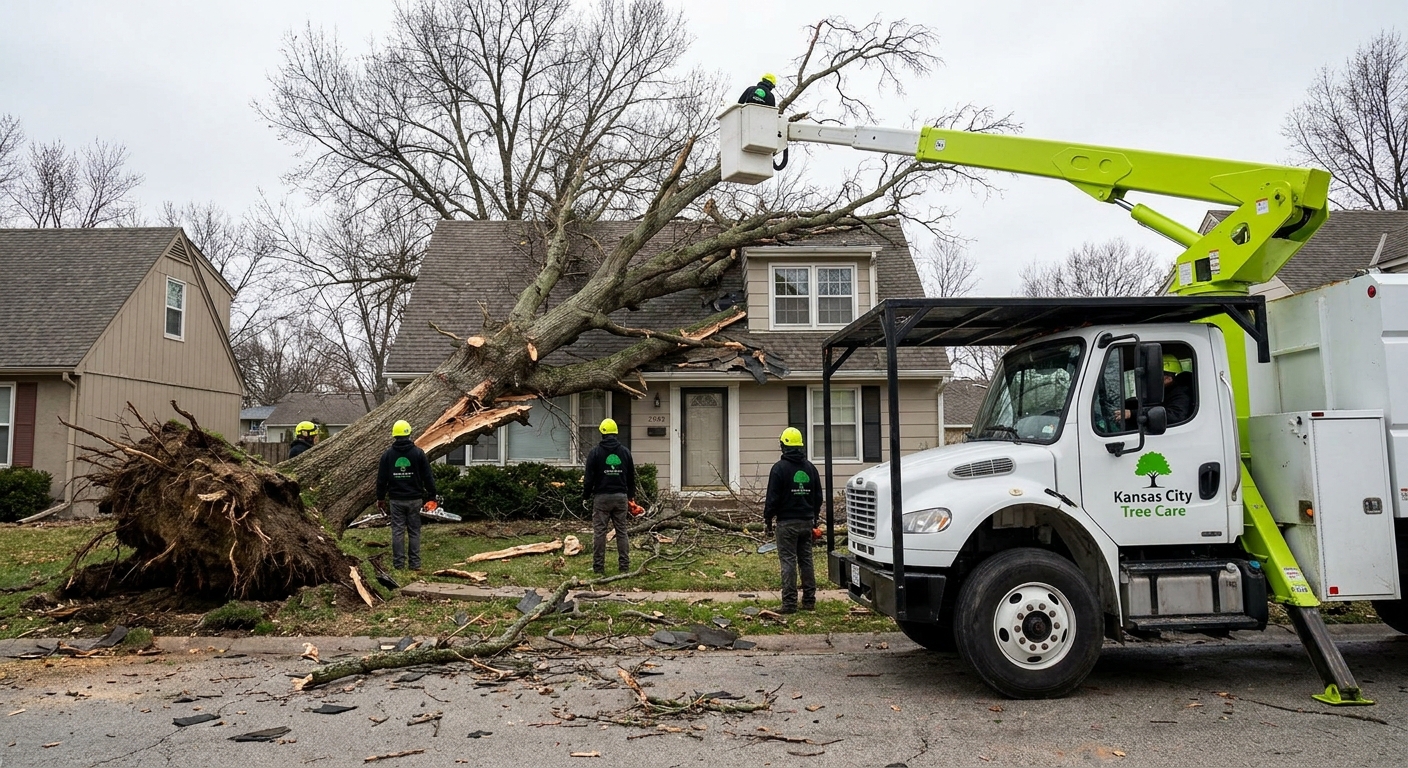
Emergency tree work costs more than scheduled tree work. It has to — crews are working long hours, often at night, under hazardous conditions, with equipment that’s already been running hard. Here’s what honest pricing looks like for storm-damaged trees in the KC metro:
- Tree on house, limb removal only: $1,500-$3,500
- Tree on house, full removal: $2,500-$5,000+
- Tree on vehicle or outbuilding: $1,200-$3,500
- Large tree blocking driveway or street: $800-$2,500
- Hanging limbs or widowmakers: $350-$1,200 per tree
- Uprooted tree, no structural contact: $1,000-$3,000
- Multi-tree emergency job (10+ trees): typically priced as a project — $8,000-$25,000+
A few factors push those numbers up. Crane work — needed when a tree is too tangled in a structure for conventional rigging — adds $1,200-$3,000 to a job. Nighttime or holiday response adds 20-40% to the base rate. Trees that have to be cut in sections and lifted over a house cost significantly more than trees that can simply fall into an open yard.
The honest answer most homeowners want: when the tree is on the house or actively hazardous, skip the bidding war and get one reputable crew on-site fast. The cost difference between the cheapest and most expensive quote is usually small compared to what another day of water intrusion or structural load can do.
Save or Remove? How We Evaluate a Damaged Tree
Not every storm-damaged tree needs to come down. Sometimes the damage looks catastrophic but the tree has a good chance of recovering. Other times a tree looks mostly intact but has taken structural damage that makes it dangerous. Here’s the framework our arborists use:
Likely saveable:
- Less than 25% of the canopy lost
- Main leader and major structural branches intact
- No visible trunk cracks or splits
- Root plate undisturbed (no soil heaving)
- Species known for good wound recovery (oaks, hackberry, linden)
Consider cabling or bracing:
- Split or weakened union between two large stems
- High-value specimen tree with structural weakness
- Tree with sentimental or shade value worth preserving
Removal recommended:
- More than 50% of the canopy lost
- Trunk split or cracked vertically
- Root plate lifted or partially uprooted
- Main leader broken in a species that doesn’t recover well (silver maple, Bradford pear, cottonwood)
- Tree leaning toward a target (house, power line, neighbor’s property)
For borderline cases, cabling and bracing can extend a valuable tree’s life by 10-20 years. It’s a real alternative to removal when the tree is structurally compromised but not a lost cause. Cost ranges from $400 to $1,500 per tree depending on complexity.
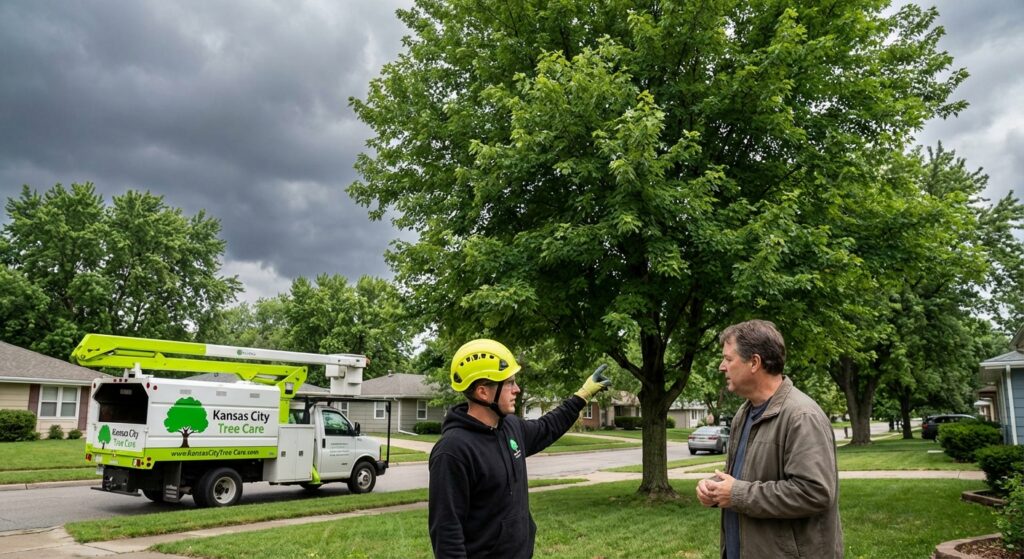
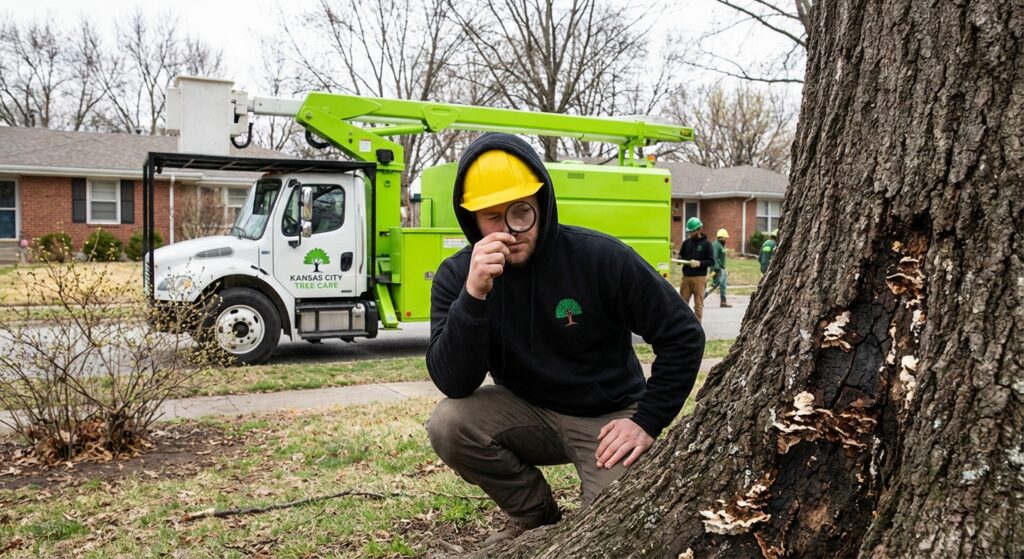
An honest hazardous tree evaluation is the right first step. Our certified arborists will tell you when a tree should come down, when it can be saved, and when you should get a second opinion before spending money on either option.
Typical Response Timeline After a Major KC Storm
Every major storm event in Kansas City follows a similar arc. Knowing where you fit in the timeline helps you set realistic expectations.
Hours 0-12: Emergency calls only. Trees on structures, power line conflicts, road-blocking trees. Our crews prioritize life-safety situations.
Day 1-3: High-priority non-emergency work. Trees leaning toward homes, large uprooted trees, hanging widowmakers over occupied areas. Expect 24-72 hour response times for these.
Day 3-10: General storm cleanup. Yard trees fully down, debris clearing, moderate damage. Response times typically 3-7 days.
Week 2-4: Deferred work. Structural pruning on damaged trees, stump grinding, replanting consultations. Normal scheduling resumes.
The biggest lesson we can share after 35 years of storm response in Kansas City: call early, take the earliest available appointment, and don’t keep shopping for a cheaper price while the damage compounds. Every day water pours into a damaged roof, your claim total goes up and your insurance coverage doesn’t.
When you need fast, reliable emergency tree service in Kansas City, we run 24/7 response crews with the equipment and experience to handle whatever the storm left behind.
Avoiding Storm Chasers and Door-to-Door Scammers
Within 12 hours of any major storm, out-of-state “storm chaser” crews roll into the Kansas City metro. Some are legitimate. Most are not. Every single tornado in Wyandotte or Johnson County is followed by the same pattern — unmarked trucks, high-pressure sales, cash-only demands, and jobs left half-done.
Red flags to watch for:
- Knocks on your door with no appointment — legitimate Kansas City tree companies are slammed after storms and have no time for door-to-door sales
- Out-of-state plates and no local business presence — if they can’t point to a physical address in the metro, be cautious
- Demands for large cash deposits up front — reputable companies invoice after work is done or take a small deposit
- No written estimate, just verbal pricing — always get the scope and price in writing
- No proof of insurance — ask for a certificate of insurance naming your property. A real company will have it ready
- Pressure to sign immediately — “this price only good today” is a scam tactic
Verify the company you hire. Search their business name on the Kansas Secretary of State website. Check BBB accreditation. Call references. Our crew at Kansas City Tree Care is BBB accredited, ISA certified, and carries full liability and workers’ comp insurance — the baseline you should expect from any crew you let onto your property.
Insurance Claims: Deductibles, Coverage, and Paperwork
Standard homeowner’s insurance in Kansas and Missouri covers tree damage under specific conditions. Understanding what’s covered keeps you from paying for things insurance should handle.
Typically covered:
- Trees falling on your home, garage, shed, or fence
- Trees falling on vehicles (under comprehensive auto coverage, not homeowner’s)
- Emergency tree removal to prevent further damage
- Removal of trees blocking driveways or entries
- Structural damage from impact
Typically not covered:
- Removal of trees that fell in the yard but didn’t hit anything
- Damage from a tree you knew was dead or hazardous before the storm
- Replacement cost of the tree itself (most policies pay debris removal only)
- Stump grinding (usually a separate cost)
Most KC metro homeowner policies have a $500 to $1,500 cap on tree debris removal per occurrence, with limits per tree. Deductibles typically run $1,000 to $2,500 for standard wind and hail claims, but some policies have separate — and higher — deductibles for named storms.
Call your insurance agent before approving major work. Ask specifically: What’s my deductible for this claim? Does the policy pay debris removal directly to a contractor, or do I pay and get reimbursed? Are emergency mitigation costs capped?
We work with every major insurance carrier and can provide the itemized estimates, photos, and paperwork adjusters need to process claims quickly. That’s part of what a legitimate Kansas City tree removal company brings to a storm response — not just the work, but the documentation.
What to Do About Damaged Trees Between You and a Neighbor
Kansas City storms don’t respect property lines. A tree on the line between you and the neighbor next door complicates the claim and the cleanup. Here’s how it usually works in Kansas and Missouri:
- A tree that falls on your property is typically your responsibility, regardless of which side of the line the trunk was on — unless the tree was known to be hazardous and the owner was notified in writing
- Property-line trees where the trunk crosses the boundary are jointly owned. Both homeowners need to agree on removal, and the cost is typically split
- Your insurance handles damage to your property — even if the tree came from the neighbor’s yard. The neighbor’s insurance doesn’t pay just because their tree caused the damage
If a hostile property-line dispute is developing, document everything in writing. A quick arborist evaluation with written findings — noting the condition of the tree before the storm — can save years of legal friction.
Cleanup After the Emergency: What Comes Next
Once the immediate hazards are handled, most homeowners still have a few weeks of work ahead. A typical post-storm property needs:
- Hanging limb removal from undamaged trees — widowmakers that got loose but didn’t fall
- Structural pruning on trees that took partial damage but are worth saving
- Stump grinding on trees that had to come down
- Debris hauling and disposal — Kansas City, KS has specific yard waste limits
- Replanting consultations for trees that were a significant part of the property’s canopy
We usually recommend waiting 2-4 weeks after a major storm before doing any non-urgent planning work. It gives you time to see how damaged trees recover, evaluate your canopy honestly, and plan replanting with a clearer head. Good tree care in Kansas City isn’t just emergency response — it’s thinking through the next 5 to 20 years of your property’s canopy.
Frequently Asked Questions
Does insurance pay for tree removal after a tornado in Kansas City?
Yes, when the tree caused damage to an insured structure (home, garage, fence, outbuilding). Most Kansas and Missouri policies cover $500-$1,500 in debris removal per occurrence. Trees that fell in the yard without hitting anything are usually not covered. Call your agent before authorizing major work to confirm coverage and deductible.
How fast can I get emergency tree removal in Kansas City after a storm?
For trees on structures or actively hazardous situations, we run 24/7 emergency response with crews typically on-site within 2-6 hours. Non-emergency storm cleanup response times stretch to 2-7 days after a major event. Call as early as possible — first-in typically gets handled first.
Can a tree leaning after a storm be saved?
Sometimes. A tree leaning 15 degrees or less, with the root plate still intact and no trunk damage, can often be stabilized. Trees leaning more than 15 degrees, with lifted soil at the base, or with visible root damage are usually hazards that need removal. A certified arborist can make the call after a site visit.
Should I hire the first tree company that shows up after a tornado?
Only if they’re a local, insured, reputable company — which is unusual for door-knockers. Most storm chasers who show up unsolicited are out-of-state crews with no local accountability. Take 15 minutes to verify insurance, check BBB, and get a written estimate before signing anything. A legitimate Kansas City tree service will provide all three without hesitation.
What if I can’t afford tree removal but the tree is threatening my house?
Call your insurance company first — emergency mitigation is typically covered under most homeowner’s policies even before your deductible is met, up to the debris removal cap. We can also structure payment plans for larger jobs and prioritize the most urgent work while you sort out the rest. Don’t delay because of cost; delayed emergency work typically costs more, not less.
How do I find the right crew for major storm damage cleanup?
Look for: local address you can visit, BBB accreditation, ISA certified arborists on staff, written proof of general liability and workers’ comp insurance, online reviews from real local customers, and willingness to provide a written estimate. For Kansas City tree service you can trust after a storm, verify all of these before signing any contract.
You Don’t Have to Figure This Out Alone
Severe storms are disorienting, expensive, and emotionally draining. The best thing you can do in the first 48 hours is slow down, document everything, and call a crew you trust before you make any big decisions about what comes down and what stays.
We’ve been the emergency response team for Kansas City tree care for over 35 years. Our crew is ISA certified, BBB accredited, and fully licensed and insured in both Kansas and Missouri. We work with every major insurance carrier and handle everything from single-tree emergencies to multi-property cleanup after tornadoes and derechos.
Call Kansas City Tree Care at 913-894-4767 for a free estimate. If it’s an active emergency, tell the dispatcher — we’ll route you straight to the on-call response crew.