It’s Late May and Your Tree Still Looks Bare — Is It Dead?
You’re standing in your backyard in Kansas City, KS, and everything around you is green. The maples two doors down have full leaves. The oak in the front yard finally pushed out its canopy last week. But that one tree — the one you’ve been worried about since the February ice storm — still looks like winter.
Is it dead? Maybe. Maybe not.
Here’s the honest answer: give it until June 1 before you panic. Some KC metro tree species leaf out late, and a rough winter can delay bud break by several weeks even on healthy trees. But if it’s June and still nothing, it’s time to run a few simple tests — and the results will tell you whether you’re dealing with a dead tree, a partially dead tree, or one that just needed more time.
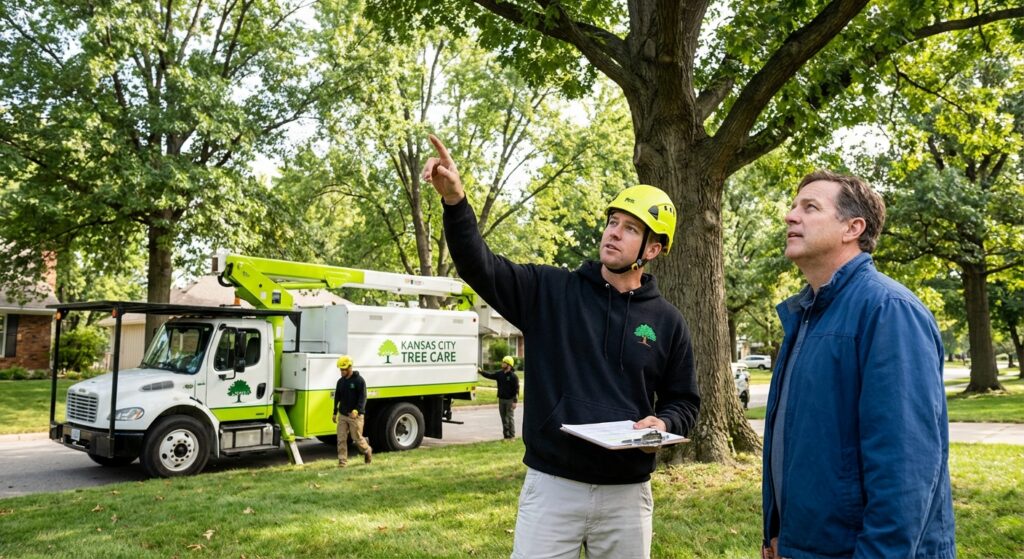
Our crew has inspected thousands of winter-damaged trees across Kansas City over 35+ years. This guide walks you through the same checks we run during a spring hazardous tree evaluation — the leaf-out test, the scratch test, the bud check, the bark inspection — plus what salt damage and root rot actually look like after a tough KC winter.
The Leaf-Out Test: Give It Until June 1
Different species leaf out on different schedules. In the Kansas City metro, here’s the general timing in a normal spring:
- Early leaf-out (late March to mid-April): silver maples, cottonwoods, willows, and most fruit trees
- Mid leaf-out (mid-April to early May): red oaks, pin oaks, hackberry, ash, elm, and most ornamental trees
- Late leaf-out (early to late May): bur oaks, walnuts, catalpa, sycamore, Kentucky coffeetree, and honey locust
- Very late leaf-out (late May to early June): old-growth bur oaks, pecan, and Kentucky coffeetree in shady or cool microclimates
After a harsh winter with prolonged cold snaps — like much of the KC metro has seen the past few years — leaf-out can run 10-14 days late on otherwise healthy trees. That’s stress, not death.
The honest rule: if your tree hasn’t leafed out by June 1 and trees of the same species nearby have, start investigating. Before June, be patient.
The Scratch Test: Is the Cambium Still Alive?
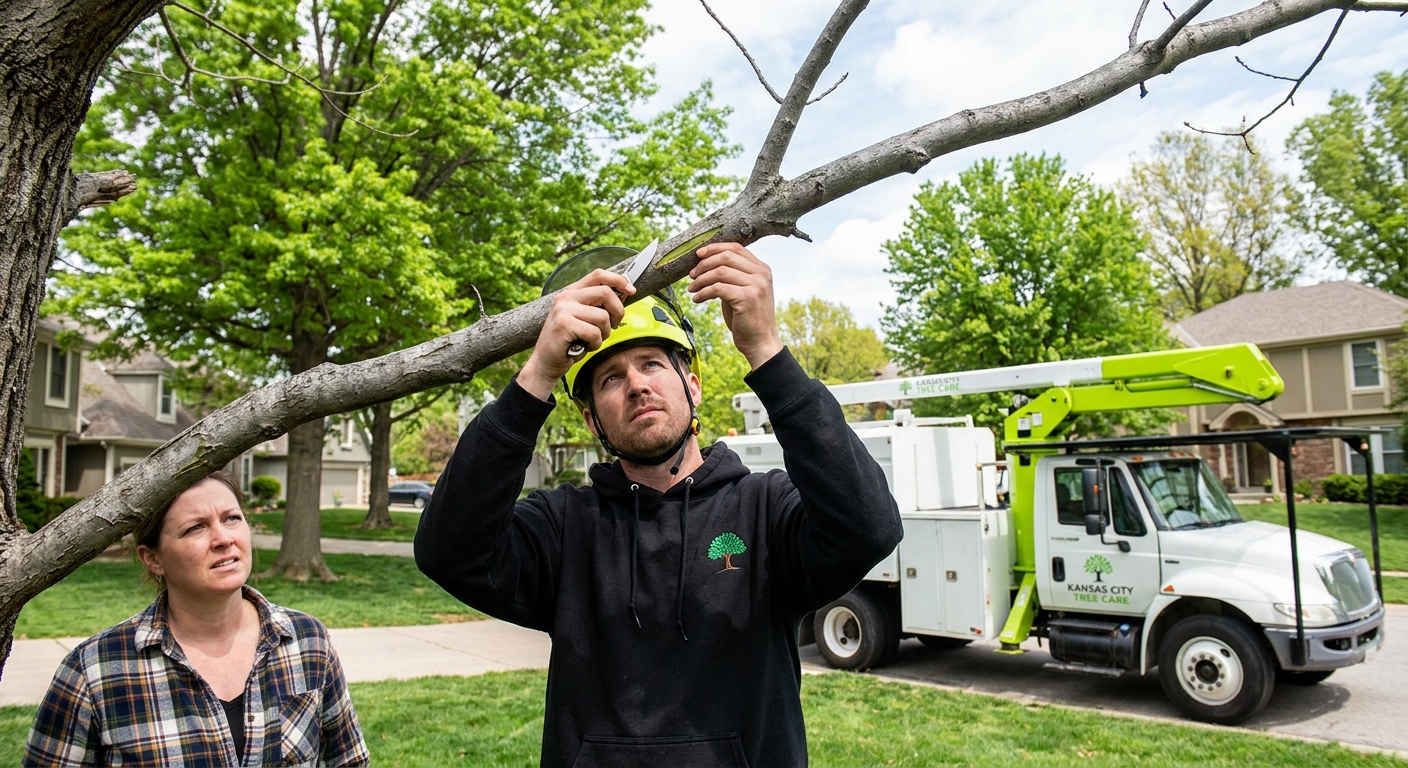
The cambium is the thin layer of living tissue just beneath the bark. As long as it’s green, the branch (or the trunk) is alive. When it turns brown and dry, that part of the tree is dead.
Here’s how to do the test yourself:
- Pick a small twig or branch in question
- Use your thumbnail or a pocketknife to scrape away a thin strip of bark — no deeper than 1/16 inch
- Look at the color underneath
- Bright green or moist yellow-green: living tissue, branch is alive
- Tan, brown, or dry: dead tissue on that branch
Start at the tips of the branches and work toward the trunk. Dead tissue at the tip with live cambium further back means dieback — you’ve lost the outer growth but the interior is still alive. The tree can recover with proper pruning.
If the cambium is brown all the way down to the main trunk, that limb is completely dead. If you scratch the trunk itself and see brown, the whole tree has likely failed.
The Bud Check: A Quick Second Opinion
Even when leaves haven’t emerged, live buds tell you the tree is alive and just running late. Here’s what to look for:
- Live bud: firm, plump, and either swelling or fully formed. Some species show tiny bits of green at the bud tip by May
- Dead bud: shriveled, dry, brittle, and falls off when you touch it
- Partially dead tree: live buds on lower branches, dead buds at the top — a common pattern with winter dieback
On most KC-area trees, you can feel the difference between a live and dead bud with your fingertips. If the buds are plump, the tree is still committed — give it more time before you assume the worst.
Bark Inspection: Looking for Splits and Frost Cracks
Kansas City winters regularly swing between extreme cold and sudden warm-ups. Those temperature swings damage tree bark in ways that don’t show up until spring.
Walk around each tree and look carefully at the trunk and main limbs:
- Frost cracks: vertical splits in the bark, usually on the south or southwest side of the trunk. They develop when the sun heats bark on a cold day, then temperatures plunge overnight. Small cracks usually heal on their own. Cracks wider than 1/4 inch need professional evaluation.
- Bark splits from ice load: horizontal or diagonal tears at branch crotches, often with visible wood underneath. These happen when ice weight pulls branches down beyond what the bark can stretch.
- Sunscald: sunken, discolored patches on the southwest side of young or thin-barked trees. Often affects young oaks, maples, and fruit trees in open KC yards.
- Peeling, sloughing bark: large sections falling off in ways that don’t match the species’ normal shedding pattern. This is a serious sign — the cambium underneath may be dead.
Small cracks and minor sunscald usually aren’t emergencies. Wide splits, large sloughing patches, or cracks that go deep into the wood warrant a professional look — especially if the damaged tree is near your house, driveway, or anywhere people walk.
Salt Damage: The KC Curbside Tree Problem
Kansas City, KS road crews apply deicing salt heavily during winter storms. That salt splashes onto curbside trees from passing traffic and accumulates in the soil as snow melts. The damage shows up in a very distinctive pattern in spring.
Signs of road-salt damage on trees in Kansas City, KS:
- Browning on the street-facing side only — the side exposed to splash is stressed, while the back side looks normal
- Tip dieback on evergreens — arborvitae, spruce, and pines along roadways often brown from the outside in
- Delayed or partial leaf-out on the damaged side of deciduous trees
- Leaf scorch later in the season — browning along leaf edges as summer heat stresses salt-damaged roots
- Twig dieback at the branch tips on the exposed side
Root-zone salt damage from snow piled near the trunk is a separate issue. This type shows up as overall tree decline — small leaves, early leaf drop, and slow growth — not the one-sided pattern of splash damage.
What you can do: deep-water salt-damaged trees heavily in April and May to leach salt through the root zone. An inch or two of water per week, applied at the dripline, helps flush accumulated sodium. Apply gypsum (calcium sulfate) around the root zone — it displaces salt and is safe for soil. For severely damaged curbside trees, a certified arborist assessment will tell you whether the tree can recover or needs to come out.
Root Rot After Wet Winters
When winter snow melts over already-saturated ground — or when heavy rains follow a snowpack — root rot becomes a serious problem in the KC metro. Clay soils in much of Kansas City hold water longer than sandier soils, which makes root rot common in low-lying yards.
Signs your tree may have root rot:
- Mushrooms or conks growing at the base of the trunk or on surface roots
- Leaning tree that appears to have shifted since last fall — especially after a windy spring
- Soil mounding or cracking on one side of the trunk, signaling root-plate movement
- Overall canopy decline — small leaves, sparse foliage, branch dieback in the upper canopy
- Soft or spongy wood at the root flare when you press it with a screwdriver
Root rot is not something homeowners can diagnose with certainty from the surface — much of the damage is underground. If you see any of these signs, especially on a large tree near your house, get it evaluated quickly. Root-rotted trees can fall without warning, and they’re one of the most common causes of storm-related structural damage we respond to in the KC metro.
Evergreen Desiccation: Why Your Arborvitae Turned Brown
If your arborvitae, yew, juniper, or young spruce has brown patches this spring, you’re not alone. KC had several weeks of subzero cold with low humidity and wind. That combination pulls moisture out of evergreen needles faster than frozen roots can replace it — a process called winter desiccation or “winter burn.”
Here’s what to look for and what to do:
- Browning on the windward side of the tree — usually the north or northwest side in KC
- Needle tips brown, bases still green — the tree is stressed but often recoverable
- Whole branches crispy brown — those branches may need pruning out
- Entire plant brown — the root system may have frozen; recovery is uncertain
The good news: most winter-burned evergreens push new growth through the browned areas by mid-June. Wait before pruning. You’ll see where the live buds are breaking, and you can remove just the dead portions rather than reshaping the whole tree. If there’s no new growth by July 1, the damage is permanent.
Partial Death: Half-Alive, Half-Dead Trees
One of the most common spring calls we get in Kansas City, KS is from homeowners with a tree that’s leafed out on one side but not the other. The classic example: a big silver maple with full leaves on the east half and bare branches on the west half.
Here’s what usually causes it:
- One-sided winter storm damage — ice loaded heavier on the windward side, killing back that half
- Root damage on one side — construction, trenching, or root rot killing the root zone that feeds half the canopy
- Trunk defect — a crack or decay pocket cutting off sap flow to part of the tree
- Species-specific dieback — certain diseases kill branches from the top down or one side at a time
The decision isn’t always removal. Depending on the cause and the tree’s overall structure, cabling and bracing can stabilize a partially dead tree. Strategic pruning can remove dead limbs while preserving the live canopy. In some cases, if the dead side is over your roof or driveway, removal is the safer call.
A certified arborist assessment makes this call based on three factors: how much live canopy remains, what caused the dieback, and what the tree threatens if it fails. We’ve preserved plenty of partially dead trees in Wyandotte County that had decades of good life left — and we’ve removed others that were hazards waiting to happen.
When Removal Is the Right Call
Not every damaged tree is worth saving. Here’s when our crew recommends Kansas City tree removal rather than trying to preserve:
- More than 50% of the canopy is dead and the tree is near structures or walkways
- Trunk has a major split, cavity, or decay pocket that compromises structural integrity
- Root rot is confirmed and the tree is leaning toward a target
- Multiple large branches are dead and likely to fall unpredictably
- The species is short-lived and beyond its prime — silver maples, Bradford pears, and cottonwoods rarely justify expensive preservation past middle age
Removal pricing in Kansas City, KS for winter-killed trees generally runs $800-$1,500 for small trees (under 30 feet), $1,500-$2,500 for medium trees (30-50 feet), and $2,500-$3,500+ for large trees or difficult access. Dead trees are actually more expensive to remove than live ones because the brittle wood requires more careful rigging.
Cost of a Spring Arborist Assessment
A professional spring tree assessment in the KC metro runs $0-$200 depending on scope. Most local tree services offer free estimates for straightforward removal or trimming work. If you need a detailed written report — for an insurance claim, HOA request, or real estate transaction — expect $150-$300 for a full arborist report.
Our crew offers free on-site estimates for any Kansas City, KS homeowner worried about a winter-damaged tree. If you need a detailed report, we’ll quote that separately and include everything an insurance adjuster or municipal inspector expects to see.
Frequently Asked Questions
How long should I wait before assuming a tree is dead?
Wait until at least June 1 before concluding a tree didn’t survive winter. Some species — bur oaks, walnuts, Kentucky coffeetree — leaf out naturally in late May. After a harsh KC winter, even healthy trees can run 10-14 days behind schedule. If it’s past June 1 and nothing has leafed out, run the scratch test and bud check to confirm.
Will a partially leafed-out tree recover on its own?
Often, yes. Trees that leaf out only on lower branches or one side will typically push secondary buds later in the season. Give the tree a full growing season before judging the outcome. If by September the dead areas still haven’t recovered, plan for professional tree trimming to remove the dead portions and reshape the canopy.
What does salt damage on a KC curbside tree look like?
The signature sign is browning and dieback only on the street-facing side. The back side of the tree looks completely normal. You’ll also see delayed leaf-out on the exposed side, leaf-edge scorch later in summer, and tip dieback on evergreens. Heavy spring watering at the dripline helps flush accumulated salt from the root zone.
Can I save a tree with frost cracks in the trunk?
Small frost cracks (under 1/4 inch) usually heal on their own over 1-3 seasons — the tree compartmentalizes the wound. Wide cracks, deep cracks, or cracks that extend into the wood itself are structural concerns and should be professionally evaluated. Do NOT apply wound paint, tar, or sealers — they trap moisture and make decay worse.
How much does it cost to remove a winter-killed tree in Kansas City, KS?
Expect $800-$1,500 for trees under 30 feet, $1,500-$2,500 for medium trees (30-50 feet), and $2,500-$3,500+ for large trees or difficult access. Dead trees typically cost 15-25% more than live trees of the same size because the brittle wood requires more careful rigging. Stump grinding adds $200-$400.
Is root rot obvious from above ground?
Not always. Clear signs include mushrooms or conks at the base, a new lean, soil mounding on one side, or sparse canopy growth. But many root-rotted trees look normal until they fail. If your tree was in a flood zone, had construction near it, or has been slowly declining for two or more years, get a certified arborist to evaluate the root flare and surrounding soil.
Let’s Take a Look Together
If you’ve got a tree in Kansas City that looks questionable this spring, an honest assessment is worth your time. Some trees that look finished are just late. Others that look okay from the street have serious problems that only show up with a closer look.
Our ISA-certified arborists have been evaluating winter-damaged trees across the KC metro for 35+ years. We know which species bounce back, which ones don’t, and when to recommend Kansas City tree care versus removal. Our estimates are always free and always no-pressure.
Here’s where you can find us:
You can also find us on our Google Business Profile for Kansas City Tree Care, LLC with reviews, photos, and directions.
Call Kansas City Tree Care at 913-894-4767 for a free spring tree assessment. We’ll walk your property, run the tests, and give you a clear, honest answer on every tree you’re worried about.