
Why Construction Kills More Olathe Trees Than Disease (And How to Stop It)
Olathe is growing fast. New homes, additions, pools, driveway expansions, deck builds, and landscape renovations are happening on streets all over the city. And in the middle of all that activity, mature trees that took 40, 60, or 80 years to grow are quietly being killed — not by storms or insects, but by the construction work happening right next to them.
Here’s the part most homeowners don’t realize until it’s too late: trees damaged during construction often don’t show signs of decline for two to five years. The pool gets finished, the family enjoys the backyard for a couple of summers, and then one fall the big oak starts dropping branches. The leaves come in thin the next spring. By year four, the tree is dead — and nobody connects it to the construction project that finished years earlier.
Our crew has worked on tree protection plans for projects across Olathe for over 35 years. Here’s how construction actually damages trees, what a real protection plan looks like, and how a small upfront investment in arborist consultation can save you thousands of dollars in tree value.
The Critical Root Zone: What It Is and Why It’s Bigger Than You Think
Most people picture a tree’s root system as a mirror image of the trunk and canopy — deep, narrow, going straight down. That picture is almost completely wrong.
A mature tree’s roots actually spread out horizontally, mostly within the top 12 to 18 inches of soil, and they extend well beyond the dripline of the canopy. The vast majority of feeder roots — the ones that absorb water, oxygen, and nutrients — live in this shallow zone.
Arborists call the area where these critical feeder roots live the Critical Root Zone, or CRZ. The standard formula is one foot of CRZ radius per inch of trunk diameter, but for mature trees in good condition, we usually expand that to 1.5 times the dripline of the canopy. So a mature oak in your Olathe backyard with a 40-foot canopy spread has a CRZ of roughly 30 feet in every direction from the trunk.
That’s a much bigger area than most homeowners imagine. And it’s the area where almost any construction activity — equipment, trenching, grading, material storage — can do irreversible damage. Once you understand how big the CRZ actually is, you start to see construction projects very differently.
How Construction Actually Kills Trees (Five Common Ways)
There isn’t just one way construction harms a tree. There are five, and most projects do at least three of them.
1. Soil Compaction From Heavy Equipment
Bobcats, mini-excavators, dump trucks, and even repeated foot traffic compact soil under their weight. Compacted soil has fewer air pockets, which means roots can’t get the oxygen they need. Water penetration drops, and the existing roots in that zone start to die back. Compacted clay soil — which is what most of Olathe sits on — recovers extremely slowly. Damage from a single pass of heavy equipment can take a decade to undo.
2. Root Severing From Trenching and Grading
Any time a trench gets dug for utilities, irrigation, or pool plumbing, it cuts through whatever roots are in its path. An excavator doesn’t cut roots cleanly — it tears them, leaving ragged wounds that don’t heal properly and become entry points for fungal pathogens. Grading is worse: stripping topsoil to level a lot for a new build can remove the entire upper root layer of every tree on the property.
3. Trunk and Bark Damage
Equipment swings, boards lean against trunks, scaffolding scrapes bark, ropes tied to limbs strip the cambium. Even small wounds in mature tree bark create disease entry points and stress responses. We’ve seen perfectly healthy 60-year-old oaks die over five years from a single deep gash put there by a careless backhoe operator.
4. Soil Grade Changes
Adding fill dirt over a tree’s root zone — even just a few inches — can suffocate the upper roots that depend on oxygen at the existing soil surface. Removing soil exposes feeder roots to drying, sun damage, and freezing. Both grade changes are quietly devastating to mature trees and very common during landscape projects.
5. Material and Chemical Storage
Stockpiles of dirt, gravel, lumber, and pavers compact the soil beneath them and block oxygen exchange. Even worse, storing concrete, mortar, paint, or fuel inside the CRZ can leach toxic compounds into the soil. Concrete washout — rinsing concrete tools and trucks — is one of the most common silent tree killers we see on residential builds.
Most construction projects in Olathe involve at least three of these damages. The trees survive the immediate insult and look fine when the project wraps. The decline starts later.
Why Trees Often Die 2-5 Years After Construction
This is the part that makes construction-related tree death so frustrating: by the time the symptoms show up, the cause is invisible.
Here’s what’s actually happening biologically. A mature tree has reserves of stored energy — sugars and starches accumulated over years of growth. When the root system is damaged during construction, the tree taps those reserves to compensate. It pushes leaves, maintains the canopy, and looks healthy because it’s spending savings to survive.
The reserves last about 2-5 years for most mature shade species. Once they run out, the tree can’t sustain itself anymore. Canopy thinning starts. Branches die from the tips inward. The tree becomes vulnerable to opportunistic diseases and insects that wouldn’t have touched a healthy tree. And over the next year or two, it dies.
By that point, the homeowner has long forgotten about the pool installation that finished four summers ago. They call us and ask what’s wrong with their tree, and we have to deliver the bad news: the damage was done years ago, and there’s nothing we can do to reverse it.
This pattern is so consistent that arborists have a name for it: delayed construction decline. We see it constantly in newer Olathe subdivisions where the builders cleared and graded aggressively, and on older properties where homeowners added pools or large landscape features without considering the trees.
What a Real Tree Protection Plan Looks Like
A tree protection plan isn’t a vague idea — it’s a specific document developed by an ISA-certified arborist before construction starts. Here’s what should be in one for any meaningful Olathe project:
1. Tree Inventory and Assessment
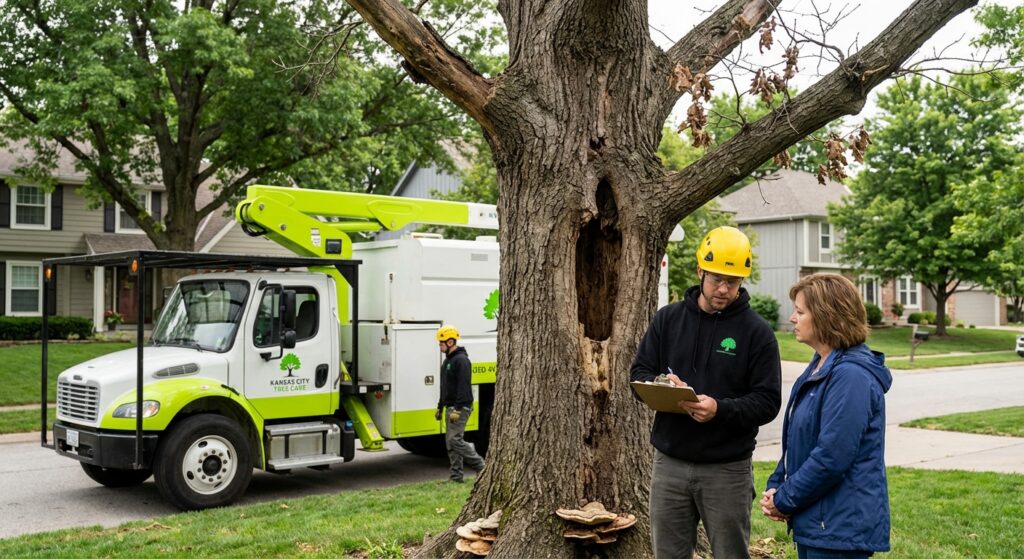
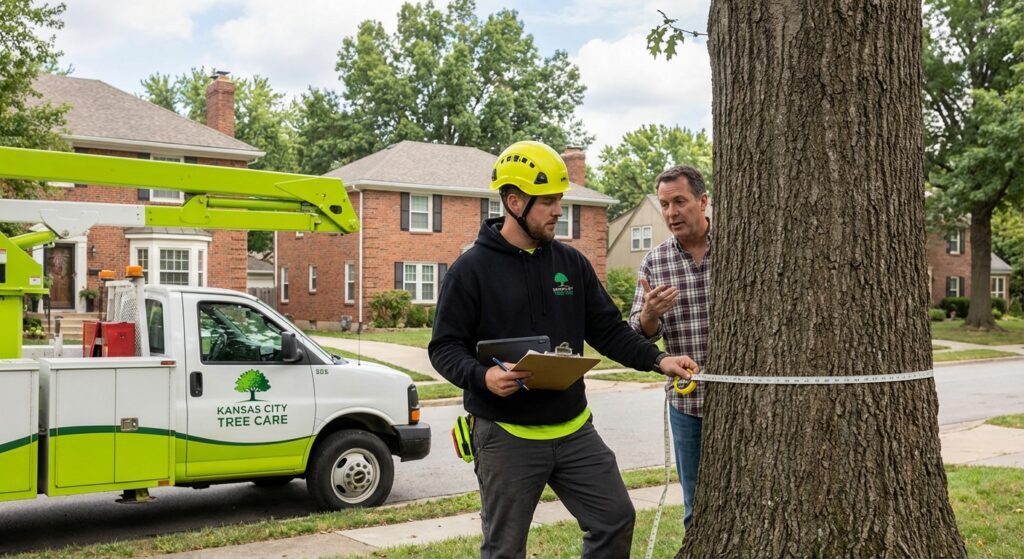
The arborist walks the property, identifies every significant tree, measures trunk diameter, evaluates current health, and rates each tree’s likelihood of surviving the proposed work. Some trees are worth aggressive protection. Others — especially trees already in decline — may not be worth the effort. Knowing the difference matters.
2. Critical Root Zone Mapping
For each tree being preserved, the CRZ is mapped onto the site plan. This shows the contractor exactly where they cannot drive, dig, store materials, or wash out concrete. It’s not negotiable — it’s the boundary that has to be respected for the tree to survive.
3. Tree Protection Fencing
Sturdy fencing (typically 4-foot orange construction fencing with metal T-posts) goes up around the CRZ before any equipment arrives on site. The fence is the visible reminder to the entire crew that this area is off-limits. Cheap plastic ribbon doesn’t work — we’ve seen it ignored, knocked down, or “moved temporarily” within the first day of work.
4. No-Go Zones for Equipment, Materials, and Vehicles
The plan specifies where the contractor can stage materials, where dumpsters and porta-potties can sit, and what routes equipment can use to reach the work area. These zones are chosen to keep the CRZ clear at all costs.
5. Root Pruning Where Necessary
If a trench has to cross part of the CRZ, the plan calls for root pruning ahead of time — clean cuts with sharp tools at the trench line, made by an arborist, not torn by an excavator. Clean cuts heal. Torn roots become disease vectors.
6. Soil Protection Layers
If equipment absolutely has to cross root zones, the plan calls for a temporary protection layer: 6-12 inches of wood chips spread over plywood or geotextile fabric. This distributes the equipment weight and reduces compaction damage.
7. Post-Construction Recovery Plan
After construction wraps, the plan includes soil aeration in any compacted areas, deep watering schedules during the next two growing seasons, and a follow-up arborist consultation to check on the trees. Recovery support during years 1 and 2 dramatically improves survival.
A protection plan for a typical Olathe residential project — a pool, an addition, a driveway expansion — runs $150-$400 for the consultation and written plan. That’s a tiny fraction of what the trees being protected are worth.
Pre-Construction Arborist Consultation: The Best Money You’ll Spend
The single most valuable thing a homeowner can do for their trees during a construction project is bring in an arborist before signing the contract with the builder or pool company. Not after the design is finalized. Not after equipment has shown up. Before.
Here’s what a pre-construction arborist visit accomplishes:
- Identifies which trees on your property are worth protecting and which aren’t
- Reviews the proposed site plan and flags conflicts between construction and the CRZ
- Suggests design modifications that would reduce tree damage (different equipment routes, alternate utility paths, smaller staging areas)
- Produces a written protection plan you can attach to the contractor agreement
- Establishes who’s responsible if the plan gets violated and trees die
The cost is small — $150-$400 for most residential projects. The savings are enormous. We’ve worked on Olathe pool projects where a pre-construction consultation moved the proposed pool location by eight feet, saving a 70-year-old burr oak that the appraisal valued at over $13,000. That’s a 30x return on the consultation fee.
Compare that to homeowners who skip the consultation, lose the tree two summers later, and then call us for tree removal at $2,500-$4,500. They paid for the construction, paid for the removal, and lost five-figure tree value in the process.
Soil Aeration and Recovery Treatments After Construction
Even when a protection plan is followed perfectly, some compaction and stress are usually unavoidable. The good news is that several recovery treatments can help trees bounce back during the first year or two after construction.
Vertical mulching involves drilling vertical holes (about 2 inches wide and 12 inches deep) in a grid pattern throughout the CRZ, then filling them with compost or biochar. This creates oxygen channels and adds organic matter to compacted soil. It’s especially effective in the heavy clay soils common throughout Olathe.
Air spading uses high-pressure compressed air to gently break up compacted soil around the root zone without damaging roots. It’s the most effective decompaction method we use, and it’s standard treatment after any project that involved equipment in the CRZ.
Deep root fertilization delivers slow-release nutrients directly into the root zone via injection probes. This supports the tree as it rebuilds feeder roots damaged during construction.
Supplemental watering matters more than most homeowners realize. A construction-stressed tree needs deep, slow watering — about 1-2 inches per week during the growing season — for at least two seasons after the work is done. Soaker hoses or slow drip irrigation work better than sprinklers.
Recovery treatments typically cost $300-$800 per tree depending on size and what’s needed. Done in the first year after construction, they significantly improve survival odds for stressed trees.
Olathe’s Tree Preservation and Building Permit Process
Olathe has development regulations that touch on tree preservation, particularly for new subdivisions and commercial projects. For residential additions and accessory structures, the requirements are usually less formal — but it’s worth checking with the City of Olathe’s Planning Division before any major project to see what applies to your specific situation.
A few things worth knowing:
- Building permits are required for most pools, additions, decks, and accessory structures. Check the Olathe planning website or call the permit office for specifics.
- Your contractor should pull permits — but the permit doesn’t automatically include tree protection requirements unless your lot is part of a preservation overlay.
- Easements (utility, drainage, sewer) often run through residential lots and can affect what trees can be preserved during construction.
- The city’s stormwater ordinance and tree planting requirements for new development affect builders more than individual homeowners.
The bottom line for most Olathe residential projects: tree preservation is mostly the homeowner’s responsibility, not the city’s. If you don’t make tree protection a requirement, your contractor probably won’t.
Common Scenarios We See in Olathe
A few real-world examples of what construction-related tree damage looks like, and what could have prevented it:
Scenario: New Pool Installation
Pool excavation typically happens within 20-40 feet of mature backyard trees. The excavator tears through major roots, the spoil pile sits on the CRZ for weeks, and the equipment compacts soil throughout the work area. Two years later, the homeowner notices their oak’s leaves are smaller and the canopy is thinning. Prevention: Pre-construction consultation, root pruning ahead of excavation, fenced protection zones, post-construction air spading.
Scenario: Driveway Replacement or Expansion
Removing the old driveway, regrading, and pouring new concrete sounds harmless but compacts soil along the entire driveway edge. Trees with roots extending under the driveway lose access to oxygen permanently. Prevention: Use permeable pavers, leave gaps for root breathing, keep equipment off the CRZ, install root barriers if necessary.
Scenario: New Addition or Sunroom
Foundation excavation cuts roots, scaffolding scrapes trunks, and material storage compacts the lawn. The tree closest to the addition slowly declines over the next 3-4 years. Prevention: Tree protection fencing, designated material staging area away from CRZ, root pruning before foundation work.
Scenario: Major Landscape Renovation
Heavy equipment to remove old landscaping, grading for new beds, irrigation trenching, and stockpiles of mulch and stone. All of it concentrated in the CRZs of mature trees. Prevention: Work the protection plan into the landscape design from day one, hand-dig within CRZs whenever possible.
Every one of these scenarios is something our team has handled across Olathe. The homeowners who consulted with us before the project consistently kept their trees. The ones who called after the damage was done usually didn’t.
Frequently Asked Questions
How much does a pre-construction tree consultation cost in Olathe?
A pre-construction arborist consultation typically runs $150-$400 for a residential project, depending on the number of trees being assessed and the size of the project. The consultation includes a site walk, written tree protection plan, and recommendations to share with your contractor. For projects involving valuable mature trees, it’s the highest-return investment you can make.
Can a tree recover from having its roots cut during construction?
Sometimes — it depends on how much of the root system was lost and how cleanly the cuts were made. If less than 25% of the root zone was disturbed and the cuts were clean (made by an arborist, not torn by equipment), recovery is likely with proper aftercare. If more than 30% was lost, especially if the cuts were ragged, the tree usually declines over 2-5 years.
How do I know if my tree was damaged by construction that already happened?
Look for canopy thinning, smaller-than-normal leaves, branches dying from the tips inward, increased deadwood, or earlier-than-normal fall color. Damage usually shows up 1-3 years after the construction. An arborist assessment can confirm the cause and tell you whether recovery treatments are likely to help.
What’s the most damaging thing contractors typically do to trees?
Soil compaction from heavy equipment driven across the root zone. It’s invisible, it’s irreversible without active intervention, and almost every contractor does it. A well-placed protection fence is the single most effective prevention.
Do I need a permit to remove a tree before construction in Olathe?
For most residential lots, no — routine tree removal on private property doesn’t require a permit. But if your project requires building permits, your overall site plan may need to address tree protection or replacement, especially for newer subdivisions with HOA tree requirements. Check with Olathe’s Planning Division before removing significant trees.
Can my contractor handle tree protection, or do I need a separate arborist?
Most general contractors don’t have arborist training and don’t specialize in tree biology. They’ll do their best, but tree protection isn’t their expertise. Hiring an ISA-certified arborist for a separate consultation is the smart move — it usually pays for itself many times over.
Save Your Trees Before the Bulldozers Show Up
The trees in your Olathe yard took decades to grow into what they are now. Once they’re damaged, there’s no fast fix and no replacement that gets you back to where you started. The smart play is to protect them before construction starts — and the cost of doing it right is a tiny fraction of what you’d lose if a mature tree dies.
We’ve been helping Olathe homeowners protect their trees during construction, additions, and renovations for over 35 years. Our crew includes ISA-certified arborists, we’re BBB accredited, and we’re fully licensed and insured. Whether you need a pre-construction consultation, a tree protection plan, or recovery treatments after a project that didn’t go great, we’ll help you make the right call. You can also check out our reputation as a trusted Olathe tree service through our Google Business Profile.
Call Kansas City Tree Care at 913-894-4767 for a free pre-construction tree assessment. We’ll walk your property with you, look at the project plans, and tell you exactly what it’ll take to keep your trees alive through the work.