
Not Every Tree Wants to Be Pruned in May
Every April and May, we get a wave of calls from Kansas City homeowners ready to knock out yard work. The grass is finally growing, the trees are leafing out, and the pruners are right there in the garage. Seems like the perfect time.
For some species, it is. For others — particularly oaks — pruning between mid-April and mid-July can actually kill the tree. Oak wilt is the reason, and it’s the single biggest seasonal pruning mistake we see across the KC metro.
Here’s the honest answer on spring pruning: a few things you can do any time, a few things that are specifically better in May, and a few things you should absolutely wait until winter for. We’ve been pruning trees across Kansas City for 35 years, and this guide walks through the month-by-month rules that actually matter. If you want a professional assessment of a specific tree before you prune, our tree care in Kansas City team is happy to come take a look.
The Oak Wilt Window: Why Pruning April 15 – July 15 Can Kill Your Oak
This is the rule every Kansas City homeowner with an oak needs to know, and most don’t: do not prune oak trees between April 15 and July 15.
Here’s why. Oak wilt is a fungal disease that’s already present across Kansas and Missouri, including confirmed cases throughout the KC metro. The fungus spreads primarily through sap beetles (nitidulid beetles) that are attracted to fresh wounds on oak trees. These beetles feed on sap oozing from pruning cuts, pick up fungal spores from infected trees, and carry them to the next healthy oak they visit.
Beetle activity peaks in late spring and early summer. A pruning cut made in May on an otherwise healthy red oak can infect the tree within days, and red oaks typically die within 3-6 weeks once infected. Once oak wilt establishes, treatment options are limited and expensive — and the fungus can spread through connected root systems to neighboring oaks, wiping out entire yards.
The safe pruning window for oaks in the KC metro:
- Best: November through February (dormant season, no beetle activity)
- Acceptable: July 16 through October (post-peak beetle activity, but dress cuts with pruning paint as a precaution)
- Avoid: April 15 through July 15 under any non-emergency circumstance
The exception: storm damage, broken limbs, or limbs hanging over a house where safety is on the line. In those cases, you prune — but you immediately paint the wound with standard tree-wound dressing (the only situation where we recommend wound paint). The paint seals the wound against beetles.
Red oaks (pin oak, scarlet oak, red oak, black oak) are the most susceptible. White oaks (bur oak, white oak, chinkapin oak) are somewhat more resistant but still vulnerable. Don’t take the risk on either group. If you’ve got a hazardous oak situation requiring pruning in May or June, call a certified arborist rather than tackling it yourself — we know how to minimize beetle exposure during emergency work.
Maples and Birches: The “Bleeders”
If you prune a maple or birch in early spring — March or April — you’ll get a dramatic, soggy stream of sap running out of the wound for days. This is what arborists call “bleeding,” and it scares a lot of homeowners into thinking they’ve seriously damaged the tree.
Here’s the honest answer: bleeding is cosmetic. The tree is not hurt. The sap flow seals itself off within a few weeks, and the tree continues normally. Silver maples, red maples, sugar maples, and river birches all do this.
That said, heavy bleeding is unsightly and drips onto sidewalks, cars, and patio furniture. If you can avoid it, prune maples and birches during one of these windows instead:
- Mid-summer (June through August): the tree is actively transpiring and doesn’t bleed. Our preferred window for most maple pruning in KC
- Late fall (October through November): after the tree has moved sugars back into the roots. Clean cuts, no bleeding, fast wound closure
- Avoid February through April: peak sap flow, peak bleeding, messiest results
Silver maples are the most common large shade tree in older KC neighborhoods, and they’re also one of the most frequently pruned because of their tendency toward brittle branches. We handle a lot of silver maple tree trimming in Kansas City in July and August specifically to avoid the bleeding issue.
Flowering Trees: Prune AFTER They Bloom, Not Before
This is one of the most common mistakes we see. A homeowner gets pumped up to do yard cleanup in early April, prunes their lilac or forsythia, and then wonders why it didn’t flower that year.
Spring-flowering trees and shrubs set their flower buds on the previous year’s growth. The buds that would have bloomed this spring were formed last summer. When you prune in March or early April, you’re cutting off this year’s flowers.
Prune AFTER bloom (late spring to early summer):
- Lilac — prune immediately after the May flowers fade. Take out the oldest canes at ground level to encourage new growth
- Forsythia — same rule. Prune right after the yellow flowers drop
- Flowering crabapple — prune in late May or June, after bloom, but before peak beetle activity if it’s in the apple/oak-adjacent group
- Ornamental cherry and plum — prune lightly after bloom; avoid heavy cuts that expose large wood
- Redbud — prune after the pink flowers are gone, typically late April to early May
- Serviceberry — light pruning after bloom, usually in May
- Viburnum and dogwood — post-bloom shaping, late spring
Prune in late winter (for summer-flowering species):
- Hydrangea (most varieties, though check the species — some bloom on old wood)
- Butterfly bush
- Crape myrtle
- Panicle hydrangea
The easy rule: if it blooms before June 15, prune after bloom. If it blooms after June 15, prune in late winter before growth starts.
Evergreens: Light Shaping in May Is Fine
Evergreens are more forgiving than deciduous trees when it comes to spring timing. Pines, spruces, junipers, arborvitae, and yews all tolerate light shaping in May and June.
Key evergreen pruning rules for KC:
- Pines — “candle pruning” in May. Pinch back new growth (candles) by half to control size. Never cut into old wood — pines don’t resprout from brown wood
- Spruces — light shearing of new growth in late May or June. Like pines, don’t cut into bare brown branches
- Arborvitae, junipers, yews — tolerate heavier pruning. Can be shaped in May, June, or early summer. Yews are the most forgiving and will even resprout from old wood
- Boxwood — light shearing after new growth emerges in late May
What not to do with evergreens:
- Don’t shear pines or spruces aggressively — they don’t recover
- Don’t prune in late summer — this triggers tender new growth that won’t harden before winter
- Don’t top an arborvitae — once you cut the leader, it never looks right again
In KC specifically, we handle a lot of arborvitae pruning in May when homeowners want to tighten up property-line screens. That’s the right time for it. But for pines and spruces, we usually recommend a single candle pruning in late May and leaving the rest alone.
Dead, Damaged, and Diseased Branches: Always Fair Game
Here’s the good news. Regardless of species or season, three situations always justify pruning:
- Dead branches — no disease risk, no bleeding issue. Remove them whenever you notice them
- Broken or cracked branches — from ice, wind, or storm damage. Remove them immediately for safety
- Diseased branches — prune out cankers, hypoxylon, fire blight (with sterilized tools between cuts), and other disease pockets as soon as you see them
The only caveat is the oak wilt rule. If you have to cut a live oak branch between April 15 and July 15 for safety reasons, paint the wound immediately with tree-wound dressing. Otherwise, proceed — removing a cracked branch that’s about to fall is always the right call.
After a spring storm in the KC metro, we’re often out doing emergency storm recovery work — removing broken limbs, cabling stressed branches, and cleaning up split trunks. That’s all season-agnostic work. Safety first, species rules second.
Young Tree Structural Pruning: Spring Is Actually Ideal
One category of spring pruning is not only OK — it’s preferred. Young trees (first 5-10 years after planting) benefit significantly from structural pruning in late spring.
The goal with young trees is to establish good architecture:
- Single dominant leader — one central trunk, not a Y-shaped split
- Well-spaced scaffold branches — main lateral branches distributed around the trunk, not clustered on one side
- Wide branch angles — branches that grow out at closer to 90 degrees are stronger than narrow Y-forks
- Proper branch spacing — 18 inches or more between main scaffolds on larger trees
Late spring (May on non-oak species, July 16+ on oaks) is ideal because the tree is actively growing and wound closure is fast. A cut made in May is often fully sealed by August. The same cut made in November waits until the following spring to begin closing.
For homeowners planting new trees in KC yards, we recommend structural pruning every year for the first 3-5 years. It’s a small investment — usually $150-$350 per visit for a young tree — and it prevents the structural problems that cost thousands to correct on a 30-year-old tree.
Why Fall Pruning Is Usually a Bad Idea in the KC Metro
Homeowners often ask us about pruning in September or October. The yard is starting to quiet down, the leaves are changing, seems like a logical time.
Here’s the problem: fall is peak spore release season for many of the decay fungi that affect KC trees. Pruning wounds made in September and October stay open longer than wounds made in spring or summer, because wound closure slows as the tree moves into dormancy. That gives disease spores an extended opportunity to colonize fresh cuts.
In our experience across the metro, fall-pruned oaks, maples, and elms show higher rates of decay, canker development, and wound cavities than trees pruned in winter or mid-summer.
Recommended KC pruning calendar:
- November – February: Best window for oaks, elms, ashes, sycamores, cottonwoods, and most shade trees. Tree is dormant, no beetles, no spores, clean wound closure the following spring
- March – Early April: OK for shade trees except maples/birches (bleeding) and spring bloomers (no cutting yet)
- Mid-April – Mid-July: No oaks. Everything else is fine. Prime time for structural work on young trees and flowering species post-bloom
- Mid-July – August: Safe for all species. Maples and birches don’t bleed. Oaks are past the beetle window
- September – October: Avoid non-emergency pruning. Disease pressure is high, wound closure is slow
For most KC homeowners, the practical advice is: do your major pruning between November and February, do spring flowering shrubs right after bloom, do structural work on young trees in May/June (non-oaks), and handle storm damage whenever it happens.
When a Pro Should Handle the Job
A lot of spring pruning is homeowner-scale work. Small ornamentals, shrubs, and young trees under 15 feet are reasonable DIY projects if you have sharp bypass pruners, a good pole saw, and know how to make proper cuts (just outside the branch collar, no flush cuts, no stub cuts).
Call a certified arborist when:
- The branches you need to reach are higher than 15 feet
- You’re pruning oaks and can’t wait until winter
- Branches are over a house, driveway, or power line
- The tree has structural defects — co-dominant stems, included bark, cracks, or cavities
- You’re pruning a high-value specimen tree where mistakes have real consequences
- You don’t have time for the proper cuts and cleanup
Typical professional pruning costs in the KC metro:
- Small tree, light trim (under 25 feet): $150-$350
- Medium shade tree, full prune (25-50 feet): $350-$800
- Large shade tree, crown cleaning and thinning (50-75 feet): $800-$1,800
- Very large heritage tree, complex pruning: $1,800-$4,000+
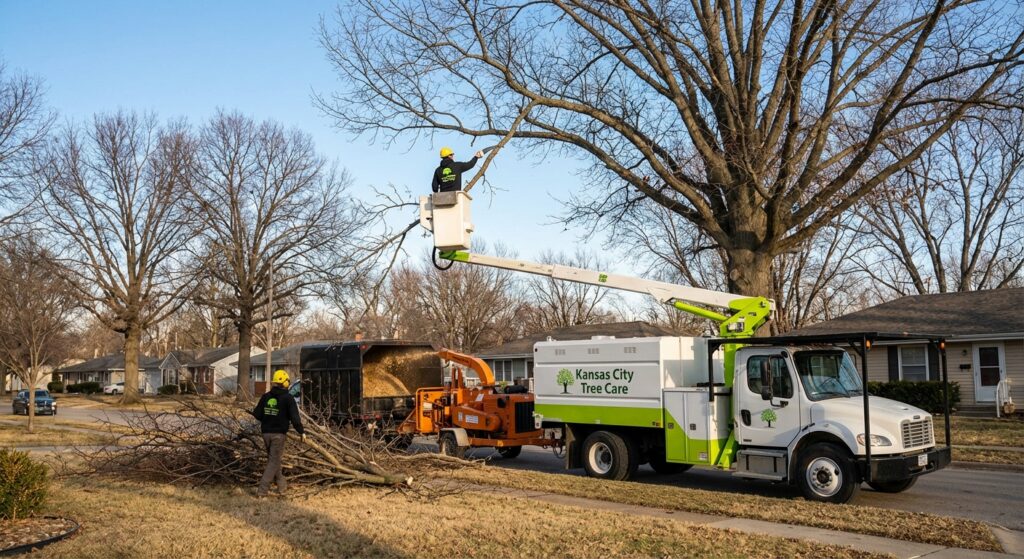
Our crew handles a mix of everything from a quick 20-foot crabapple shape-up in Rosedale to full crown restoration on a 90-foot bur oak in the older Kansas City, KS neighborhoods around Wyandotte County Lake. Whatever the scope, we work to ISA pruning standards — no topping, no flush cuts, no more than 25% canopy removal in a single year.
Frequently Asked Questions
Can I prune my oak tree in May?
Not safely. Between April 15 and July 15, oak wilt beetles are active across the KC metro, and a fresh pruning cut on an oak can attract them and infect the tree. Wait until November through February for routine oak pruning. If you have an emergency situation — storm damage, hazardous limb — paint the wound immediately with tree-wound dressing to block beetle access.
Why is my maple dripping sap after I pruned it in April?
Maples bleed heavily when pruned in early spring because sap is flowing upward from the roots. It’s cosmetic, not harmful. The bleeding stops within a few weeks, and the tree heals normally. Next time, prune maples in mid-summer (June-August) or late fall to avoid the sap flow entirely.
When should I prune my lilac in Kansas City?
Immediately after the May flowers finish blooming — usually late May or early June. Lilacs set next year’s flower buds on new growth made in summer, so pruning any later than mid-June removes next year’s blooms. Take out the oldest, thickest canes at ground level to keep the shrub youthful.
Is it OK to prune dead branches any time of year?
Yes. Dead branches have no sap flow, no disease risk from the cut, and no aesthetic downside to immediate removal. The only caveat is on oaks — if the dead branch is attached to live wood, the cut still hits living tissue and the April 15-July 15 rule still applies. Pure deadwood removal can happen any time.
How much does professional tree trimming cost in Kansas City?
Small trees under 25 feet typically run $150-$350, medium shade trees $350-$800, and large shade trees $800-$1,800. Heritage oaks and complex jobs with tight access can go higher. For most residential properties, a yearly pruning on 2-4 major trees totals $800-$2,500 depending on sizes.
Should I paint pruning cuts with tree sealant?
Almost never. Modern arboricultural research shows wound paints don’t speed healing and can sometimes trap moisture and slow decay compartmentalization. The one exception is oak wounds made during the April 15-July 15 oak wilt window — those should be painted immediately to block beetle access. Otherwise, leave the cut clean and let the tree seal itself.
When You Want It Done Right
Spring pruning done right can shape a tree for the next 30 years. Spring pruning done wrong — especially on oaks during the oak wilt window — can kill a tree in a single season. If you’re not sure what’s right for your specific trees, it’s worth a conversation before you start cutting.
We’ve been pruning Kansas City trees for 35 years. Our crew is ISA certified, BBB accredited, fully licensed and insured, and we follow the same pruning standards arborists use for civic and heritage trees. You can also find Kansas City Tree Care on Google with hundreds of reviews from homeowners across Kansas and Missouri.
Call Kansas City Tree Care at 913-894-4767 for a free pruning consultation. We’ll walk the property, tell you what each tree needs and when, and give you an honest estimate — no pressure, no upsell.