
Bagworms and Fall Webworms in Overland Park: Two Pests, Two Very Different Problems
You’re standing in your backyard in Overland Park, and something looks wrong. Either your arborvitae hedge is suddenly covered in tiny brown cones that you swore weren’t there a week ago, or your big pecan tree has a giant white spiderweb tent hanging off the end of a branch. Both are insect problems. But they’re not the same problem — and they don’t get the same treatment.
Here’s the honest answer most homeowners need: bagworms can kill your evergreens in a single season if you ignore them. Fall webworms look terrifying but are mostly cosmetic. Knowing which one you’re dealing with changes everything about how you respond.
We’ve handled both pests on hundreds of properties across Overland Park over the past 35 years. The older neighborhoods around Corporate Woods, Indian Hills, and the streets near the Overland Park Arboretum see these pests every year. Here’s how to tell them apart, when to act, and when you can leave well enough alone.
How to Identify Bagworms in Overland Park
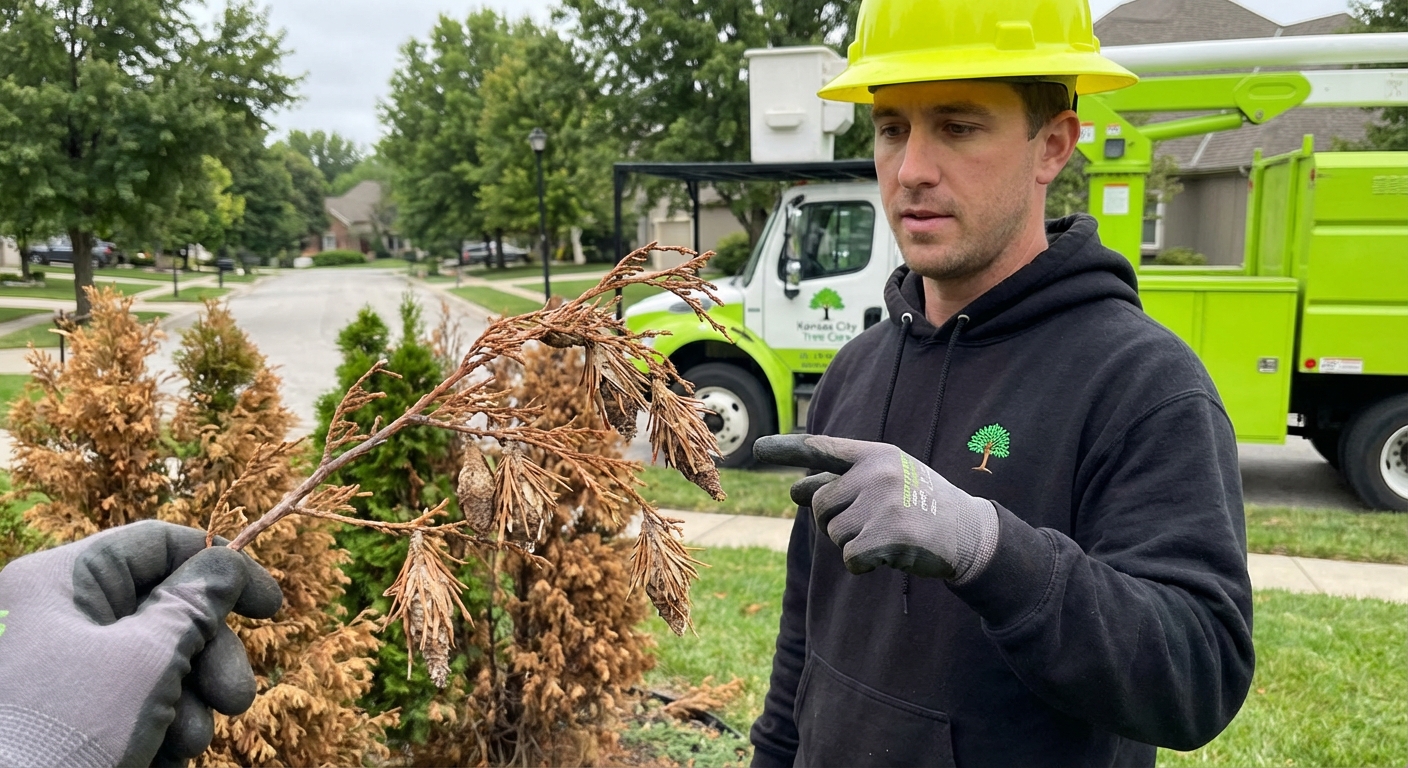
Bagworms are caterpillars that build small, spindle-shaped bags out of silk and bits of the host plant they’re feeding on. Each bag is about 1 to 2 inches long and looks like a tiny pinecone or a piece of dried plant material hanging from the branch.
That camouflage is the whole problem. Most homeowners walk past their arborvitae hedge for weeks without noticing anything. By the time the bags become obvious, the caterpillars have already done significant feeding damage.
Here’s what to look for:
- Spindle-shaped bags hanging from branch tips, made of silk woven with needle or leaf fragments from the host plant
- Browning or thinning evergreen foliage — especially on arborvitae, juniper, and spruce, often starting at the top of the plant
- Bare patches on the side of a hedge or tree where the bagworms have been actively feeding
- Movement when touched — during summer, the bags will wiggle if you tap them, since the caterpillar is alive inside
Bagworms hatch in late May to early June in the KC metro. The young caterpillars are nearly invisible — about the size of a grain of rice. They feed actively through July and August, growing their bags as they eat. By September, the females (which never leave the bag) lay 500 to 1,000 eggs inside, sealing them in to overwinter and hatch the next spring.
Why Bagworms Are a Real Threat to Your Evergreens
This is the part most homeowners don’t realize until it’s too late. Bagworms can kill evergreens in a single growing season. Unlike deciduous trees, conifers like arborvitae, juniper, and spruce don’t easily regenerate foliage they’ve lost. Once a branch is stripped, it usually stays bare.
We’ve seen entire arborvitae privacy hedges in Overland Park go from healthy to half-dead in one summer because nobody spotted the bagworms early enough. By the time the damage is obvious, the caterpillars have moved on to other branches and the original ones are already gone for good.
The most vulnerable plants in Overland Park yards include:
- Arborvitae (especially Green Giant and Emerald Green privacy hedges) — bagworm magnet number one
- Eastern red cedar and juniper — common in older landscapes, often heavily infested
- Colorado blue spruce — already stressed by KC’s humid summers, bagworms make it worse
- Honeylocust and sycamore — bagworms occasionally feed on these deciduous trees but the damage is rarely fatal
If you’ve got an arborvitae hedge, check it every two weeks from June through August. Catching bagworms early is the difference between a quick treatment and replacing a $3,000 privacy screen.
How to Identify Fall Webworms
Fall webworms are an entirely different animal — literally. They’re a different species, they target different trees, and they cause different damage. The good news is they’re far less destructive than bagworms.
The signature sign is the web. Fall webworms build large, loose, papery silk tents at the ends of branches. The tents enclose the leaves the caterpillars are feeding on, and they get bigger as the colony grows. By August or September, a single tent can engulf an entire branch tip.
Here’s what you’ll see:
- Large white silk tents at the ends of branches — sometimes 2 to 3 feet across by late summer
- Hairy caterpillars inside the webs, light yellow to greenish with dark stripes and tufts of long white hairs
- Skeletonized leaves within the tent — the caterpillars eat the soft tissue but leave the leaf veins behind
- Frass (caterpillar droppings) on the ground or lower foliage beneath the web
Fall webworms favor walnut, pecan, hickory, cottonwood, ash, and fruit trees. In Overland Park, we see them most often on the big black walnuts in older neighborhoods and on the cottonwoods along the Indian Creek corridor.
Why Fall Webworms Are Mostly a Cosmetic Problem
Here’s the reassuring news. Fall webworms feed late in the season — typically July through September — when established trees are already winding down for the year. The leaves they eat were going to drop in a few weeks anyway. The tree has already done most of its photosynthesis for the season, stored its energy reserves, and is preparing for dormancy.
That means even a heavy fall webworm infestation rarely kills a healthy mature tree. We’ve seen 60-foot pecans in Overland Park covered in webs in September that leafed out perfectly fine the following spring.
The damage looks dramatic but it’s mostly aesthetic. A tree can lose 20 to 30 percent of its late-summer leaves with little long-term impact. The exceptions worth watching:
- Young or recently planted trees — small trees with limited leaf area can be set back significantly
- Trees already stressed by drought, construction damage, or disease — these have less reserve to spare
- Repeated heavy infestations year after year — chronic defoliation can weaken even mature trees over time
- Fruit and nut trees where you care about the harvest — webs can reduce fruit quality and quantity
For most situations, fall webworms are something to monitor, not panic about. Save your tree budget for things that actually threaten the tree’s survival.
Bagworm Treatment: When DIY Works and When to Call a Pro
Bagworm treatment timing is everything. The window when treatment is most effective is narrow — late May to early July, when the caterpillars are small and actively feeding.
DIY hand removal works well if the infestation is small and you can reach the bags. Pick them off and drop them into a bucket of soapy water. This is most practical in fall, winter, or early spring when the bags contain overwintering eggs but not active caterpillars. One hour of hand-picking in March can prevent next summer’s infestation.
Bacillus thuringiensis (Bt) is a biological insecticide safe for pets, kids, and beneficial insects. It only affects caterpillars that eat treated foliage. Spray young bagworms (under 1/2 inch) in June and again 7 to 10 days later. Effectiveness drops off sharply once the caterpillars are larger and their bags are fully formed.
Professional treatment makes sense for large hedges, tall trees, or heavy infestations. Our crew uses commercial-grade insecticides applied with high-pressure sprayers that reach the upper canopy of mature evergreens. Cost typically runs $150 to $400 for a residential property, depending on the size of the area and the height of the plants.
If your arborvitae privacy screen is already showing brown patches and bags hanging visible, professional treatment is the right call. Hand removal at that point won’t catch them all, and DIY sprays from a hose-end bottle don’t penetrate dense evergreen foliage well enough to be effective.
Fall Webworm Treatment: Usually Unnecessary, But Here Are Your Options
For most fall webworm situations, the best treatment is patience. The caterpillars complete their life cycle by October, the leaves drop, and the tree moves on. But if you want to take action — for cosmetic reasons or because the tree is young or stressed — here’s what works.
Physical removal is the simplest option. Use a long pole pruner to cut off the affected branch tip and dispose of the entire web in a sealed bag. This works well if the webs are within reach and limited to a few branches. Don’t try to burn the webs in the tree — that causes far more damage than the caterpillars ever would.
Bt application can knock down a heavy infestation if applied while caterpillars are small. You’ll need to break open the web first or use enough spray pressure to penetrate the silk. This is hard to do effectively from the ground on tall trees.
Professional treatment is usually overkill for fall webworms. We’ll honestly tell you when treatment isn’t worth the cost. If you have a young tree, a heavily infested fruit tree, or repeated severe infestations on the same tree year after year, our tree trimming team can prune out affected branches and assess the overall health of the tree.
The honest conversation we have with most Overland Park homeowners about fall webworms: yes, they look bad, no, your tree is fine, and your money is better spent on things that actually matter — like watering during August drought, mulching the root zone, or scheduling structural pruning over the winter.
Why These Pests Are Common in Older Overland Park Neighborhoods
If you live in one of Overland Park’s older subdivisions — anywhere developed before about 1990 — you’re more likely to see both bagworms and fall webworms than someone in a newer neighborhood. There are a few reasons for that.
Older neighborhoods have older landscapes. Mature trees provide the host plants both pests prefer. Established arborvitae hedges, large walnut and pecan trees, and big cottonwoods are all common in areas built between the 1960s and 1980s. Newer subdivisions often have smaller, more diverse plantings that don’t concentrate either pest as heavily.
Bagworm populations also build up in areas with lots of arborvitae privacy hedges. Once a few hedges in a neighborhood get infested, the females lay eggs in place and the population spreads to neighboring yards. That’s why we sometimes see bagworm outbreaks that affect an entire street at once.
For fall webworms, the host trees are the limiting factor. The big walnuts and pecans in older Overland Park yards are exactly what these caterpillars want. Newer neighborhoods with primarily ornamental flowering trees don’t see nearly as much webworm activity.
The takeaway: if you live in an older Overland Park neighborhood with mature trees, build pest checks into your spring and summer routine. A 10-minute walk around your yard every two weeks from May through September catches most issues early enough to handle them easily.
When to Call a Certified Arborist
Some situations are clearly DIY territory. Others need professional eyes. Here’s when to bring in a certified arborist for a closer look:
- Your arborvitae or juniper hedge is showing brown patches and you can see bags — the infestation is past the easy-treatment window
- Bagworms are present on tall evergreens you can’t reach safely with a pole sprayer
- The same tree gets heavy fall webworm tents three or more years in a row
- A young or newly planted tree is heavily defoliated by either pest
- You’re not sure what you’re looking at and want a positive ID before treating
- Multiple pest or disease problems are showing up on the same tree
Our ISA-certified arborists can diagnose the issue, recommend the right treatment, and tell you honestly when a tree needs intervention versus when it can ride out the problem on its own. We’ve been doing this work across the KC metro for over 35 years, and we handle bagworm and webworm calls in Overland Park every season. For trusted Kansas City tree service, you can find us on Google.
Frequently Asked Questions
How much does professional bagworm treatment cost in Overland Park?
Treatment for a residential property typically runs $150 to $400, depending on the size of the area, the height of the plants, and how many trees or hedges are affected. A single arborvitae hedge along a property line is on the lower end. A full yard with mature spruces, junipers, and arborvitae trends toward the higher end.
When is the best time to treat for bagworms in Kansas City?
Late May through early July, while the caterpillars are still small and actively feeding. This is the window when Bt and other treatments are most effective. After mid-July, the bags are larger and harder to penetrate with sprays. Hand removal in fall, winter, or early spring is also effective and very low-cost.
Will fall webworms kill my walnut or pecan tree?
Almost never. Fall webworms feed late in the growing season after established trees have already stored most of their energy reserves for winter. Mature trees can lose 20 to 30 percent of their late-summer leaves with no long-term harm. Young trees, stressed trees, and fruit trees you care about harvesting are the exceptions worth treating.
Can I just burn the webs out of my tree?
No — and please don’t. Burning webs causes severe damage to the bark and underlying tissue and creates a serious fire risk. The damage from the torch is far worse than anything the caterpillars would do. Use pole pruners to cut out affected branches instead, or apply a Bt spray if treatment is warranted.
How do I tell bagworms from spider webs or pinecones?
Bagworm bags hang from branches by a small silk thread and are made of woven silk plus needles or leaf bits from the host plant. They look like tiny upside-down ice cream cones. Spider webs are flat or sheet-like and contain no plant material. Real pinecones grow attached directly to branches and are uniform in shape.
Do I need to spray every year if I had bagworms last year?
Yes — at least for the first couple of years after an infestation. Female bagworms lay 500 to 1,000 eggs that overwinter and hatch the following spring. Without treatment, the population rebuilds quickly. Two to three consecutive years of treatment usually breaks the cycle, after which monitoring without spraying is often enough.
Catch It Early, Save the Tree — We’re Here to Help
Bagworms and fall webworms look similar at first glance, but they’re very different problems with very different urgency levels. Knowing which one you’re dealing with — and when to act — is the difference between a quick fix and a dead arborvitae hedge.
If you’re not sure what you’re seeing in your yard, we’re happy to come take a look. Our crew at Kansas City Tree Care has been helping Overland Park homeowners protect their trees for over 35 years. We’re ISA certified, BBB accredited, fully licensed and insured, and we’ll give you an honest assessment without any pressure.
Call Kansas City Tree Care at 913-894-4767 for a free pest inspection. We’ll come out, identify exactly what’s bothering your trees, and recommend the right treatment — or tell you honestly if no treatment is needed.

