Kansas City Sits in the Worst Hail Zone in the Country
If you live in the Kansas City metro, you already know hail is part of the spring calendar. What you may not know is that the KC area — at the overlap of Tornado Alley and the Great Plains storm corridor — gets some of the most frequent and most severe hail events in the entire United States. April through June is peak season, and storms producing hail the size of quarters, golf balls, and occasionally baseballs roll through nearly every year.
Roofs and cars get most of the attention after a hail storm. Trees get overlooked — even though a severe hailstorm can strip leaves, scar bark, break branches, and open wounds that lead to infestations or disease months later.
The good news is that most trees are more resilient to hail than they look right after a storm. Given the right care in the first few weeks, even badly defoliated trees usually recover. But there’s a real range — from cosmetic damage you can ignore to structural damage that puts the tree’s long-term survival at risk.
Our crew has responded to hundreds of hail-damage calls across the Kansas City metro over 35+ years. This guide walks through the actual damage types we see, recovery odds by species and severity, what to do the day after a storm, and when Kansas City tree care calls for professional help.
The Three Types of Hail Damage on Trees
Not all hail damage is equal. The size of the hail and the speed it fell at determine which kind of damage you’re looking at — and each type has a different recovery outlook.
1. Defoliation (pea to dime-sized hail): small hail shreds and knocks off leaves. This is the most common hail damage in the KC metro. The tree looks stripped, but the branches, bark, and buds are usually intact. Most trees push a second flush of leaves within 4-6 weeks and recover fully.
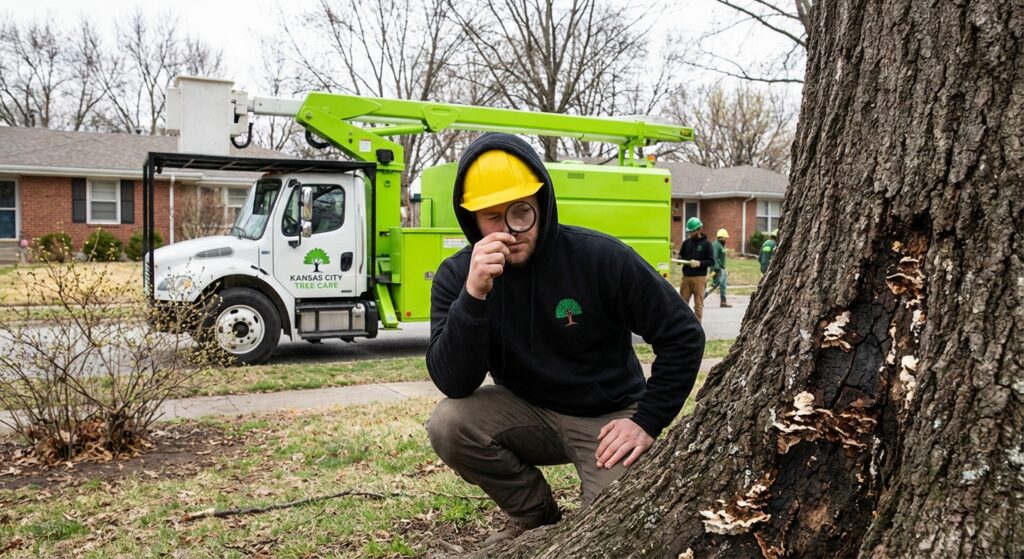
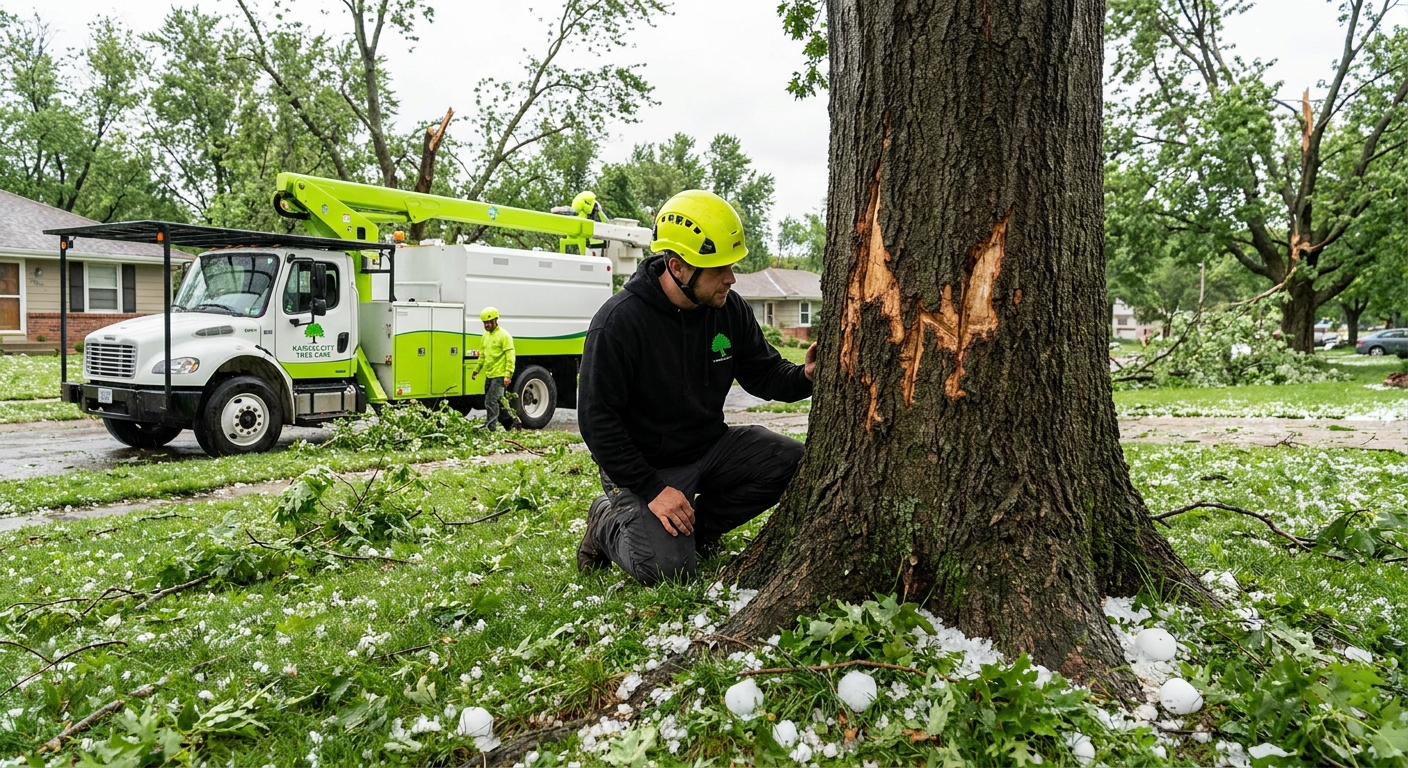
2. Bark scarring (nickel to golf ball-sized hail): larger hail hits hard enough to bruise or tear bark, especially on the upward-facing sides of branches. The visible wounds become entry points for diseases and insects. Recovery depends on how much bark was lost and how quickly the tree can compartmentalize the injuries.
3. Branch breakage and trunk wounds (golf ball to baseball-sized hail): severe hail breaks small to medium branches, shreds twigs, and can crack trunks on young or thin-barked trees. This is the damage level where hail starts to cause lasting structural problems.
Most KC-area hail storms produce defoliation plus some bark scarring. Severe storms with golf-ball or larger hail produce all three types — and those are the storms that warrant a professional hazardous tree evaluation a few weeks later.
What to Do the Day After a Hail Storm
The first 24-48 hours matter more than most homeowners realize. Here’s the checklist we give customers calling in after a severe hail event:
- Walk the yard and check every tree. Look at branches above head height too. Some damage isn’t visible from the ground without looking up carefully.
- Photograph everything. Stripped leaves on the ground, broken branches, bark wounds, the hail itself if any is still around. Time-stamped photos support any future insurance or property claim.
- Clear downed limbs from walkways and driveways, but don’t rush to prune damaged branches still attached to the tree.
- Water thoroughly. Defoliation stresses a tree’s hydration system. A deep soak — 1-2 inches over the root zone — helps the tree push new leaves faster.
- Leave a 3-4 inch mulch ring at the dripline if you don’t already have one. Mulch moderates soil temperature and moisture during recovery.
- Do NOT apply wound paint, tar, pruning sealer, or any coating to bark wounds. These trap moisture and accelerate decay. Bare wounds heal better.
- Do NOT fertilize immediately. Hail-stressed trees don’t need a nitrogen surge; they need water and time.
- Wait 2-4 weeks before pruning any damaged but still-attached branches. You’ll see clearly by then which branches are alive and which are dead.
If a branch is still attached but shattered or hanging in a way that threatens a structure, vehicle, or walkway, that’s when to call for immediate emergency tree service. Otherwise, patience produces better outcomes than rushing in.
Disease and Insect Risk From Open Bark Wounds
Bark wounds from hail are entry points. A tree’s bark is its primary immune defense — when that barrier is broken, several KC-area pests and pathogens get access to the living tissue underneath.
The problems we watch for after a hail event in the Kansas City area:
- Cytospora canker on ornamentals (especially ash, maple, and poplar) — sunken, discolored areas that form around hail wounds within months
- Nectria canker on hardwoods — concentric ring patterns of decay that girdle branches or trunks over 2-3 seasons
- Bacterial wetwood — dark, oozing staining that develops from damaged heartwood
- Flatheaded borers and roundheaded borers — these insects target stressed and wounded trees, especially the ash, maple, and oak common in KC yards
- Fungal decay — wood-rotting fungi enter through bark wounds and slowly compromise structural integrity over years
You won’t see any of this the week after the storm. Most disease and insect problems show up 2-6 months later, which is why a follow-up inspection in midsummer is smart after a severe hail event. A certified arborist can spot early signs of canker development and insect entry holes before major damage occurs.
How to Help a Hail-Damaged Tree Recover
Recovery support is mostly about reducing stress. Here’s what actually helps:
- Deep watering on a schedule. 1-2 inches per week at the dripline during the recovery period — more during hot, dry weeks. Soaker hoses work better than sprinklers for targeted root-zone watering.
- Mulch ring maintenance. A 3-4 inch layer of wood chip mulch over the root zone, kept 6 inches away from the trunk. Mulch conserves moisture and moderates soil temperature.
- Light corrective pruning — only shredded, clearly dead, or hazardous branches. Remove them with clean cuts back to healthy wood or the next live branch junction.
- Patience with fertilization. Wait until the following spring before applying any fertilizer. An exhausted tree recovering from hail doesn’t need forced growth.
- Monitoring over the next 12 months. Watch for new dieback, unusual leaf discoloration, bark damage progression, or insect activity around wounded areas.
What you specifically should NOT do: heavy pruning to “shape” the tree, stripping out damaged limbs before new growth confirms which are alive, or applying wound sealers. These interventions almost always make recovery worse rather than better.
When Hail Damage Is Fatal: The 50% Bark Rule
Most hail-damaged trees recover. The exception is trunk damage — and specifically, how much of the trunk’s circumference lost bark.
Here’s the practical rule arborists use:
- Under 25% of trunk circumference damaged: tree almost always recovers. Compartmentalization closes the wounds over 2-5 years.
- 25-50% of trunk circumference damaged: recovery is possible but uncertain. Decline may show up over years. Worth close monitoring and possibly a professional assessment.
- More than 50% of trunk circumference damaged: the tree has been partially girdled. Even if it leafs out in the short term, long-term decline is very likely. Structural failure risk increases as the wounded area decays.
- More than 75% of trunk circumference damaged: the tree is functionally girdled. It will die within 1-3 years and becomes a falling hazard as wood decays. Removal is the smart call.
This rule applies to contiguous bark loss on the main trunk. Several small, scattered wounds don’t add up the same way — a tree can have many small hail scars totaling more than 50% of surface area and still be structurally fine, because the damaged areas are separated by intact bark pathways.
If you’re not sure whether your tree’s trunk damage crosses the threshold, get a professional assessment. Pattern, depth, and location all matter — a photo or a quick on-site look from a certified arborist gives you a clearer answer than guesswork.
Recovery Outlook by Tree Species in Kansas City
Different species handle hail differently. Based on what we’ve seen across the KC metro:
- Oaks (bur, pin, red): very tough. Thick bark resists moderate hail well. Even heavily defoliated oaks usually push a second flush and recover fully
- Hackberry: tough and resilient, recovers well from defoliation and moderate bark damage
- Sycamore: recovers well but hail wounds combined with anthracnose (common in wet KC springs) can cause prolonged stress
- Maples (sugar, red, silver): variable. Sugar and red maples handle hail better than silver maples. Silver maples already have brittle wood and thin bark — hail damage compounds their structural weakness
- Ash (green, white): already stressed by emerald ash borer in most of the KC metro. Added hail damage often tips declining ash trees past the point of recovery
- Bradford pear: splits easily under any stress. Hail-damaged Bradford pears are prime candidates for Kansas City tree removal rather than restoration
- Fruit trees (apple, peach, cherry): the most vulnerable. Bark thinner, branches smaller, wounds more likely to allow disease entry. Treat hail-damaged fruit trees with extra care
- Evergreens (spruce, pine, arborvitae): hail shreds needles but rarely causes structural damage unless hail is very large. Most evergreens green back up in 1-2 seasons
A mature oak that looks devastated the day after a storm is almost always going to be fine. A mature silver maple or Bradford pear that took the same hit may have structural problems for years to come.
Hail Damage on Fruit Trees and Crops
For Kansas City homeowners with apple, peach, cherry, or pear trees, hail is more than a tree problem — it affects the current year’s crop and next year’s bud development.
What happens to hail-hit fruit trees:
- Current-year fruit is often destroyed or heavily scarred. Even hail that doesn’t knock fruit off the tree bruises it enough to cause early drop or spoilage
- Leaf damage reduces photosynthesis during the critical fruit-sizing weeks, resulting in smaller, less developed fruit
- Bark wounds on trunks and main scaffolds create entry points for fire blight — a bacterial disease devastating to apple and pear trees in KC
- Broken twigs disrupt next year’s fruit bud development. Expect a reduced crop in year two, even if the tree recovers fully
For serious backyard fruit growers, the practical response is: deep watering, remove any badly shattered branches with clean cuts, watch for fire blight symptoms (wilted, blackened shoots) over the next several weeks, and consider a copper-based fungicide at leaf drop in the fall to protect wound sites over winter.
Insurance Claims for Hail-Damaged Trees
Here’s the honest answer most homeowners don’t want to hear: homeowners insurance usually does NOT cover hail damage to trees themselves. Standard policies cover trees only when a tree damages an insured structure (house, garage, fence), and most specifically exclude “acts of nature” affecting landscaping.
Typical coverage situations:
- Tree falls on your roof during a hail storm: usually covered under the dwelling section of your policy
- Hail damages the tree but it remains standing: not covered. Tree care and recovery are the homeowner’s expense
- Hail-damaged tree later falls and damages property: covered, typically, but not the damaged tree itself
- Commercial fruit tree orchards: covered only under specific crop-insurance policies, not homeowners insurance
Most policies also exclude tree removal costs unless the tree is blocking a driveway or an entrance to the home. Read your specific policy and ask your agent about landscape coverage. Some policies offer optional endorsements for tree replacement up to a few thousand dollars — worth considering if you have valuable specimen trees in the KC metro.
Document hail damage with photos regardless of coverage. If the tree later fails and damages a structure, that documentation helps establish the timeline for any future claim.
When to Call an Arborist After Hail
Some hail damage is cosmetic and heals on its own. Some is structural and gets worse if ignored. Here’s when to bring in a professional:
- Multiple branches longer than 2 inches in diameter broken or hanging — safe removal usually requires climbing and rigging
- Bark loss on the main trunk covering 25% or more of circumference — needs professional evaluation for long-term survival odds
- Tree near your house, driveway, or walkway with any significant damage — structural risk assessment is worth the peace of mind
- Large trees (over 40 feet) with any damage — the higher the potential failure point, the more dangerous the consequences
- Signs of decline in the weeks after the storm — no second leaf flush, canker development, visible insect activity around wounds
- Fruit trees with moderate-to-severe damage — fire blight risk and crop-loss mitigation need targeted care
A professional arborist inspection in the KC metro typically runs free to $200 depending on scope. For storm damage after a severe hail event, most local tree services — including ours — offer free on-site assessments. We’ll walk the property, flag anything urgent, and give you a written evaluation with recommendations. You can also reach our team on our Google Business Profile for Kansas City Tree Care, LLC for photos, reviews, and directions.
Frequently Asked Questions
Will my tree recover from hail damage?
Most trees recover from hail damage — especially damage limited to leaves and small twigs. Trees defoliated by small hail almost always push a second flush of leaves within 4-6 weeks. Bark wounds heal through compartmentalization over 2-5 years. The exceptions are trees with more than 50% trunk circumference damage, trees with major structural breakage, and fruit trees hit hard during the fruit-development window. For those situations, a certified arborist assessment gives you a clear outlook.
Should I prune hail-damaged branches right away?
Only prune branches that are clearly shattered, hanging hazardously, or blocking walkways. Wait 2-4 weeks before pruning damaged but still-attached branches — you’ll see clearly by then which are alive and which need to come off. Pruning too early removes branches that might have recovered. When you do prune, use clean cuts back to healthy wood or the next live branch junction, and don’t apply sealers.
Can I use wound paint or tar to seal hail-damaged bark?
No. Wound paints, tar, pruning sealers, and similar products trap moisture against the wood and actually accelerate decay. Research has consistently shown that bare wounds heal faster than sealed wounds. The tree’s natural compartmentalization process is more effective than any coating. Leave bark wounds open and let the tree heal on its own.
Does homeowners insurance cover hail damage to trees?
Usually no. Standard homeowners policies cover trees only when they damage an insured structure like your house, garage, or fence. Hail damage to the tree itself — bark wounds, defoliation, broken branches — is typically the homeowner’s expense. Some policies offer optional landscape or specimen-tree endorsements with limited coverage. Check with your specific insurance agent for policy details.
How long does it take for a tree to recover from severe hail?
Leaf recovery takes 4-6 weeks — most defoliated trees have pushed new leaves by then. Bark wound compartmentalization takes 2-5 years depending on wound size and tree species. Full structural recovery — the tree returning to healthy canopy and normal growth — typically takes 1-3 years for moderate damage. For severe damage with multiple bark wounds or major branch breakage, the tree may carry stress markers for 5-10 years or longer.
Should I remove a hail-damaged tree in Kansas City?
Consider professional tree removal if more than 50% of the trunk circumference lost bark, if the tree has major structural breakage near a target (house, driveway, power line), if it’s a short-lived species (silver maple, Bradford pear) already past its prime, or if follow-up inspection shows progressive decline. Otherwise, most hail-damaged trees are worth saving through recovery care and professional tree trimming.
Hail Is Hard on Trees — But Most Make It Through
After 35+ years of responding to hail damage across Kansas City, KS and the surrounding metro, we’ve seen trees that looked completely destroyed the morning after a storm come back stronger than ever. We’ve also seen trees that looked fine develop serious problems months later from wounds no one caught. The difference is usually the care and attention in the first few weeks.
Our ISA-certified arborists handle hail-damage assessments, recovery pruning, disease monitoring, and removal across the KC metro. Kansas City Tree Care, LLC is fully licensed, insured, and BBB accredited, serving homeowners in Wyandotte County and Johnson County for over three decades.
Call Kansas City Tree Care at 913-894-4767 for a free hail-damage assessment on your trees. We’ll come out, walk the property, and give you an honest recommendation — recovery plan, pruning needs, or removal if that’s really the right call. No pressure, no obligation.