How much does tree removal cost in Kansas City? Here’s the honest answer: most residential removals run $800 to $3,500, with the typical job landing right in the middle of that range.
That spread feels wide, and there’s a good reason for it. A small dogwood by your patio is a different job than a 70-foot cottonwood leaning over your roof. Size, location, and access drive almost every dollar.
We’ve been removing trees across the KC metro for more than 35 years, on both the Kansas and Missouri sides. After that many jobs, we can usually ballpark a price the moment we pull into the driveway. This guide walks you through the same factors we weigh, so you’ll know what to expect before anyone gives you a quote.
As a trusted Kansas City tree service, we believe in clear pricing up front. No surprises, no padded estimates. Let’s break it down.
What Tree Removal Cost in Kansas City Really Looks Like
Let’s start with the real numbers. The tree removal cost in Kansas City depends mostly on the size of the tree and how easy it is to reach.
Here’s how the ranges typically break down for our area:
- Small trees (under 25 feet): $400 to $900. Think dogwoods, redbuds, small ornamentals, or young trees.
- Medium trees (25 to 50 feet): $900 to $1,800. Most maples, smaller oaks, and established yard trees fall here.
- Large trees (50 to 80+ feet): $1,800 to $3,500 and up. This covers the big oaks, cottonwoods, and sycamores you see all over older KC neighborhoods.
Most homeowners land somewhere between $800 and $3,500. That’s the honest, everyday range we quote across Overland Park, Olathe, Lee’s Summit, and the rest of the metro.
The good news is that a clear, accessible removal almost always costs less than people expect. When a tree sits in an open backyard with room to drop limbs safely, the work goes fast and the price stays reasonable.
How Tree Size and Trunk Width Set the Base Price
Size is the single biggest factor in any quote. A taller tree means more climbing, more cutting, and more wood to haul away.
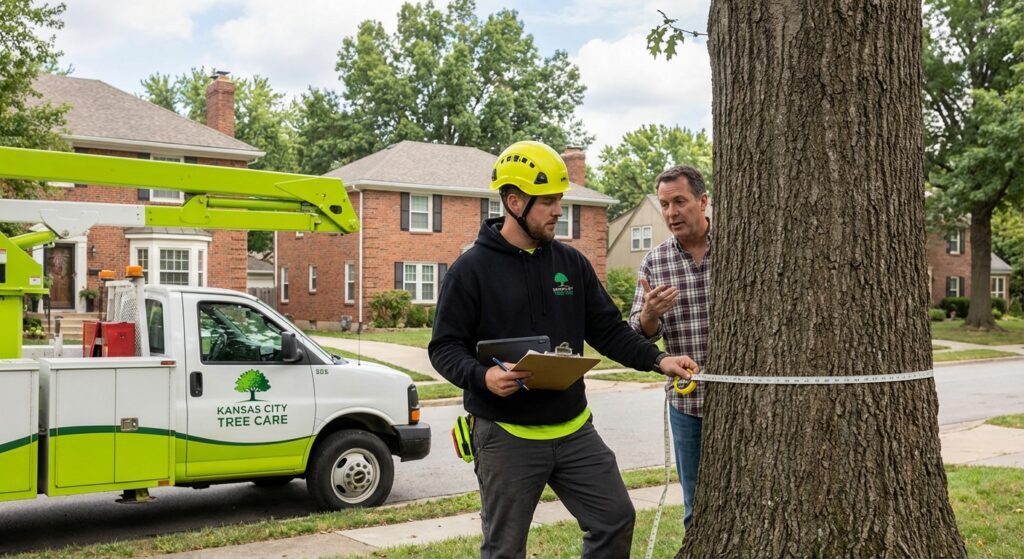
But height isn’t the whole story. We also look at trunk width, measured as DBH (diameter at breast height, the thickness of the trunk about four and a half feet off the ground).
A tall, skinny tree is easier to take down than a short, thick one. A wide trunk means heavier sections, slower cuts, and more time on the chipper.
We removed a stout bur oak in Leawood last fall that was only 45 feet tall but nearly four feet across at the base. That trunk alone took most of an afternoon, which put it at the higher end of the medium range.
Weight is the reason a thick trunk slows things down. A wider trunk holds far more wood than a narrow one, even at the same height. That extra mass means heavier rigging, more time on the saw, and more loads through the chipper.
This is why two trees that look similar from the street can quote very differently. The one with the broader trunk almost always costs more to take down.
The takeaway: when you measure a tree to estimate cost, note both its height and how thick the trunk is. Both numbers matter.
Why Location and Access Change Everything
Where your tree stands matters almost as much as how big it is. This is the factor most homeowners underestimate.
A tree in an open field can simply be felled in one piece. A tree wedged between your house, the fence, and the power line has to come down in careful sections, piece by piece. That second job takes far longer.
Here’s what raises the price on access:
- Close to the house: Limbs have to be roped and lowered so nothing lands on your roof or gutters.
- Near power lines: Work slows down for safety, and sometimes we coordinate with Evergy first.
- Tight backyards: If our equipment can’t reach the tree, the crew carries wood out by hand.
- Over a fence, pool, or shed: Every obstacle below the tree adds rigging time.
We handle these situations every week, and skilled rigging is exactly where our our tree removal service earns its keep. A tricky drop in a packed Prairie Village backyard is routine for our climbers.
Here’s a real example. We took down a large silver maple in a fenced Olathe backyard with a swimming pool directly below the canopy. There was no room to drop a single limb, so our crew roped down each section by hand and walked it out the side gate. That careful approach protected the pool and the patio, and it’s the kind of work access fees pay for.
The smart move: clear what you can from around the tree before we arrive. Open access can shave real money off the bill.
Local KC Species and What They Cost to Remove
The KC metro has its own mix of trees, and some are pricier to remove than others. Knowing your species helps you anticipate the cost.
Here’s what we see most often, and how each tends to price out:
- Silver maple: Fast-growing and brittle. Common in Overland Park yards, and storms love to break them. Medium-range pricing, usually $900 to $1,800.
- Pin oak: Beautiful but heavy, and they hold their leaves late. Larger ones push into the $1,800 to $2,800 range.
- Cottonwood: Massive, fast, and shallow-rooted. These are the giants, and removal often runs $2,000 to $3,500 or more.
- Sycamore: Big, broad canopies that need careful sectioning. Expect $1,800 to $3,000 for a mature one.
- Ash: Emerald ash borer has hit the metro hard. Dead ash trees turn brittle, which adds care and cost. More on that below.
- Bradford pear: Splits easily and usually stays small. Often one of the more affordable removals, $500 to $1,000.
The good news is that knowing your tree gives you a head start on budgeting. If you’re not sure what you’ve got, we’re happy to identify it for you on a free visit.
Dead, Diseased, or Damaged Trees Cost More
It seems backward, but a dead tree often costs more to remove than a healthy one. Here’s why.
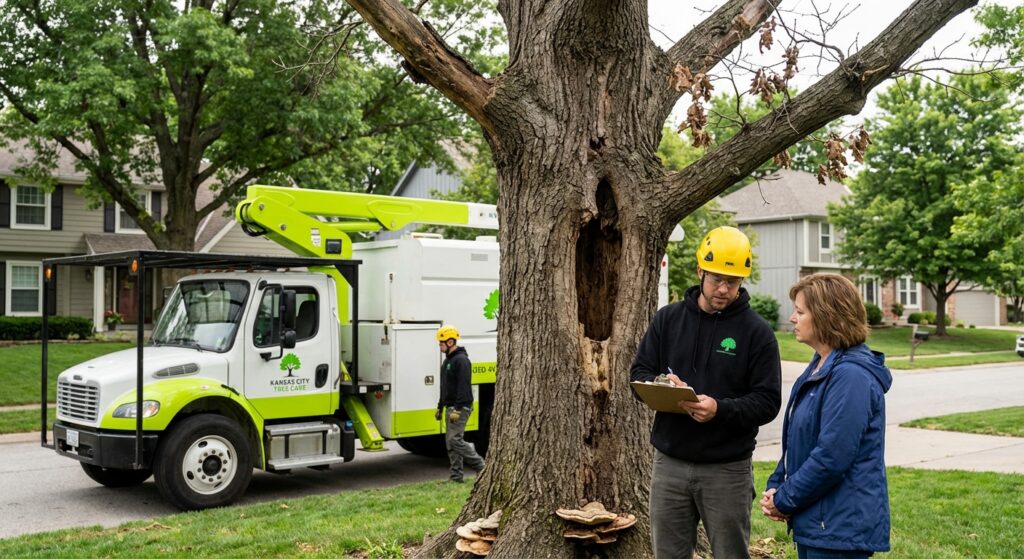
Living wood is flexible and predictable. Dead wood is brittle and unpredictable. Branches can snap without warning, so our crew slows down and rigs more carefully.
This comes up constantly with ash trees right now. Emerald ash borer (a beetle that kills ash trees from the inside out) has left thousands of dead ash standing across the metro. Once the wood dries and weakens, the removal takes extra care.
We took down a dead ash in Independence last spring that had been gone for two years. The trunk was so dry that pieces crumbled mid-cut, so our climber lowered everything in small, controlled sections. That patience is what keeps your property and our crew safe.
The honest takeaway: if a tree has died, removing it sooner usually costs less than waiting. Fresh-dead wood is far easier to handle than wood that’s been brittle for years.
KC Weather and Why Timing Affects Your Quote
Kansas City weather plays a real role in tree removal demand and pricing. Our seasons each bring their own challenges.
Ice storms roll through from December into February, and they’re hard on brittle species like silver maple and Bradford pear. A heavy glaze can snap limbs overnight, and our phones light up the next morning.
Spring brings the storm season, with high winds and the occasional tornado from March through June. That’s when we see the most uprooted and split trees across the metro.
Our clay soil adds another wrinkle. It holds water, which can loosen root systems and stress trees during wet stretches. Lee’s Summit and parts of Independence see this often.
Here’s the practical angle on cost. Routine, planned removals are easiest to schedule (and easiest on your budget) during calmer stretches like late summer or early fall. After a major storm, demand spikes everywhere at once.
The smart move: if a tree already worries you, handling it before storm season is both safer and easier to schedule.
Emergency Removal and Crane Jobs: The Higher End
Some jobs sit above the standard range, and it’s worth knowing why so the number doesn’t catch you off guard.
Emergency calls carry a premium. When a tree falls on a house at midnight during an ice storm, we send a crew out immediately. That fast, after-hours response costs more than a scheduled daytime visit, and that’s fair given the urgency.
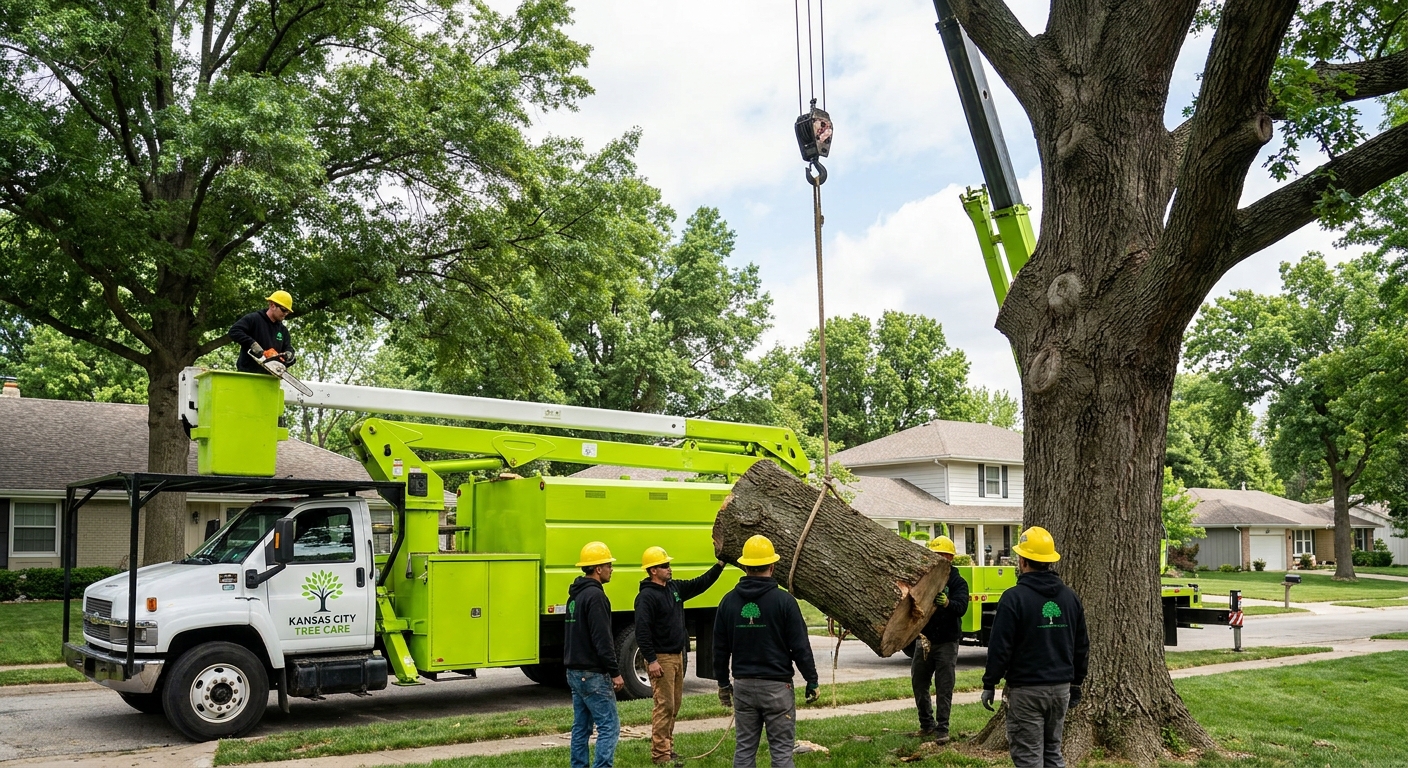
Crane jobs are the other big-ticket category. When a tree is too large, too dangerous, or too boxed-in to climb safely, we bring in a crane to lift sections out cleanly. A crane keeps everyone safe and protects your home, but it adds equipment cost.
These bigger removals often run $3,500 to $6,000 or more, depending on the tree and the setup. We always explain exactly why a crane is the right call before we book it.
If you’re staring at a leaning or storm-damaged tree and aren’t sure how serious it is, a hazardous tree evaluation gives you a straight answer. Not every scary-looking tree needs a crane, and we’ll tell you honestly either way.
Stump Grinding, Debris Haul, and Add-On Costs
One thing to know up front: the price to remove a tree usually does not include the stump. Most companies, including ours, price stump grinding separately.
That’s actually good for your budget, because it lets you choose only what you need. Here’s how the common add-ons typically price out:
- Stump grinding: $100 to $400 per stump, depending on diameter. Big cottonwood and oak stumps land at the higher end.
- Debris and brush haul: Often included, but extra-large jobs may add a haul-away fee.
- Wood cut to firewood length: Many homeowners ask us to leave the rounds for firewood, which can lower the haul cost.
- Root or surface-root grinding: Sometimes added when roots have lifted a sidewalk or patio.
Grinding the stump is the step that truly finishes the job. It clears the way for new grass, a garden bed, or simply a clean, open yard. Our stump grinding leaves you with mulch and a level spot instead of a tripping hazard.
The takeaway: when you compare quotes, ask whether the stump and haul-away are included. That single question keeps the comparison apples to apples.
How KC-Area Prices Compare Across Cities
People often ask whether removal costs more on the Kansas side or the Missouri side. The honest answer is that the tree matters far more than the city line.
A 60-foot pin oak costs roughly the same to remove in Olathe as it does in Lee’s Summit. What shifts the price is access, species, and condition, not the zip code.
That said, lot styles do vary. Newer neighborhoods in Olathe and Lenexa often have younger, smaller trees. Older areas like Leawood, Prairie Village, and parts of Kansas City MO have large, mature canopies that price higher simply because the trees are bigger.
We serve 16 cities across the metro, so we see the full spread every week, from compact Independence lots to sprawling Leawood properties. If you want a city-specific breakdown, our guide to tree removal costs in Overland Park digs into one of our busiest service areas in detail.
The smart move: focus on your specific tree, not a generic city average. That’s where the real number lives.
How to Get an Accurate Estimate
The only way to know your exact cost is a quick on-site look, and that visit is free.
When we come out, here’s what we check to build your quote:
- Tree height and trunk width to set the base price
- Access and obstacles like the house, fence, lines, and lawn features
- Tree condition, whether it’s healthy, dead, or storm-damaged
- Add-ons you want, such as stump grinding or firewood rounds
This whole assessment usually takes 15 to 20 minutes. You get a clear, written number with no obligation to book.
One tip when you collect quotes: make sure each one covers the same scope. A low number that skips the stump or the haul-away isn’t really cheaper. We spell out every line on our estimates so you can see exactly what you’re paying for.
As an ISA Certified, licensed, and insured crew, we stand behind every estimate we give. That certification means our team is trained and tested to industry standards, which protects your property and gives you confidence in the work.
Frequently Asked Questions
How much does it cost to remove a large oak tree in Kansas City?
A large oak typically runs $1,800 to $3,500 in the KC metro. Mature pin oaks and bur oaks with wide trunks land at the higher end, especially when they sit close to a house or power lines. Add stump grinding for another $150 to $400.
Does tree removal cost include the stump?
No, stump grinding is almost always priced separately. Most stumps run $100 to $400 depending on size, with big oak and cottonwood stumps costing more. Bundling it with the removal is usually the most efficient way to handle it.
Is emergency tree removal more expensive?
Yes, emergency and after-hours removals carry a premium for the fast response. A tree on your house during an ice storm needs immediate, careful work, which costs more than a scheduled daytime visit. We always explain the pricing clearly before any crew starts.
How long does it take to remove a tree?
Most residential removals take a few hours, from a quick small-tree job to most of a day for a large, boxed-in tree. Crane jobs and storm cleanups can run longer. We give you a realistic time window with your estimate.
Do I need a permit to remove a tree in the KC metro?
It depends on your city. Some areas like Overland Park and Olathe have specific tree ordinances, especially for trees in the right-of-way. We know the local rules and help you sort out any permit questions before we begin.
Get Your Free Tree Removal Estimate Today
Now you know exactly what shapes the tree removal cost in Kansas City, from size and access to species, condition, and add-ons. That knowledge puts you in a strong spot to compare quotes and budget with confidence.
For more than 35 years, our ISA Certified, licensed, insured, and BBB-accredited crew has handled removals of every size across 16 cities on both sides of the metro. Whether it’s a small ornamental in Mission or a towering cottonwood in Raytown, we bring the same care, honest pricing, and respect for your property. As a top-rated Kansas City tree service, we treat every yard like it’s our own.
We’re happy to come take a look, answer your questions, and give you a clear written estimate with no pressure and no obligation. Call Kansas City Tree Care at 913-894-4767 for a free estimate.