Why Bradford Pear Trees Are a Problem in Overland Park
Every April in Overland Park, the Bradford pears put on a show. White blossoms line streets from 75th to 159th, and for about ten days the whole city looks like a postcard. Then the blossoms drop, that unmistakable smell fades, and you’re left with the same tree that’s been causing problems since it was planted in the 1980s.
Here’s the honest answer about Bradford pears: they were a landscaping mistake. Developers across South Overland Park and the Blue Valley corridor planted them by the thousands because they grew fast, bloomed early, and looked uniform. Nobody told homeowners that these trees have a shelf life of about 20-25 years before they start splitting apart.
We’ve removed more Bradford pears in Overland Park than any other single species. After 35+ years of tree care across the KC metro, we can tell you exactly what to expect when it’s time to take one down and what to plant in its place.
Kansas Has Put Bradford Pears on the Invasive Species Watch List
This isn’t just our opinion as arborists. The Kansas Department of Agriculture has formally identified Callery pear (the parent species of Bradford pear) as an invasive concern. Kansas State University’s extension service has been recommending against planting them for over a decade.
The reason is simple. Bradford pears were bred to be sterile, but they cross-pollinate with other Callery pear varieties. The result is aggressive, thorny offspring that spread into native grasslands, fence rows, and woodlands. Drive along any highway interchange near Overland Park and you’ll see the evidence — clusters of thorny Callery pear seedlings crowding out native vegetation.
Several states have already banned the sale of Bradford pears entirely. South Carolina led the way. Missouri is considering similar legislation. Kansas hasn’t passed a formal ban yet, but the writing is on the wall. Removing your Bradford pear now puts you ahead of what’s coming.
Johnson County Parks and Recreation has been actively removing Callery pear from public parks and greenways. If the county is spending money to remove them from parkland, that tells you everything about where the science stands.
Weak Branch Structure and Storm Damage in Overland Park
The structural problem with Bradford pears is built into their DNA. Every major branch grows from the same tight point on the trunk, creating what arborists call “included bark.” Instead of strong, wide branch unions, Bradford pears have narrow V-shaped crotches where bark gets trapped between branches. This creates a weak seam that eventually fails.
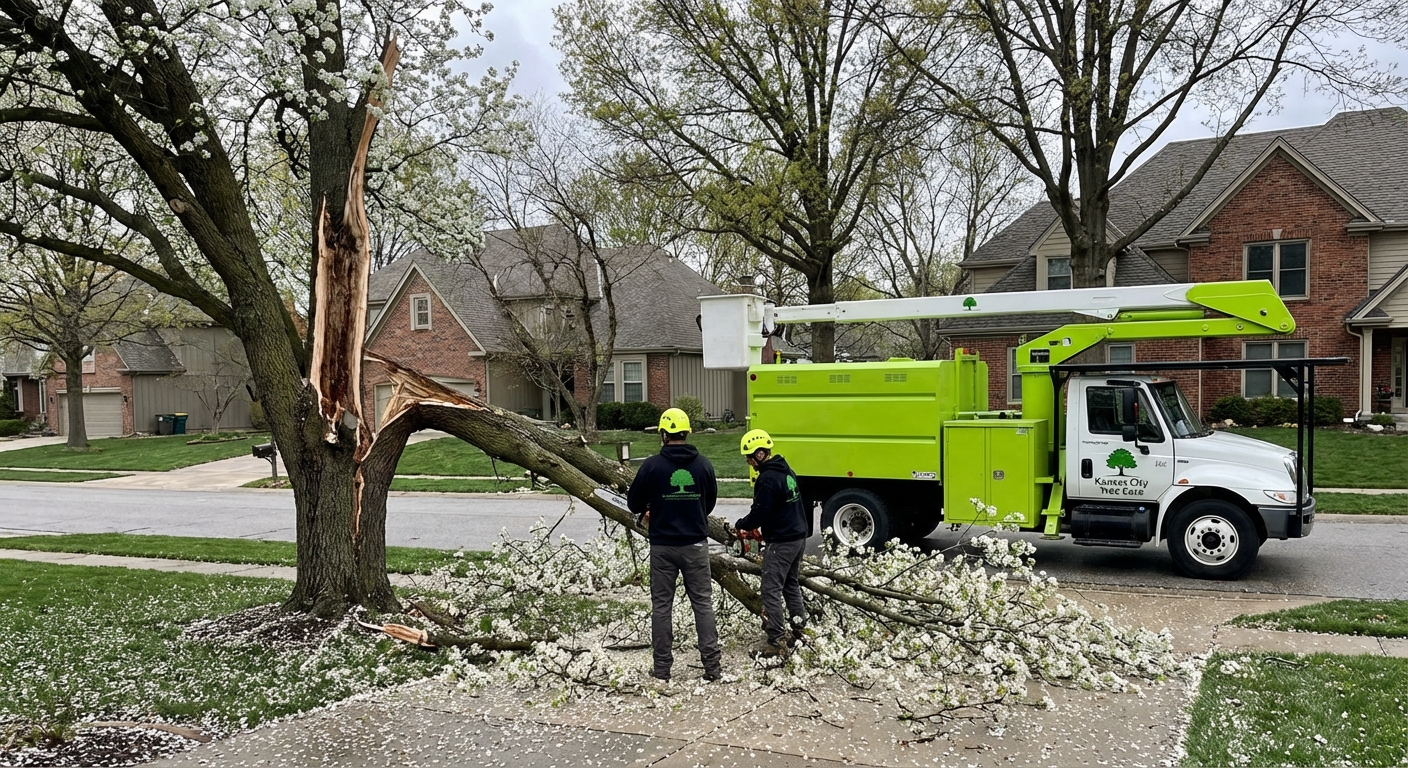
Most Bradford pears start splitting between 15 and 25 years of age. We see it every spring in Overland Park — a storm rolls through in late April or early May, and Bradford pears that looked perfectly healthy the day before are suddenly split in half. The blooms actually make it worse. All that flower weight at the branch tips acts like a sail in the wind.
Our crew responded to 14 Bradford pear emergency calls in Overland Park during the April 2025 storms alone. One homeowner near 135th and Metcalf had a Bradford pear split four ways onto their driveway, fence, and the neighbor’s yard. That emergency removal cost nearly twice what a planned removal would have been.
Ice storms are the other major trigger. The December 2024 ice event brought down Bradford pear limbs across Johnson County. Ice loads on those tight, upright branches create leverage that the weak unions simply can’t hold. Unlike a spreading oak that sheds ice naturally, a Bradford pear’s upright form catches and holds ice weight until something gives.
The pattern is predictable: your Bradford pear will look fine for years, then fail suddenly during the first strong spring storm or ice event after it passes the 20-year mark. Planned removal before that point saves money, prevents property damage, and gives you time to choose a great replacement tree.
How Bradford Pears Spread Through Overland Park’s Green Spaces
Beyond your own property, Bradford pears are actively degrading the native plant communities around Overland Park. The thorny seedlings they produce are extremely aggressive. They form dense thickets that shade out native wildflowers, grasses, and young trees.
Indian Creek Trail, the Tomahawk Creek corridor, and greenways along Blue River in South OP are all dealing with Callery pear invasion. These seedlings have thorns up to three inches long — genuinely dangerous for kids, pets, and maintenance crews.
Every mature Bradford pear in a residential yard contributes to this spread. Birds eat the small fruits and deposit seeds along creek corridors and open ground. One Bradford pear in your front yard can seed hundreds of thorny offspring across a surprisingly wide radius within just a few years.
Removing your Bradford pear isn’t just a property decision. It’s a neighborhood benefit. You’re eliminating a source of invasive spread that affects everyone’s green spaces.
Bradford Pear Removal Cost in Overland Park
Here’s what Bradford pear removal typically costs in Overland Park, based on the hundreds we’ve taken down across the city:
- Small Bradford pear (under 20 feet): $500-$800 — typically younger trees or ones that have already lost major branches
- Medium Bradford pear (20-35 feet): $800-$1,200 — the most common size we remove, usually 15-25 years old
- Large Bradford pear (35-50 feet): $1,200-$1,500 — fully mature trees in good access areas
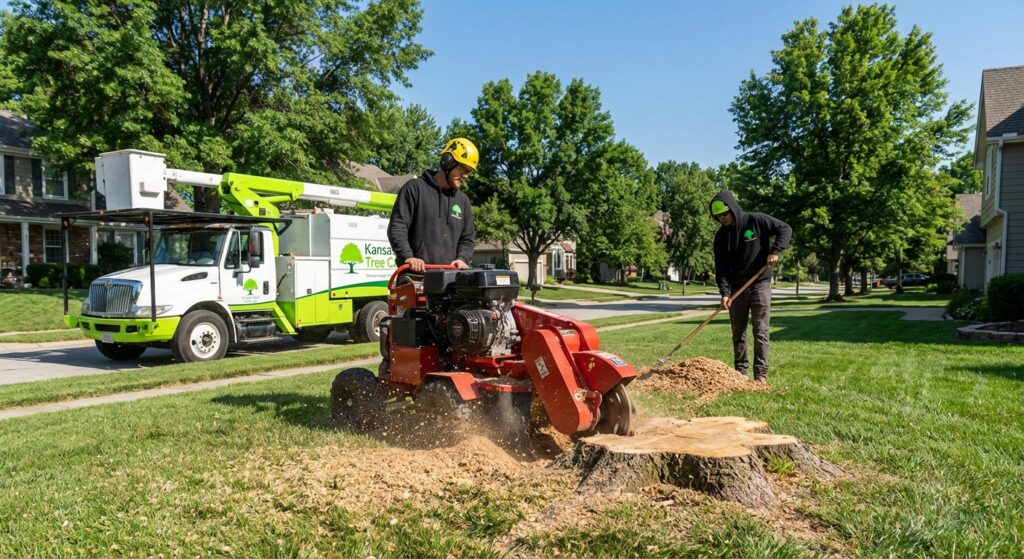
- Stump grinding (add-on): $150-$300 depending on stump diameter
Several factors affect your specific cost. Access is the biggest variable. A Bradford pear in the middle of a front yard with no obstacles is straightforward. One growing between a fence, a power line, and a neighbor’s garage requires more time and rigging.
Emergency removal after a storm split runs 30-50% more than a planned removal. That’s not a markup — it’s the reality of working around broken branches, unpredictable weight distribution, and urgent timelines. This is the strongest financial argument for removing your Bradford pear on your schedule rather than the tree’s.
We include cleanup and debris hauling in every quote. Some companies quote low and add haul-off as an extra — always ask what’s included. Our tree removal service covers everything from the cut to the cleanup.
Best Time to Remove a Bradford Pear in Overland Park
You can remove a Bradford pear any time of year. That said, certain seasons have advantages.
Late fall through early spring (November – March) is ideal. The tree is dormant, there are no leaves to add weight and bulk, and the ground is typically firm enough for equipment access. This is also when tree service crews have the most availability, so scheduling is easier and pricing is most competitive.
Avoid late April through early June if you’re planning a removal. That’s peak storm season in the KC metro, which means it’s also peak emergency call season. Our schedule fills up fast during spring storms, and wait times for non-emergency work increase.
Late summer (August – September) is a solid secondary window. Storm season has tapered off, crews are available, and the ground is dry and firm for equipment. You’ll also have time to plant a replacement tree in October, which gives the new tree a full dormant season to establish roots before its first Kansas summer.
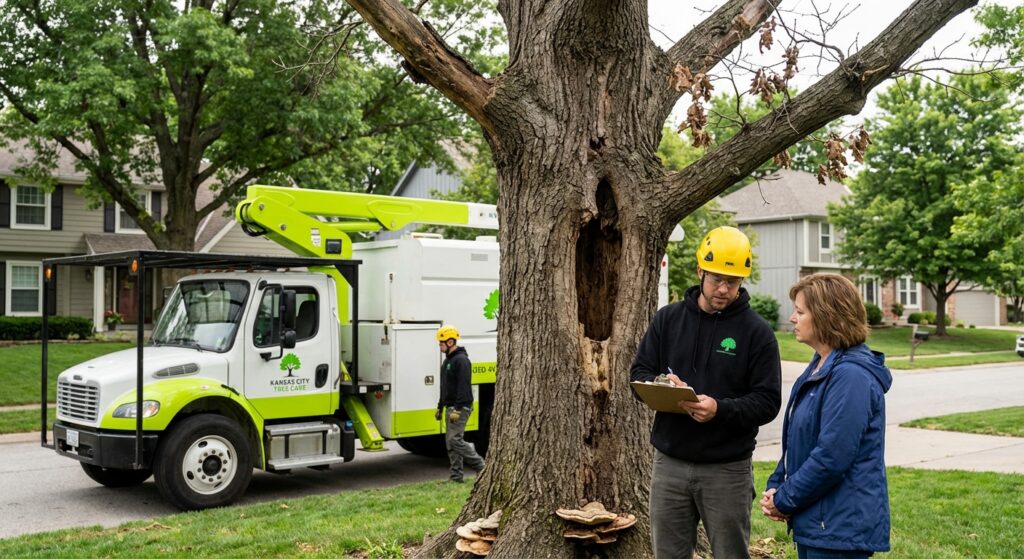
If your Bradford pear is already showing signs of splitting — visible cracks at branch unions, a lean that wasn’t there before, or bark separating at the main trunk — don’t wait for the optimal season. A compromised Bradford pear can fail in any weather. Get it assessed now and schedule removal before it becomes an emergency.
Our hazardous tree evaluation will tell you exactly where your tree stands and how much time you realistically have.
Native Alternatives for Overland Park Landscaping
The best part of removing a Bradford pear is what comes next. You get to replace a short-lived, invasive, structurally weak tree with something that actually belongs in a Kansas landscape and will last for generations.
Here are the native and well-adapted alternatives we recommend for Overland Park homeowners:
Eastern redbud (Cercis canadensis). Native to Kansas, stunning spring blooms (purple-pink, not white like Bradford pear), and perfect for front yards. Grows 20-30 feet — large enough to provide character without overwhelming a residential lot. Thrives in Johnson County’s clay soil. This is the most popular Bradford pear replacement we see in Overland Park.
Serviceberry (Amelanchier). White spring blooms that actually smell pleasant, edible berries that attract songbirds, gorgeous fall color. Multi-stem or single-trunk forms available. Grows 15-25 feet. Excellent for front yards near the house where you want spring interest without the risk of a large tree growing into your roof line.
Flowering dogwood (Cornus florida). The gold standard ornamental tree. Spring blooms, red fall berries, attractive winter branching. Grows 20-35 feet. Prefers some afternoon shade in Kansas summers — ideal for east-facing yards or locations with partial canopy from larger trees. Does best in amended soil with good drainage.
Bur oak (Quercus macrocarpa). If you want a legacy tree, this is it. Native to Kansas, drought-tolerant once established, and will outlive your house, your kids, and your grandkids. Grows 60-80 feet — this is for large lots in South OP or Blue Valley where you have the space. Not a direct replacement for a Bradford pear’s size, but the tree your property deserves.
Kentucky coffeetree (Gymnocladus dioicus). An underused native that deserves more attention. Tolerates KC’s alkaline clay soil beautifully, unique compound leaves, open winter branching. Grows 50-70 feet. Nearly pest and disease-free. This is the tree our arborists most wish more people would plant.
HOA and City Incentives for Bradford Pear Removal
Several communities in the KC metro are actively encouraging Bradford pear removal. Here’s what’s currently available in and around Overland Park:
Overland Park: The city doesn’t currently offer a direct rebate for Bradford pear removal, but the Parks and Recreation department has partnered with local nurseries on native tree giveaway events. These typically happen each spring and fall. Follow the city’s ArborDay announcements for dates.
Johnson County K-State Extension: The extension office periodically runs native tree programs where residents can purchase native species at cost. They also provide free consultations on species selection for your specific soil and sun conditions.
HOAs with tree replacement requirements: Many Blue Valley-area HOAs actually require you to plant a replacement tree within a certain timeframe after any removal. If your HOA has this rule, you’re already required to replant — use it as an opportunity to choose a better species. Some HOAs maintain approved tree lists that have already removed Bradford pear as an option.
Kansas Forest Service: The state offers conservation tree seedling programs each spring. While these are bare-root seedlings (small), they’re an affordable way to add native trees to your property for as little as $1-$2 per tree when ordered in bulk.
Even without direct financial incentives, the math works in your favor. A planned Bradford pear removal at $800-$1,200 today prevents an emergency removal at $1,500-$2,000+ after a storm — plus whatever damage the tree does to your roof, fence, car, or neighbor’s property on its way down.
Some Overland Park homeowners coordinate Bradford pear removal with neighbors on the same block. When we’re already on-site with the crew and equipment, adding a second or third tree on the same street brings the per-tree cost down noticeably. We’ve done block-wide removals in South OP neighborhoods where five or six homeowners scheduled together and everyone benefited from the volume pricing.
Frequently Asked Questions About Bradford Pear Removal
How do I know if my Bradford pear is about to split?
Look at the main branch unions where large limbs meet the trunk. If you see tight V-shaped crotches with bark ridges pushing up between branches, that’s included bark — the primary failure point. Visible cracks or seams along these unions mean the tree is actively separating. Any Bradford pear over 20 years old with tight branch unions is a candidate for removal before the next storm season.
Can I just prune my Bradford pear instead of removing it?
Pruning can extend the life of a younger Bradford pear by a few years, but it doesn’t fix the fundamental structural problem. The tight branch architecture is genetic — no amount of trimming changes the fact that every major limb is weakly attached. If your tree is under 15 years old, strategic pruning to reduce weight on overextended branches can help. Over 20 years old, removal is the more practical investment.
Will my property value decrease if I remove a large Bradford pear?
Temporarily, removing any large tree changes your curb appeal. But a well-chosen replacement tree actually increases property value more than a Bradford pear does — especially as buyers become more educated about invasive species. A mature Eastern redbud or serviceberry in full bloom is a genuine selling point. A split Bradford pear on the ground is not.
Does Overland Park require a permit to remove a Bradford pear on my property?
Overland Park does not require a permit for removing trees on private residential property in most situations. If your property is in a new development or subject to a tree preservation plan tied to construction, check with the city’s Planning department. Standard removal of a dead, diseased, or hazardous tree on an existing residential lot is your call.
How long does Bradford pear removal take?
Most Bradford pear removals in Overland Park take 2-4 hours including cleanup. The tight branch structure actually makes removal somewhat more complex than a similarly sized tree with wide-spreading branches, because each limb needs to be rigged carefully to prevent uncontrolled splitting. Stump grinding adds about 30-60 minutes.
What happens to the wood after removal?
Bradford pear wood isn’t great for firewood — it burns fast and doesn’t produce much heat. We chip the branches for mulch and haul larger trunk sections to wood recycling. Some woodworkers do value Bradford pear lumber for small turning projects because the grain can be attractive. But for most homeowners, disposal is included in the removal cost and you won’t need to deal with it.
Schedule Your Bradford Pear Assessment in Overland Park
If you’ve read this far, your Bradford pear is probably already on your mind. Maybe it’s showing cracks. Maybe a neighbor’s split last spring. Maybe you just want to get ahead of the problem before storm season rolls around again.
Kansas City Tree Care has been helping Overland Park homeowners make smart decisions about their trees for over 35 years. We’re ISA Certified, BBB Accredited, and licensed and insured. We’ll give you an honest assessment — and if your Bradford pear has a few good years left, we’ll tell you that too.
Call Kansas City Tree Care at 913-894-4767 for a free Bradford pear assessment and removal estimate. We serve all of Overland Park and 15 other cities across the KC metro. No pressure, no obligation — just honest advice from people who know these trees inside and out.