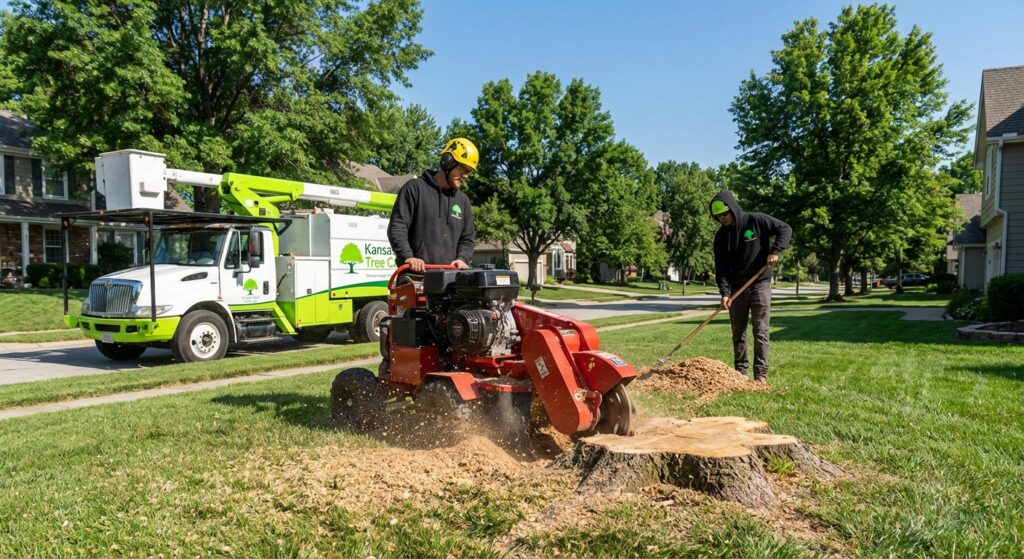

Tree Removal Is Not a DIY Project — Here’s Why
Every spring, we get calls from homeowners in the KC metro who started a tree removal project themselves and realized halfway through that they were in over their heads. Sometimes it’s a tree that fell the wrong direction. Sometimes it’s a branch that dropped onto the fence instead of the open yard. And sometimes — more often than anyone wants to admit — it’s a trip to the ER.
Tree removal consistently ranks among the top 3 most dangerous jobs in America. Professional tree workers have fatalities every year despite full training and equipment. For homeowners with a chainsaw and a YouTube video, the risk is exponentially higher.
We’ve been removing trees across the Kansas City metro for over 15 years — from 20-foot ornamentals to 80-foot cottonwoods leaning over houses. Here’s what safe tree removal actually looks like, when you can reasonably handle it yourself, and when you absolutely need to call a pro.
Can You Remove a Tree Yourself? A Realistic Assessment
Let’s be honest about what’s within a homeowner’s capability and what isn’t:
You can probably handle it if ALL of these are true:
- The tree is under 15 feet tall and under 6 inches in trunk diameter
- It’s in an open area with no structures, power lines, or fences within 1.5 times the tree’s height in any direction
- The tree is alive and standing straight (not dead, not leaning)
- You have a chainsaw, safety gear (chaps, helmet, eye and ear protection), and know how to use them
- The tree has a clear fall zone with nothing to hit
You need a professional if ANY of these are true:
- The tree is over 20 feet tall
- The trunk is over 10 inches in diameter
- The tree is within falling distance of a house, garage, fence, car, or power line
- The tree is dead (dead wood is unpredictable — branches snap without warning)
- The tree is leaning toward a structure or property line
- The tree has a split trunk, major cracks, or visible decay
- Any part of the job requires a ladder (ladders + chainsaws = the most common cause of tree work fatalities)
- Power lines are within 50 feet
If you’re reading this and thinking “well, my tree is borderline” — it’s not borderline, it’s professional territory. The cost of hiring a tree removal company is always less than the cost of damaging your house, your neighbor’s property, or yourself.
How Professional Tree Removal Works
When we show up to remove a tree, there’s a specific process we follow every time. It’s designed around safety first, property protection second, and efficiency third. Here’s what happens:
1. Site assessment. Before anyone starts a saw, the crew leader walks the entire site. They’re looking at: direction the tree naturally leans, weight distribution of the canopy, proximity to structures and utilities, ground slope, access for equipment, and escape routes. Every cut is planned before the first one is made.
2. Drop zone establishment. The area where debris will land is cleared of obstacles, vehicles, and people. We set up cones or barriers around the work area. Neighboring properties are notified if branches could cross property lines.
3. Rigging for tight spaces. In many KC neighborhoods — especially older areas like Prairie Village, Fairway, Mission, and Roeland Park — trees are surrounded by houses, fences, and overhead lines. You can’t just fell these trees. Instead, we climb the tree and remove it in sections, using ropes and rigging to lower each piece to the ground in a controlled manner. This is called “technical removal” and it’s the bread and butter of urban tree work.
4. Top-down sectional removal. Starting at the top of the tree, branches are removed first. Then the trunk is cut into sections — typically 4-6 foot lengths — and either lowered on a rope or dropped into the clear zone. Each cut is planned to manage the weight and direction of the falling piece.
5. Felling (when possible). If there’s enough room, the final trunk section can be felled in a controlled direction using a face cut and back cut. A proper felling cut includes a notch (face cut) that determines the direction of fall, and a back cut that releases the tree toward the notch. A “hinge” of uncut wood between the two cuts guides the tree as it falls. This is the part that looks simple but requires significant skill — misjudging the hinge by an inch can send a tree in an unintended direction.
6. Cleanup. All branches are chipped, trunk sections are cut to manageable size and either chipped, stacked as firewood (if you want it), or hauled away. The site is raked clean. Optional stump grinding can be done the same day.
The Dangers You Don’t See Coming
Most tree removal accidents happen because of hazards the person didn’t anticipate. Professional arborists are trained to identify these. Homeowners typically aren’t:
Spring poles. When a bent or compressed branch is cut, it can release stored energy like a spring — launching wood, tools, or the person cutting it. We see this with storm-damaged trees where branches are under tension but it’s not obvious from the outside.
Barber chairs. This is when a tree being felled splits vertically up the trunk before falling. The trunk slab swings back toward the cutter like a door. Barber chairs are the single most dangerous event in tree felling and one of the leading causes of fatalities. They happen more often with certain species (including cottonwood and willow, both common in KC) and with dead or decayed trees. Cottonwood in particular presents unique challenges — our guide covers cottonwood tree problems in Kansas City and why they require professional handling.
Hung-up trees. A tree that starts to fall but gets caught in another tree’s branches is extremely dangerous. It’s under tension, leaning at an unnatural angle, and can shift or complete its fall without warning. We see DIY attempts to pull or push hung-up trees with trucks, tractors, and cables — all of which are recipes for disaster.
Overhead hazards. Dead branches in the canopy that shake loose during cutting and fall on the person below. Power lines that aren’t visible through the foliage. Neighboring trees with dead wood dislodged by vibration.
Kickback. A chainsaw can kick back toward the operator’s head and upper body in a fraction of a second. This happens when the tip of the bar contacts wood or a hard surface. It’s the most common cause of chainsaw injuries and the reason professionals wear helmets with face screens and cut-resistant chaps.
Tree Removal Costs in Kansas City: What to Expect
Real pricing for the KC metro — these are ranges based on hundreds of jobs across Overland Park, Olathe, Shawnee, Lee’s Summit, and surrounding areas:
Small trees (under 25 feet, under 12″ diameter): $300-$800. Small ornamentals, young trees, small dead trees.
Medium trees (25-50 feet, 12-24″ diameter): $800-$2,500. This covers most residential tree removals — silver maples, hackberries, medium-sized oaks, ash trees.
Large trees (50-75+ feet, 24″+ diameter): $2,000-$5,000+. Large pin oaks, mature cottonwoods, big silver maples. Price depends heavily on access and proximity to structures.
Hazardous/complex removals: $3,000-$8,000+. Trees on structures, crane-assisted removals, trees near power lines requiring utility coordination, dead trees that are too unstable to climb safely.
Factors that increase cost:
- Proximity to structures (requires rigging, more time)
- Tight access (fenced backyards, narrow side yards)
- Power line proximity (requires utility coordination)
- Dead or hazardous trees (can’t be climbed, unpredictable wood)
- Steep terrain or poor ground conditions
- Emergency/after-hours service (50-100% premium)
What’s included: A reputable tree company includes all labor, equipment, debris removal, and site cleanup in their quote. Stump grinding is usually priced separately ($150-$400) because some homeowners want to keep the stump.
Choosing a Tree Removal Company in Kansas City
The tree service industry has low barriers to entry. Anyone with a chainsaw and a truck can call themselves a tree company. Here’s how to separate professionals from amateurs:
Insurance verification. This is the most important criterion. Ask for a certificate of insurance showing general liability AND workers’ compensation coverage. Call the insurance company to verify it’s current. If a worker is injured on your property and the company doesn’t have workers’ comp, your homeowner’s insurance could be on the hook.
ISA certification. The International Society of Arboriculture (ISA) certifies arborists through rigorous testing. While not all good tree workers are ISA certified, certification demonstrates a commitment to professional standards and ongoing education.
Written estimate. Get a detailed written estimate that specifies: exactly which trees are being removed, what’s included (debris removal, stump grinding, cleanup), total price, and timeline. Verbal quotes and vague descriptions lead to disputes.
No topping. If a company recommends topping trees (cutting main branches back to stubs), walk away. Topping is universally condemned by every legitimate arboricultural organization. It’s destructive, dangerous, and a clear sign the company doesn’t know what they’re doing.
References and reviews. Check Google reviews, ask for references from recent jobs in your area. A company with 15+ years in the KC metro should have plenty of verifiable work.
No door-to-door solicitation. Legitimate tree companies don’t drive around looking for work door-to-door, especially after storms. Storm chasers from out of state do. Be especially cautious of anyone who shows up unsolicited offering a “great deal” on tree work.
Before and After: Preparing Your Property for Tree Removal
To make the job go smoothly and keep costs down:
Before the crew arrives:
- Move vehicles away from the tree and the access route
- Remove or relocate lawn furniture, planters, decorations, and anything fragile within the work area
- Open gates for equipment access (if applicable)
- Secure pets indoors
- Notify neighbors if the work will be near their property line
- Know where your property lines are — especially if the tree is close to a boundary
After removal:
- Inspect the area for any minor property damage (fence nicks, lawn ruts) and note immediately
- Decide on stump handling — grind, leave, or use as a decorative element
- Plan for the gap in your landscape — a new tree, garden bed, or lawn restoration
- If a large tree was removed near your house, have a foundation check within the first year — the change in soil moisture from the missing tree’s water uptake can affect foundations on KC’s expansive clay soil
Tree Removal and Kansas City’s Clay Soil
This is something most national “tree removal” articles won’t tell you, but it matters a lot in the KC metro:
Once the tree is down, you’ll need to deal with the stump. Read our complete guide on stump grinding costs and options in Kansas City. If the tree was diseased, check common tree diseases in KC to protect your remaining trees.
Kansas City sits on heavy clay soil. Clay expands when wet and contracts when dry. Large trees near foundations actually help stabilize the soil moisture by absorbing massive amounts of water through their root systems.
When you remove a large tree near a house, the soil moisture balance changes. Understanding how tree roots cause foundation damage in Kansas City helps you weigh the risks of keeping a tree versus removing it. The area that used to be dried out by the tree’s roots now stays wet. The clay expands. This can cause foundation movement — cracking, sticking doors, uneven floors — especially in the first 1-2 years after removal.
This isn’t a reason not to remove a hazardous tree. It’s a reason to be aware of potential secondary effects and to monitor your foundation after large trees near your home are removed. If you notice changes, a foundation specialist can assess whether they’re related to the tree removal.
Conversely, leaving a tree too close to your foundation creates its own problems — roots infiltrating drainage systems, soil shrinkage causing settlement, and the ever-present risk of the tree falling on your house. There’s a balance, and a qualified arborist can help you evaluate it.
What About Tree Removal Permits in KC?
Most KC metro cities don’t require permits for removing trees on private residential property. Johnson County cities (Overland Park, Olathe, Shawnee, Lenexa, Leawood) generally have no residential tree removal permits. Missouri-side cities (KCMO, Lee’s Summit, Independence, Liberty) are similar for individual homeowners.
Exceptions: trees in public right-of-way (between sidewalk and street), trees on properties in historic districts, and removals connected to building projects that require permits. HOA communities often have their own tree removal approval requirements regardless of city rules.
For a detailed breakdown by city, read our guide on tree removal permits in Kansas City.
Frequently Asked Questions
How much does it cost to remove a tree in the Kansas City area?
Small trees (under 25 feet) typically cost $300-$800, medium trees (25-50 feet) run $800-$2,500, and large trees (50-75+ feet) range from $2,000-$5,000+. Complex removals near structures or power lines can exceed $5,000. Stump grinding adds $150-$400. Get at least two written estimates from licensed, insured companies.
We remove trees throughout the metro, from Lenexa to Independence. Here’s what homeowners ask most:
How long does tree removal take?
A small to medium tree in an open area takes 1-3 hours including cleanup. Large trees or trees requiring technical rigging (near structures, in tight spaces) can take 4-8 hours. Very large or complex removals may require a full day or crane work spread over two days. Your tree company should give you a time estimate with their quote.
What’s the best time of year to remove a tree?
Tree removal can be done year-round. Winter is often ideal — the ground is harder (less lawn damage), no leaves to manage, and many companies offer better pricing due to lower demand. However, if a tree is a safety hazard, don’t wait for the “perfect” time. Dead trees, severely damaged trees, and trees with obvious structural failure should be removed as soon as possible regardless of season.
Will removing a tree damage my yard?
Some minor lawn disturbance is normal — from equipment access, falling debris, and the stump area itself. Professional crews minimize this by using plywood or mats to protect lawns from heavy equipment. Most minor lawn damage recovers within one growing season with watering and reseeding. Significant yard damage is uncommon with experienced crews.
Should I remove the stump too?
We recommend it. Leftover stumps attract termites and carpenter ants, produce unwanted sucker growth, create tripping hazards, and make mowing difficult. Stump grinding costs $150-$400 and leaves the area ready for replanting or lawn restoration within a season.
Can I keep the wood for firewood?
Absolutely. Just let your tree company know before the job starts so they cut trunk sections to firewood length (16-18 inches) instead of chipping everything. Most companies will stack the wood at a location on your property. You’ll need to split and season the wood for 6-12 months before burning. Oak, hackberry, and walnut make excellent firewood. Silver maple and cottonwood burn fast and aren’t as desirable.
Don’t Cut Corners on Safety
Tree removal is one area where cutting corners — literally — has serious consequences. Hiring an uninsured crew to save a few hundred dollars can turn into thousands in property damage or liability. Trying it yourself to save money can end in the ER or worse.
We remove trees throughout the Kansas City metro every week — Johnson County, Jackson County, Clay County, and Cass County. Every job gets the same standard: proper planning, proper equipment, proper insurance, and proper cleanup. No shortcuts.
Call Kansas City Tree Care at 913-894-4767 for a free tree removal estimate.