Kansas Law on Property Line Trees — What Overland Park Homeowners Need to Know
A tree doesn’t care about property lines. Its roots grow wherever the water is. Its branches reach toward the best sunlight. And when that growth crosses onto your neighbor’s side — or their tree crosses onto yours — things can get complicated fast.
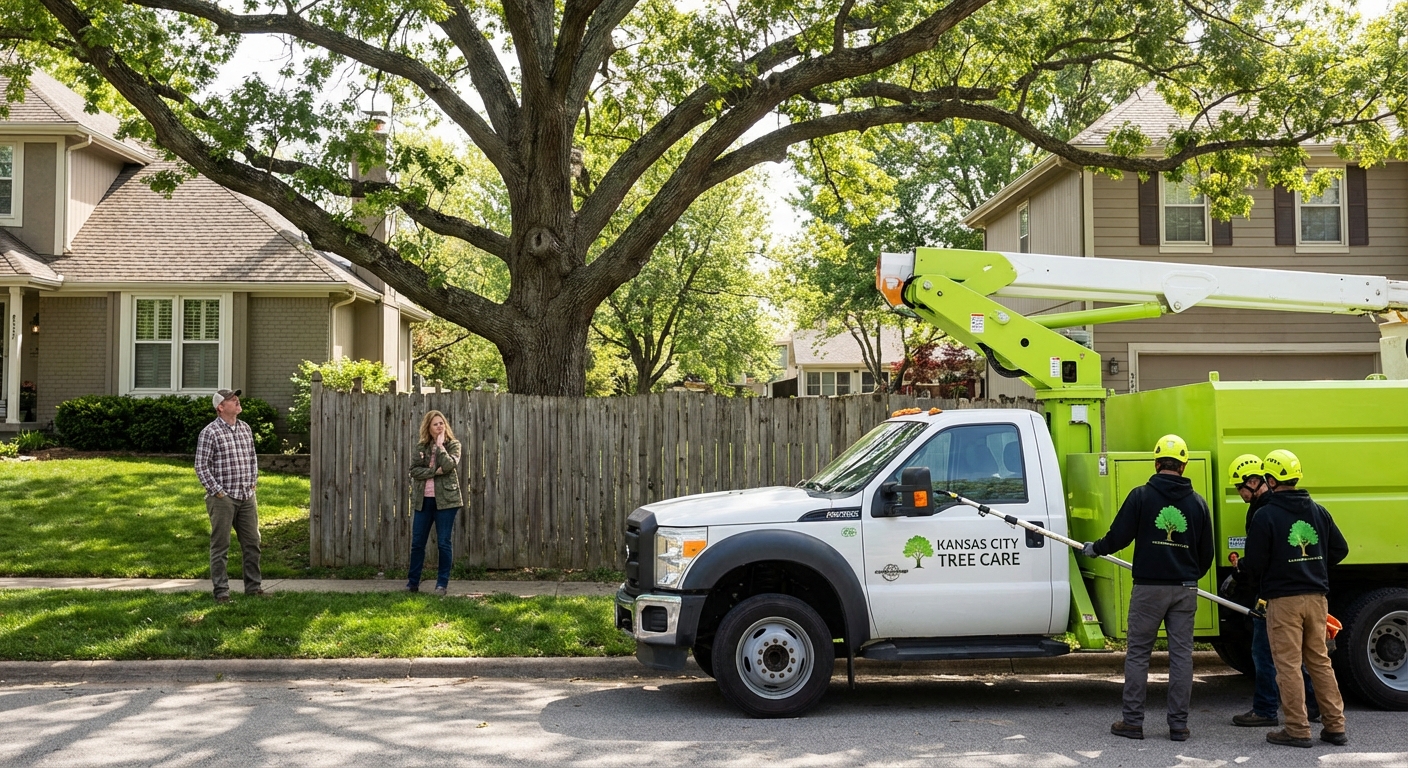
We get calls about property line tree disputes in Overland Park every week. It’s one of the most common situations we walk into across the established neighborhoods between 75th and 135th. Two homeowners, one tree, and a disagreement about who’s responsible for what.
After 35+ years of tree service across the KC metro, here’s what we’ve learned about how Kansas law handles these situations — and how to resolve them without ending up in court.
Kansas follows what’s known as the “self-help” doctrine for overhanging branches and encroaching roots. In plain terms, this means you have the legal right to trim any branches or roots that cross your property line — up to the property line, and no further. You don’t need your neighbor’s permission. You don’t need a permit from Overland Park. You just can’t cross that line.
There’s an important limitation here. You can trim back to the property line, but you cannot do anything that would kill or seriously damage the tree. If cutting encroaching roots destroys the tree’s stability or health, you could be liable for the tree’s value. This is where most homeowners get into trouble — they have the right to trim, but they go too far and damage a tree that was otherwise healthy.
Kansas also follows the “Fence Line Tree” doctrine. If a tree trunk sits directly on the property line — meaning both property owners share the trunk — the tree is jointly owned. Neither neighbor can remove it without the other’s consent. This comes up more often than you’d think in older Overland Park neighborhoods where original lot plantings grew right along fence lines.
Overhanging Branches — Your Rights and Responsibilities
The most common property line dispute we see in Overland Park involves overhanging branches. Your neighbor’s silver maple has grown 15 feet over your fence line. Leaves fill your gutters every fall. Branches shade your garden. Deadwood drops onto your deck.
Here’s what you can legally do:
- Trim branches back to the property line. You’re responsible for the cost. Your neighbor has no legal obligation to pay for trimming branches that overhang your property.
- Hire a professional. While you can do the trimming yourself, large branches over structures need proper rigging. Our tree trimming crew handles property-line work regularly and knows exactly where to cut to maintain tree health while respecting boundaries.
- Keep the cut material. Wood and branches you remove from your side of the line are yours to dispose of.
Here’s what you cannot legally do:
- Cross the property line to make cuts on your neighbor’s side. Even if you’re “just making the cut look better,” you’re trimming their tree without permission.
- Top or severely prune the tree in a way that kills it. Removing every overhanging branch back to the trunk could destabilize the tree or cause fatal dieback. You’d be liable for the tree’s assessed value — which can be thousands of dollars for a mature shade tree.
- Apply herbicide or poison to roots or trunk sections on your neighbor’s property. This happens more often than people admit, and it’s both illegal and potentially very expensive if proven.
The smart approach is to talk to your neighbor first. Most people in Overland Park are reasonable about tree maintenance when you bring it up respectfully. In many cases, your neighbor wasn’t even aware their tree was causing a problem — and they may split the cost of a professional trim.
Root Damage to Sidewalks, Driveways, and Foundations
Root encroachment is the harder version of the branch problem. You can see a branch crossing your property line. You can’t see roots expanding under your driveway, lifting your sidewalk, or pressing against your foundation wall.
The self-help doctrine applies to roots just like branches. You can cut roots at the property line. But root cutting carries serious risks that branch trimming doesn’t:
Cutting major roots can destabilize a tree. If that tree falls on your neighbor’s house because you severed its anchor roots, you could face liability. This is the scenario where getting an arborist assessment before cutting is worth every dollar.
Root damage to infrastructure is expensive to fix. Sidewalk replacement in Overland Park runs $8-$15 per square foot. A lifted driveway section is $1,500-$4,000 to replace. Foundation repair from root pressure starts at $5,000 and goes up from there. These are real numbers we’ve seen homeowners deal with while the property line dispute drags on.
Root barriers are often the practical solution. A root barrier installed along the property line at $20-$40 per linear foot redirects root growth without killing the tree. This is a one-time investment that prevents ongoing damage. We recommend barriers whenever root encroachment from a neighbor’s tree is causing infrastructure damage but the tree itself is healthy and valued.
If a neighbor’s tree roots have caused documented damage to your property, you may have a stronger legal position than the self-help doctrine alone provides. Document the damage with photos and get written estimates for repair. This becomes relevant if the situation escalates to a formal claim.
When a Neighbor’s Tree Threatens Your Property
Kansas law draws an important distinction between a healthy tree that simply overhangs your property and a hazardous tree that poses a genuine threat.
If your neighbor has a dead, diseased, or visibly dangerous tree that could fall on your house, fence, or family, the legal equation changes. Once a property owner is made aware of a hazardous tree on their property, they have a legal duty to address it. If they don’t and the tree causes damage, they can be held liable for negligence.
Here’s the practical process we recommend:
- Talk to your neighbor first. Explain your concern calmly and specifically. “The dead elm on your side of the fence line is leaning toward our house, and we’re worried about storm season.” Most people respond to a direct, reasonable conversation.
- Put it in writing. If a verbal conversation doesn’t result in action, send a certified letter describing the hazardous condition and requesting that they address it. This creates a documented record that they were formally notified.
- Get a professional assessment. Offer to split the cost of a hazardous tree evaluation from an ISA Certified arborist. A written assessment carries significant weight if the situation ever goes to court. It also gives your neighbor concrete information rather than just your opinion.
- Contact Overland Park Code Enforcement. If the tree creates a public safety hazard — hanging over a sidewalk, blocking sight lines, or threatening a public right-of-way — the city may compel the owner to act. Overland Park’s property maintenance codes include provisions for hazardous vegetation.
We’ve provided written tree assessments for dozens of property line disputes across Overland Park. In most cases, the assessment itself resolves the disagreement because it removes the guesswork. When both parties see an objective evaluation from a certified arborist, there’s usually a clear path forward.
Johnson County Small Claims Court — When Negotiation Fails
Sometimes a reasonable conversation isn’t possible. If your neighbor refuses to address a hazardous tree or disputes your right to trim overhanging branches you’ve legally cut, Johnson County District Court handles property disputes.
Small claims court in Johnson County handles disputes up to $10,000. Filing fees are under $100. You don’t need a lawyer, though having one can help for tree damage cases where appraisal values are involved.
Before going to court, you’ll need:
- Documentation of the tree’s condition: Photos, dated and with context
- Written communication with your neighbor: Copies of letters, emails, or text messages showing you attempted to resolve the issue
- Arborist assessment: A written evaluation from an ISA Certified arborist documenting the tree’s condition and any hazard it presents
- Damage estimates: Repair quotes for any property damage caused by the tree
- Property survey: If trunk location is disputed, a survey from a licensed surveyor establishes the line definitively
In our experience, the vast majority of property line tree disputes in Overland Park never reach this point. The combination of a respectful conversation, a written notice, and a professional tree assessment resolves 90% of these situations.
HOA Mediation in Blue Valley and Overland Park Subdivisions
If you live in an HOA community in Overland Park — and there are hundreds of them — your homeowners association may have specific provisions for tree disputes between neighbors.
Many HOAs in the Blue Valley area, South Overland Park, and newer developments near 159th have covenants that address:
- Minimum tree maintenance standards that all homeowners must follow
- Mediation processes for neighbor disputes before legal action
- Tree removal approval requirements — some HOAs require permission even for trees on your own property
- Shared boundary landscaping rules that specify responsibilities for trees on or near lot lines
Check your CC&Rs (Covenants, Conditions & Restrictions) before taking any action on a property line tree. If your HOA has a dispute resolution process, using it first is both required and usually faster than court. HOA boards typically want these issues resolved quickly because they affect neighborhood property values.
One word of caution: HOA rules don’t override Kansas state law. If your HOA tells you that you can’t trim branches that overhang your property, that conflicts with the self-help doctrine. The CC&Rs you signed may limit what you do with your own trees, but they can’t override your legal right to trim encroaching growth from a neighbor’s tree.
Hiring an Arborist for Property Line Tree Assessments
The single most effective thing you can do in any property line tree dispute is get an objective, professional assessment. Not your opinion. Not your neighbor’s opinion. A written evaluation from an ISA Certified arborist who has no stake in the outcome.
Here’s what a property line tree assessment from our team includes:
- Species identification and health evaluation — is the tree sound, declining, or hazardous?
- Structural assessment — are there defects that increase failure risk?
- Root zone evaluation — are roots causing documented damage?
- Trimming recommendations — what can be safely cut and where?
- Written report suitable for insurance claims, HOA submissions, or court proceedings
A professional assessment typically costs $150-$350 depending on complexity. That’s a fraction of what even a small legal dispute costs in attorney fees and court time. It’s also the document that makes insurance adjusters and HOA boards take your situation seriously.
Preventing Property Line Tree Disputes Before They Start
The best time to address a property line tree issue is before it becomes a dispute. Here are the practical steps we recommend for Overland Park homeowners:
Talk to your neighbors about trees proactively. When you notice a tree growing toward the property line — yours or theirs — bring it up early. “Hey, that maple is getting big. Want to split the cost of a trim before it gets into each other’s space?” This works remarkably well when the relationship is still positive.
Get a property survey before you assume. Many homeowners think they know where the property line is, but they’re off by several feet. A survey from a licensed Johnson County surveyor costs $300-$500 and eliminates the single biggest source of tree disputes — disagreement about where the line actually is.
Maintain your own trees. The best way to avoid being the neighbor with the problem tree is regular professional trimming. Keep branches trimmed back from fence lines and neighboring structures. Remove dead trees promptly. A well-maintained property rarely generates complaints.
Document everything in writing. If you have a conversation with your neighbor about a tree, follow up with a friendly email summarizing what you discussed. This isn’t adversarial — it’s just smart. If the situation changes a year later, you have a record.
Know when to get professional help. The moment a tree dispute involves potential property damage, insurance claims, or personal safety concerns, it’s time for a professional assessment. Opinions escalate conflict. Evidence resolves it.
Frequently Asked Questions About Property Line Trees
If my neighbor’s tree falls on my house during a storm, who pays?
In Kansas, your homeowner’s insurance typically pays for damage to your property caused by a fallen tree — even if the tree belonged to your neighbor. The exception is if you can prove your neighbor knew the tree was hazardous and failed to act. That’s where prior written notification and an arborist assessment create liability on their end.
Can I force my neighbor to remove a dead tree that threatens my property?
Kansas law doesn’t give you the direct power to force removal. However, once you’ve formally notified your neighbor in writing that a tree is hazardous, they assume legal responsibility for any damage it causes. You can also contact Overland Park Code Enforcement if the tree threatens public safety. Between written notice, city enforcement, and the threat of liability, most neighbors act.
How much does it cost to trim branches back to a property line?
Property line trimming in Overland Park typically runs $300-$800 depending on tree size, species, and how much canopy crosses the line. Large trees with significant overhang near structures cost more due to rigging requirements. The homeowner requesting the trim pays the cost — your neighbor has no legal obligation to contribute, though many do when asked.
What if a tree trunk sits directly on the property line?
Under Kansas law, a tree with its trunk on the property line is jointly owned by both neighbors. Neither party can remove it without the other’s consent. Both owners share maintenance responsibility. If you want it removed and your neighbor doesn’t, you’ll need to negotiate — or ultimately, seek a court order if the tree is hazardous.
Should I get a survey before dealing with a property line tree issue?
If there’s any doubt about where the property line falls relative to the tree, absolutely. A licensed survey is the only definitive answer. Many trees that homeowners think are “on the line” are actually entirely on one side. A $300-$500 survey can prevent a $5,000+ legal dispute. We’ve seen it make the difference dozens of times.
Get an Expert Assessment for Your Property Line Tree Concern
Property line tree disputes don’t have to ruin a neighbor relationship. The right information and a professional assessment almost always point toward a clear solution that both parties can live with.
Kansas City Tree Care has been helping Overland Park homeowners navigate tree disputes for over 35 years. Our ISA Certified arborists provide objective, written assessments that hold up with HOAs, insurance companies, and courts. We’re BBB Accredited, licensed, and insured — and we have no interest in recommending work that isn’t necessary.
Call Kansas City Tree Care at 913-894-4767 for a professional tree assessment. We’ll evaluate the tree, explain your options, and give you a clear path forward. Serving all of Overland Park and the entire KC metro — no pressure, no obligation, just honest arborist advice.