
When a Tree Emergency Hits Kansas City, Every Hour Counts
It’s 2 AM, a summer thunderstorm just ripped through, and you hear the sound no homeowner wants to hear — a deep, splitting crack followed by the ground shaking. You look outside and there’s a 50-foot silver maple draped across your roof, power lines tangled in the branches, and rain pouring through where your bedroom wall used to meet the ceiling.
We get these calls year-round across the KC metro. Ice storms in January, straight-line winds in July, the occasional tornado warning that turns into the real thing. Kansas City sits right in the path of some of the most destructive weather patterns in the country, and our trees take the hit first.
Here’s what you need to know about emergency tree service in Kansas City — before, during, and after the storm.
Our storm recovery and disaster response teams are among the first on the scene when storms hit the KC metro.
What Qualifies as a Tree Emergency
Not every fallen branch is an emergency. Understanding what is and isn’t urgent helps you make the right call — and potentially saves you money, since emergency rates are higher than scheduled work.
Call for emergency service immediately if:
- A tree or large branch has fallen on your house, garage, or any occupied structure
- A tree is on your car or blocking your driveway with no other way out
- A tree is resting on or tangled in power lines (call your utility company FIRST — Evergy at 888-471-5275 — then call us)
- A tree is blocking a public road or creating an immediate traffic hazard
- A tree has partially uprooted and is leaning toward a structure or area where people are present
- A cracked trunk is actively splitting and the tree could fall at any moment
Can wait until normal business hours:
- Branches down in the yard that aren’t threatening structures or people
- A tree leaning but stable with no crack or root heaving visible
- Minor storm damage to a tree that’s otherwise sound
- Dead branches hanging in the canopy but not directly over a walkway or structure
The difference matters financially. Emergency tree removal during or immediately after a storm can cost 50-100% more than scheduled work because of overtime, hazardous conditions, and demand surge. If the situation can safely wait 12-24 hours, you’ll get better pricing and the same result.
Kansas City’s Worst Weather Threats for Trees
Understanding what causes tree emergencies in KC helps you prepare. Here’s what we see most:
Straight-line winds. These are the number one cause of tree damage in the Kansas City metro — more than tornadoes, ice storms, or anything else. Summer thunderstorms regularly produce 60-80 mph winds that hit with almost no warning. Unlike tornadoes, straight-line winds affect entire neighborhoods at once. We’ve had storms where we fielded 40+ emergency calls in a single night across Overland Park, Olathe, and Shawnee.
Straight-line winds are particularly devastating for silver maples and cottonwoods — fast-growing, weak-wooded species that are everywhere in the KC metro. Their branches simply can’t handle the load.
Ice storms. KC averages a significant ice event every 2-3 years. The north side of the metro (Liberty, Clay County) typically gets hit hardest, but everyone is at risk. A half-inch of ice accumulation on branches can add hundreds of pounds of weight to a tree’s canopy. Trees that weren’t properly thinned before winter are the first to fail.
Ice damage is particularly insidious because it often happens overnight and progressively worsens. Our guide to ice storm emergency tree removal in Kansas City covers what to expect and how to respond when ice brings down trees across your property. You go to bed hearing occasional cracks. By morning, half the trees on the street have split apart. The weight builds gradually until branches — or entire trees — can’t hold anymore.
Tornado-season severe weather. March through June is severe weather season in the KC metro. While direct tornado hits on developed areas are relatively rare, the supercell thunderstorms that spawn tornadoes also produce extreme winds, large hail, and heavy rain that saturate soil and compromise root systems.
Saturated soil + wind. This is the combination that uproots entire trees. KC’s heavy clay soil actually holds trees well when dry — but when it’s saturated from days of rain and then hit with strong winds, the root system loses its grip. We see more whole-tree failures (tree tips over, root ball and all) after extended wet periods than after any other weather pattern.
What to Do When a Tree Falls on Your House
This is the most common emergency call we get. Here’s the step-by-step:
1. Get everyone out and safe. If the tree has penetrated the roof or wall, evacuate the affected rooms immediately. Structural damage may not be limited to the impact zone — load-bearing elements could be compromised.
2. Call 911 if there’s immediate danger — gas smell, sparking wires, fire, or someone injured/trapped. Do not attempt to move the tree yourself in any of these situations.
3. Call your utility company if power lines are involved. Evergy’s emergency line is 888-471-5275. Do NOT touch the tree or anything metal in contact with the tree if there are downed lines anywhere nearby. Assume any downed wire is live.
4. Call an emergency tree service. This is us. We operate 24/7 for emergencies and can typically have a crew on-site within 1-3 hours depending on storm severity and location. 913-894-4767.
5. Call your homeowner’s insurance. Most standard policies cover tree damage from storms, wind, and ice. Document everything with photos before the tree is removed. Your adjuster will want to see the damage in place.
6. Tarp exposed areas. If rain is ongoing and the roof is breached, temporary tarping prevents further water damage. Our crews can handle emergency tarping as part of tree removal, or your insurance company may send a separate board-up/tarp crew.
Emergency Tree Removal: What It Costs in KC
Nobody likes talking about money during an emergency, but you should know what to expect:
Standard emergency tree removal (tree on ground, no structure contact, accessible location): $1,000-$3,000
Tree on a structure (house, garage, fence): $2,000-$5,000+ depending on size, extent of structural involvement, and complexity of removal
Tree on power lines (requires coordination with utility company): $2,500-$6,000+ depending on the situation
Crane-assisted removal (tight spaces, tree too unstable for climbing, large tree on structure): $4,000-$8,000+
After-hours and weekend rates are typically 25-50% higher than regular business hours. During major storm events when every tree company in KC is slammed, prices can spike further due to pure demand.
Insurance coverage: Homeowner’s insurance generally covers tree removal if the tree damages a covered structure (house, garage, fence). If a tree falls in your yard and doesn’t hit anything, insurance typically does NOT cover removal — that’s considered maintenance. This is why proactive trimming and hazardous tree evaluation is so important. Check your specific policy — coverage varies.
Choosing an Emergency Tree Service in Kansas City
After a major storm, your phone will be ringing with tree companies soliciting door-to-door. Some are legitimate local crews adding capacity. Others are storm chasers — out-of-state operations that follow severe weather, do quick and often sloppy work, collect payment, and disappear.
How to tell the difference:
- Ask for proof of insurance. A legitimate tree company carries general liability and workers’ compensation. Storm chasers often carry neither. If a worker is hurt on your property and they don’t have workers’ comp, guess who’s liable?
- Check for a local address and phone number. If they can’t give you a physical business address in the KC metro, be cautious.
- Never pay in full upfront. A reasonable deposit for emergency work is fine (25-50%), but paying 100% before the work is complete is risky with any contractor you don’t know.
- Ask about stump grinding and cleanup. Reputable companies include full debris removal. Storm chasers often cut the tree off the structure and leave the rest for you to deal with.
- Get it in writing. Even in an emergency, a one-page estimate specifying the scope of work and total price protects both parties.
Preventing Tree Emergencies: What to Do Before Storm Season
The best emergency tree removal is the one that never happens. Here’s what we recommend for KC homeowners every year:
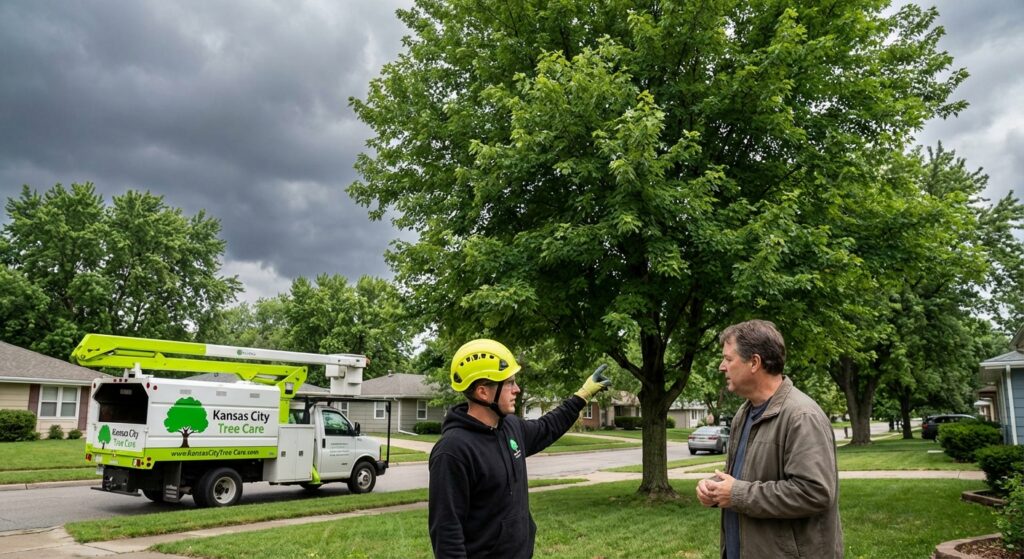
Schedule a pre-storm inspection (February-March). Have a certified arborist walk your property and evaluate every tree within falling distance of your home. They’ll identify dead wood, weak branch unions, root problems, and structural defects that could fail in a storm. A 30-minute inspection costs a fraction of an emergency removal.
Get proactive trimming done in late winter. Thinning the canopy reduces wind resistance. Removing dead and crossing branches eliminates the weakest points. This is the single most effective thing you can do to prevent storm damage to your trees — and it’s cheaper than one emergency call.
Address known problem trees. That silver maple with the co-dominant stems and included bark that you’ve been worrying about for three years? It’s not going to fix itself. Either have it cabled and braced to support the weak union, or remove it before the next ice storm makes the decision for you — through your roof.
Remove dead trees before they fall. This is especially urgent for dead ash trees. EAB-killed ash becomes dangerously brittle within 1-2 years. Every dead ash standing in your yard is a liability waiting for a weather event. We remove dead ash trees every week across the KC metro — and the cost of planned removal is always less than emergency removal.
Know your trees. Species with weak wood (silver maple, cottonwood, Bradford pear, Siberian elm) need more frequent maintenance than strong-wooded species (oak, walnut, hackberry). If your yard is full of silver maples — common in neighborhoods built in the 1960s-80s throughout Overland Park and Shawnee — budget for regular trimming.
After the Storm: Next Steps
Once the immediate emergency is handled, here’s what comes next:
Once the immediate danger is cleared, it’s smart to prepare your remaining trees for future storms. You should also check for signs of hidden damage in trees that looked fine during the storm but may have compromised root systems.
Document everything for insurance. Take photos of the tree damage, the structural damage, and the surrounding area from multiple angles. Note the date and time. Save receipts for all emergency work, tarping, and temporary repairs.
Get a structural assessment. If a tree hit your house, have a structural engineer or qualified contractor inspect the damage before making permanent repairs. What looks like minor roof damage may have shifted trusses or rafters.
Don’t rush permanent repairs. File your insurance claim, get the adjuster out, and get multiple repair quotes. Emergency tarping buys you time to make informed decisions rather than panic-hiring the first contractor who knocks on your door.
Evaluate remaining trees. A storm that takes down one tree often damages others. Have a professional inspect the trees that survived — they may have cracks, root damage, or broken branches in the upper canopy that aren’t visible from the ground but could fail in the next storm.
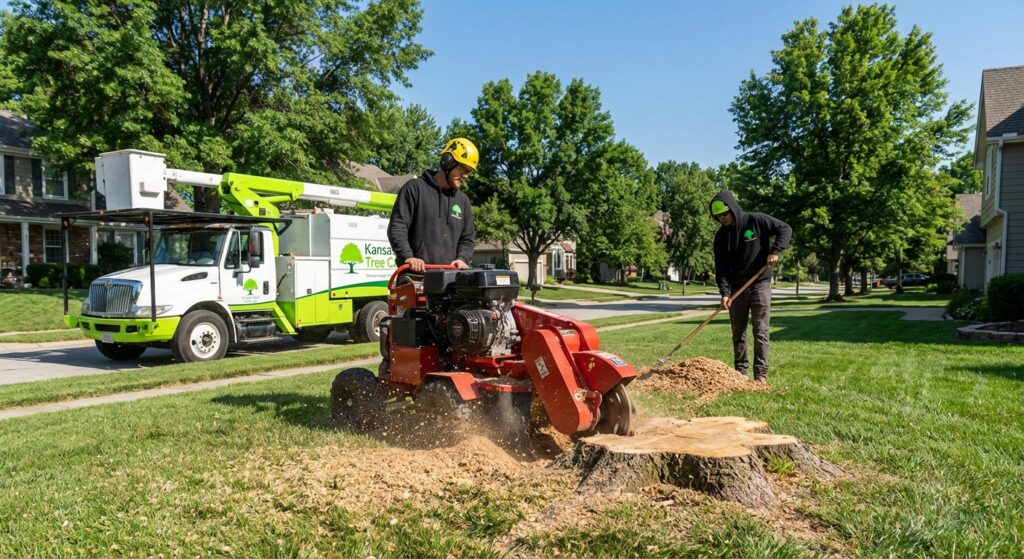
Consider stump grinding. Once the tree is removed, the stump remains. We can grind it during cleanup or come back later. Stump grinding is typically $150-$400 and prevents the stump from becoming a tripping hazard and termite magnet.
Our Emergency Response Process
When you call Kansas City Tree Care for an emergency, here’s exactly what happens:
- Phone assessment. We ask what happened, what the tree is on or near, whether there are power lines involved, and whether anyone is in immediate danger. This helps us dispatch the right crew with the right equipment.
- Response time. During normal weather, we can typically be on-site within 1-3 hours. During major storm events affecting the entire metro, response times extend because demand surges. We prioritize: trees on occupied structures first, then power line situations, then road blockages, then downed trees in yards.
- On-site assessment and pricing. Before we start cutting, we assess the situation, identify hazards, and give you a price. You’ll know the cost before we do the work. No surprises.
- Safe removal. Our crews are trained for hazardous tree removal — working around structures, power lines, and unstable trees. We use proper rigging, cranes when necessary, and full PPE. Speed matters in an emergency, but safety comes first.
- Complete cleanup. We don’t leave debris. All wood, branches, and chips are removed from the property. If the tree was on a structure, we make the area safe and coordinate with your insurance and repair contractors.
Frequently Asked Questions
Does homeowner’s insurance cover emergency tree removal?
Generally yes — if the tree damages a covered structure (house, garage, fence, shed). Most policies cover removal of the tree from the structure plus repair costs. If a tree falls in your yard and doesn’t hit anything, removal is typically not covered. Some policies include a small allowance ($500-$1,000) for tree removal even without structural damage, but check your specific policy.
We provide emergency tree service across Liberty, Shawnee, and every city in the metro. Here are common questions after storms:
How fast can you respond to a tree emergency in KC?
During normal conditions, we’re typically on-site within 1-3 hours. During major storm events when we’re handling multiple emergencies across the metro, response times can extend to 4-12 hours for non-life-threatening situations. Trees on occupied structures and situations involving power lines are always prioritized.
What should I do if a tree falls on power lines?
Stay away from the tree, the wires, and anything metal in contact with either. Assume all downed wires are live. Call Evergy at 888-471-5275 immediately. Do not attempt to remove branches from power lines yourself. Once Evergy has de-energized the line and cleared the scene, a tree crew can safely remove the tree.
Can I remove a storm-damaged tree myself?
Small branches on the ground — yes, you can clean those up. Anything involving a chainsaw, a ladder, hung-up branches in the canopy, trees on structures, or anything near power lines — no. Storm-damaged trees are unpredictable. Branches under tension can snap or spring when cut. Partially uprooted trees can shift suddenly. Professional crews have the training and equipment to handle these situations safely.
Should I get my other trees inspected after a storm?
Yes. A storm that takes down one tree often damages others in ways that aren’t immediately visible — hairline trunk cracks, partially torn root systems, broken upper branches lodged in the canopy. A professional inspection after a storm can identify these hazards before the next weather event turns them into another emergency.
Be Ready — Not Reactive
KC weather isn’t going to get gentler. The smartest thing you can do is handle known tree hazards now — during business hours, at scheduled rates, on your timeline — instead of waiting for a storm to make the decision for you at emergency prices through your roof.
We serve the entire Kansas City metro area with 24/7 emergency response — Overland Park, Olathe, Shawnee, Lenexa, Lee’s Summit, Independence, Liberty, Kansas City MO, and all surrounding communities. Licensed, insured, ISA certified, and 15+ years of storm response experience in this market.
Call Kansas City Tree Care at 913-894-4767 — available 24/7 for tree emergencies.