The Bug You’re Seeing On Your Tree Probably Isn’t the One You Should Worry About
Every summer, our phone lights up with the same kind of call. A homeowner in Kansas City spots something alarming on a tree — a giant wasp burrowing into the lawn, a cottony web hanging off a pecan branch, sawdust piled at the base of a locust — and wants to know if the tree is doomed.
Here’s the honest answer: some summer pests are cosmetic annoyances that the tree will shrug off on its own. Others are quiet killers that work under the bark for two or three years before you even notice. Knowing which is which saves you money and saves your trees.
We’ve been handling bug calls across the KC metro for 35 years. This guide walks you through the summer pests we see most often in Kansas City, what damage actually looks like, and when it’s worth calling in a certified arborist versus letting nature run its course. If you want a professional set of eyes on a specific tree, our tree service in Kansas City offers free assessments — no pressure, no sales pitch.
Cicada Killer Wasps: Scary Looking, Mostly Harmless
Mid-July through August, you’ll see them. Two-inch-long wasps with rust-colored bodies, patrolling the edge of your lawn in a low, aggressive hover. They look like something out of a horror movie. They are, for the most part, completely harmless to people.
Cicada killers hunt annual cicadas, paralyze them, and drag them into burrows in loose, sandy soil. The female stings prey; she does not sting homeowners unless you grab her. Males are territorial and will dive-bomb anything that moves — but they have no stinger at all.
What they damage: the burrows. A heavy colony can leave a lawn pocked with 3/4-inch holes and mounds of excavated dirt, especially near the drip line of mature trees where the soil stays loose. We’ve seen 40-50 burrows in a single front yard in the Rosedale neighborhood.
What to do: usually nothing. They’re solitary wasps, they die off by early September, and they don’t damage the tree itself. If the burrow density is making the lawn unusable, a targeted soil treatment in early July can reduce the colony. For most homeowners, though, tolerating them for six weeks is the better play.
Eastern Tent Caterpillars: Spring Webs on Cherry and Crabapple
If you see a dense, silky web in the fork of a branch on a wild cherry, crabapple, or ornamental plum — usually April through June — you’re looking at eastern tent caterpillars. They build their tent at branch junctions, march out each morning to feed on leaves, and return to the tent at night.
A heavy infestation can defoliate a young ornamental in a week. On a healthy, mature tree, though, the damage is almost always cosmetic. The tree refoliates within a month.
How we handle it in the KC metro:
- Small tents, reachable: prune the branch with the tent in it, bag it, throw it away. Do this in the evening when caterpillars are inside
- Multiple tents, larger tree: a Bt (Bacillus thuringiensis) spray works well — it’s a bacterial treatment that only affects caterpillars. Safe for pets, bees, and people
- Don’t burn the tent out with a torch. We’ve seen this ruin more ornamental cherries in Prairie Village than the caterpillars ever did
Cost for a professional Bt treatment on a residential tree runs $150-$275 depending on tree size and access.
Fall Webworms: Late-Summer Cotton Candy on Walnut and Pecan
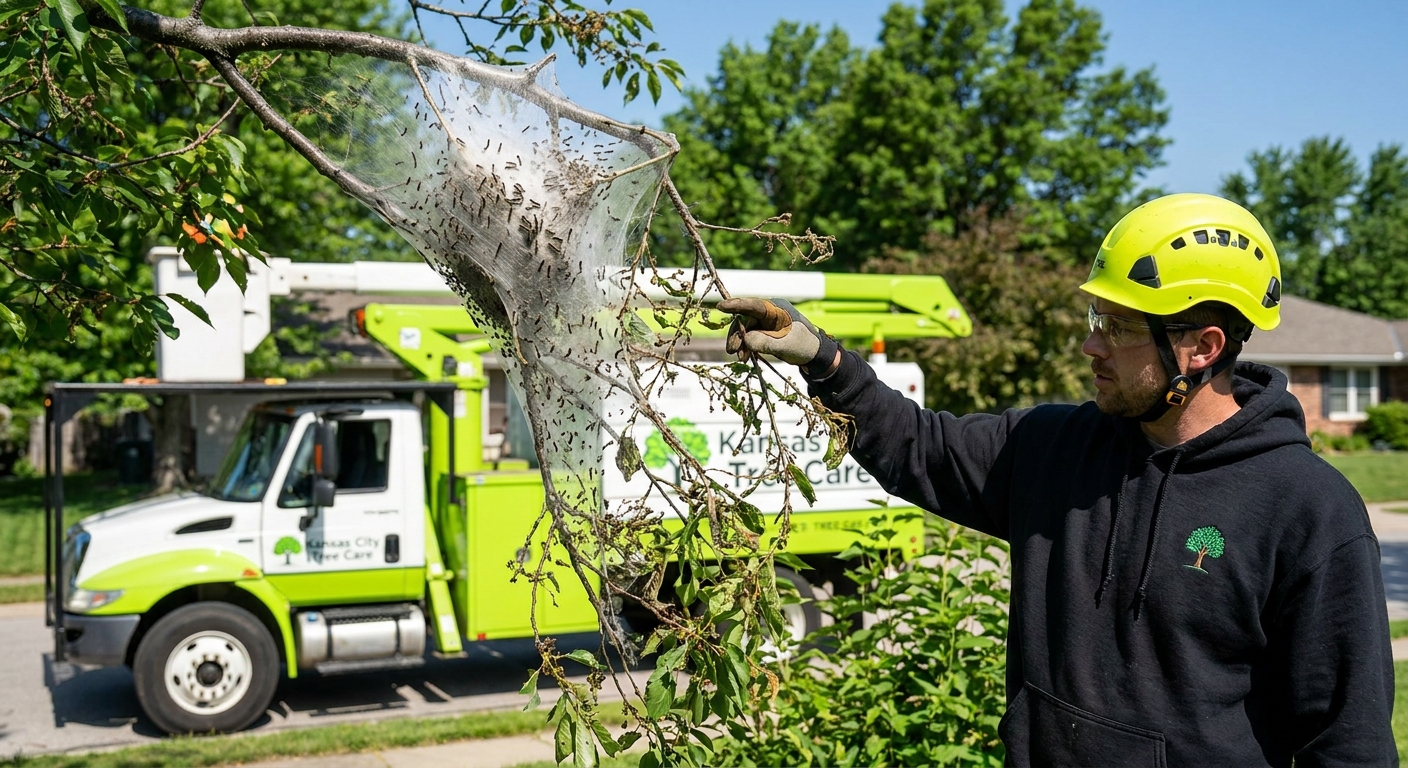
Fall webworms are the ones people confuse with tent caterpillars. Different timing, different location, different tree preference. Webworms show up in late July through September. They build their webs at the tips of branches, not in the forks. And they’ll hit walnuts, pecans, hickories, persimmons, sweetgum, and occasionally maples.
A big webworm nest can look alarming — a gauzy white bag enveloping three feet of branch tip, full of wriggling caterpillars. Every late August we get calls from homeowners on the Missouri side convinced their pecan tree is dying.
It almost never is. Fall webworms arrive so late in the season that the leaves they eat have already done their job for the year. The tree loses a little photosynthetic surface right before it was about to drop leaves anyway. Net damage to a healthy tree: negligible.
When to treat:
- The tree is young (under 10 feet tall) and heavily infested
- The tree is already stressed from drought, construction, or recent transplant
- Multiple nests per branch across most of the canopy
- Aesthetics matter (front-yard specimen tree)
Treatment is the same Bt spray, best applied when the webs are still small. Once the web is baseball-sized or larger, the caterpillars are harder to reach and the damage is mostly done.
Borers: The Ones That Actually Kill Trees
Now we’re in serious territory. Borers are the pests you should worry about — not cicada killers or webworms. They feed under the bark, disrupt the vascular system, and kill trees from the inside out. By the time you see clear external symptoms, the infestation is usually two to three years old.
We already covered emerald ash borer in a separate post on EAB treatment, so here are the other borers we see most in Kansas City:
Locust Borer
Black locust only. Adults emerge in September and lay eggs in bark cracks. Larvae tunnel in over winter, and by the following summer the tree has weakened limbs, oozing sap columns, and frequent breakage. We’ve replaced dozens of locust borer-killed trees in older Kansas City, KS neighborhoods around State Avenue. Treatment: September bark sprays of permethrin can protect healthy trees. Established infestations are hard to reverse.
Linden Borer (and Flatheaded Appletree Borer)
Attacks lindens, basswoods, and stressed shade trees across most of the KC metro. You’ll see sawdust-like frass at the base of the trunk and zigzag galleries under loose bark. Drought-stressed trees are the primary targets. Best defense: keep the tree watered in summer — a well-hydrated linden is rarely attacked.
Ash-Lilac Borer
Despite the name, this borer’s favorite host in Kansas City isn’t ash — it’s lilac. If your 20-year-old lilac shrub has dying canes, holes with sawdust at the base, and thinning bloom each year, ash-lilac borer is usually the culprit. Prune out infested canes in fall, and apply a trunk spray in late April when adults emerge.
What Borer Damage Looks Like
- Round or D-shaped exit holes in the bark (size varies by species)
- Sawdust-like frass at the base of the trunk or in bark crevices
- Oozing sap or “weeping” bark wounds
- Branch dieback working from the top down
- Bark sloughing off in sheets, revealing tunnels underneath
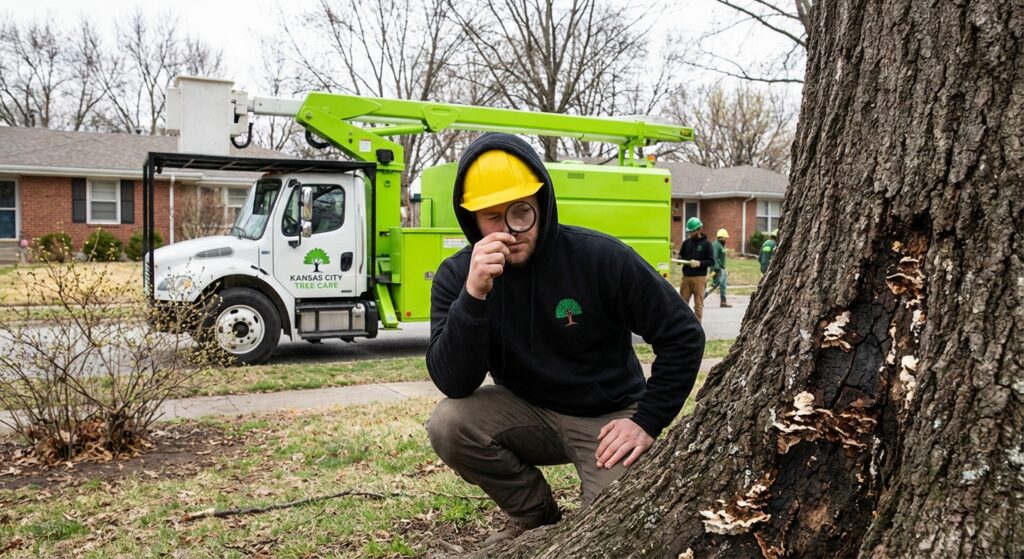
If you see any of these, get a certified arborist out to diagnose the species before treating. The wrong insecticide on the wrong borer wastes money. In advanced cases, Kansas City tree removal is safer and cheaper than trying to save a tree that’s already structurally compromised.
Pine Bark Beetles: Why KC’s Scots and Austrian Pines Are Struggling
If you’ve driven through any older Kansas City neighborhood with landscape pines — particularly Scots pine and Austrian pine — you’ve seen the result of pine bark beetle pressure. Entire stands are browning out. Individual trees go from healthy green to rust-red in a single summer.
Bark beetles attack trees weakened by drought, heat, or soil compaction. Healthy pines push beetles out with sap. Stressed pines can’t. Once the beetles establish, they ride the tree down fast.
Signs of bark beetle attack: small popcorn-like pitch tubes on the trunk (1/4 inch bumps of dried sap), fine reddish-brown dust in bark crevices, needles turning from green to yellow to red over 6-8 weeks.
Reality check: in the KC metro, saving an actively attacked Scots pine is rarely worth it. Removal and replacement with a better-suited species (bur oak, chinkapin oak, baldcypress) is usually the smart call. For healthy neighboring pines, preventive bark sprays can offer protection — but keeping trees well-watered during July-August heat does more than any chemical.
Leaf Miners, Spider Mites, and Scale: The Cosmetic Pests
Not every insect call ends with “treat immediately.” A lot of what homeowners notice in summer falls into the cosmetic-but-not-deadly category.
Hackberry Nipple Gall & Leaf Miners
Common on hackberries across the KC metro. Hundreds of small bumps on the undersides of leaves, or squiggly pale trails running through the leaf tissue. Looks bad. Doesn’t hurt the tree. No treatment recommended.
Spider Mites
Heavy in drought years, especially on arborvitae, junipers, and spruces. Look for stippled, bronzing needles and fine webbing on new growth. A strong blast of water every few days knocks populations down. For heavy infestations, a miticide (NOT a general-purpose insecticide — those kill mite predators and make the problem worse) is the right tool.
Scale Insects
Hard to spot because they don’t look like bugs — they look like bumps on twigs. Magnolia scale, oystershell scale, and euonymus scale are the most common in KC. Horticultural oil applied in early spring (dormant oil) or late June (summer-weight oil) smothers the protected nymph stage. This is a job worth having a pro handle because timing is everything — a week early or late and the treatment misses the window entirely.
DIY Treatments vs. Calling a Pro: When Each Makes Sense
We don’t try to sell every caller on a professional treatment. Sometimes the right answer is “go to Westlake and buy a bottle of this — it’ll handle it.” Here’s how we think about it:
DIY is fine when:
- The tree is small (under 15 feet) and fully accessible from the ground
- The pest is cosmetic (webworms, tent caterpillars, aphids, hackberry gall)
- You’re comfortable with Bt, horticultural oil, or insecticidal soap — all low-toxicity options
- Treatment timing isn’t tight
Call a pro when:
- The tree is large or has branches over structures
- You suspect borers (misdiagnosis costs real money)
- Treatment requires trunk injection — this is not a homeowner job. The equipment alone is $500+
- You need systemic insecticides with restricted use labels
- The tree is a valuable specimen and the margin for error is low
Typical professional treatment costs in the KC metro:
- Foliar Bt or horticultural oil spray: $150-$275 per tree
- Systemic trunk injection (borers, EAB): $150-$400 depending on trunk diameter
- Bark spray (preventive, locust/ash borer): $200-$350
- Soil drench with systemic insecticide: $125-$225
- Full diagnostic arborist assessment: free with most tree services, including ours
The Best Pest Control Is a Healthy Tree
After 35 years of watching which trees get hit hard and which ride out pest pressure with minor damage, we can tell you the pattern is almost always the same: stressed trees get the worst of it.
A tree dealing with drought, root compaction from construction, lawn-mower damage at the base, or over-pruning is a magnet for borers, bark beetles, and secondary pests. A well-watered, properly pruned tree with good mulch and no trunk damage has natural defenses that handle most pest pressure without any intervention at all.
The practical takeaway for Kansas City homeowners:
- Deep-water mature trees during July and August droughts — 15-20 gallons per tree per week during dry stretches
- Mulch properly — 3 inches deep, pulled back from the trunk, extending to the drip line where possible
- Prune correctly — no flush cuts, no stub cuts, no topping. Our tree trimming in Kansas City team follows ISA pruning standards
- Avoid mower and string-trimmer damage to the trunk — bark wounds are highways for borers
- Diversify your yard’s species mix — a monoculture gets wiped out when one pest shows up
Frequently Asked Questions
Do I need to treat my trees for bugs every summer?
No. Most healthy KC trees don’t need annual pest treatments. Bt on specific trees with known caterpillar pressure, dormant oil on ornamentals prone to scale, and deep watering during drought will handle 90% of what homeowners deal with. Systemic trunk injections are justified for ash (EAB), valuable specimen trees at borer risk, or confirmed active infestations.
What’s the giant wasp hovering over my lawn in July?
Almost certainly a cicada killer wasp. They look terrifying but rarely sting people. They die off by early September on their own. Unless your lawn is pockmarked with dozens of burrows, no treatment is needed.
How much does a professional pest treatment cost in Kansas City?
Foliar sprays run $150-$275, systemic trunk injections $150-$400, and preventive bark sprays $200-$350. Full arborist assessments are typically free. The honest answer is that most summer pest calls we respond to don’t require treatment at all — the tree is going to be fine.
Is the cottony stuff at the end of my walnut branch a problem?
That’s fall webworm. On a mature, healthy walnut or pecan, it’s cosmetic. The webs appear late enough in the season that the tree has already done most of its growing. If you want to clean it up visually, prune out the web-containing branch tips and dispose of them. Otherwise, leave it alone.
Can bug damage bring down a tree I need removed?
Yes — especially borer damage. A tree killed by borers or bark beetles becomes brittle within 12-18 months. Branches start failing unpredictably. If you have a borer-killed ash, locust, or pine, don’t wait. Hazardous tree evaluation and timely removal are always safer and cheaper than waiting for storm damage.
What’s the difference between tent caterpillars and fall webworms?
Timing and location. Tent caterpillars appear in spring (April-June) and build webs in branch forks on cherries and crabapples. Fall webworms appear in late summer (July-September) and build webs at branch tips on walnuts, pecans, and hickories. Both are mostly cosmetic on healthy trees.
Find Us on the Map
We serve all of Kansas City, KS and the surrounding metro from our shop on Merriam Lane. If you’ve got a bug-damaged tree and aren’t sure whether it’s worth saving, we’re happy to come take a look:
When You Need an Honest Diagnosis
Summer pest calls are one of the most common reasons homeowners reach out to us, and the most common outcome is: “Your tree’s fine. Here’s what to watch for.” We’d rather tell you that for free than sell you a treatment you don’t need.
When treatment IS the right call — especially with borers that can take a healthy tree down in two seasons — our ISA-certified arborists know exactly what works on which species. 35 years serving the KC metro, BBB accredited, licensed and insured. You can also find Kansas City Tree Care on Google with 200+ reviews from neighbors across Kansas and Missouri.
Call Kansas City Tree Care at 913-894-4767 for a free pest assessment. We’ll identify what’s actually on your tree, tell you whether it needs treatment, and give you a straight price if it does.