Construction in KC Starts with What’s Already on the Ground
Before the first foundation gets poured or the first slab goes down, somebody has to deal with the trees, brush, stumps, and vegetation already on the site. That’s land clearing — and in the Kansas City metro, where residential and commercial development continues to push into formerly wooded and rural areas, it’s a critical first step that affects everything built on that land afterward.
We’ve cleared land for construction projects across the KC metro for over 15 years — from single residential lots in Overland Park to multi-acre commercial sites in Olathe and Lee’s Summit. Here’s what KC contractors, developers, and homeowners need to know about the process.
What Land Clearing Involves
Land clearing is more than cutting down trees. A complete clearing operation includes:
Our tree care services include complete land clearing for residential and commercial projects — from single lot clearing to multi-acre sites across the KC metro.
Tree removal. Every tree in the construction footprint plus a perimeter buffer for equipment access. In KC’s established neighborhoods, this often means working around trees you want to preserve — which requires careful planning and root protection.
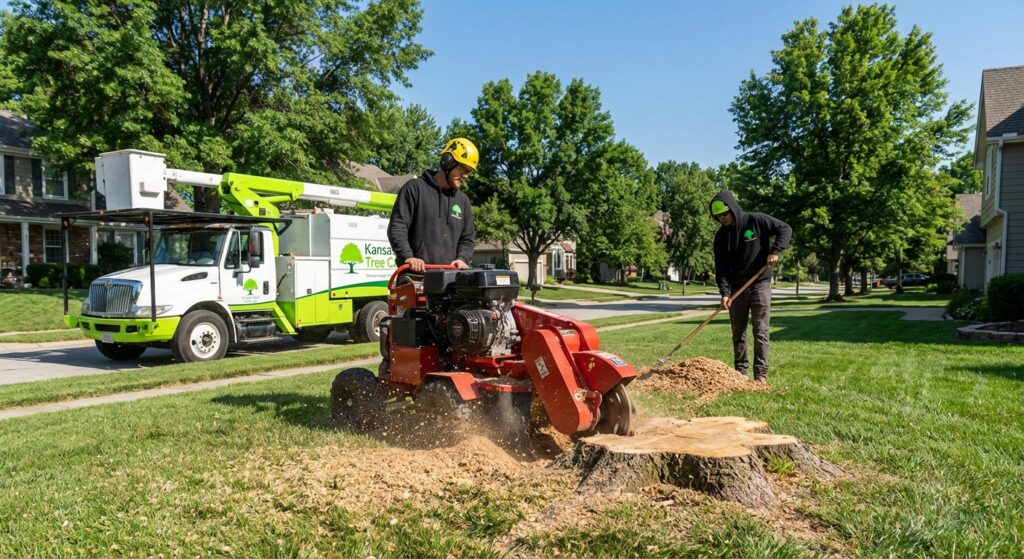
Stump removal. Construction sites need stumps removed below grade — usually 12-24 inches below the surface. Unlike residential stump grinding where stumps are ground to 6 inches below grade, construction clearing requires deeper removal to prevent settling under concrete and asphalt.
Brush and understory clearing. Smaller trees, shrubs, vines, and woody debris that conventional tree removal doesn’t address. This is typically done with forestry mulchers or brush chippers.
Grubbing. Removing root systems, rocks, and organic material from the soil to create a clean base for grading. Roots left in construction fill decompose over time and create voids that cause settling — exactly what you don’t want under a foundation or parking lot.
Debris removal and disposal. Wood chips, logs, brush, and vegetative waste need to be hauled to appropriate disposal sites or processed on-site.
Land Clearing Costs in Kansas City
Pricing depends heavily on the site — density of vegetation, terrain, access, and disposal distance. General ranges for the KC market:
Lightly wooded residential lot (0.25-0.5 acres): $2,000-$5,000. Scattered trees with grass or light brush. Common in newer Johnson County subdivisions being developed on previously farmed land.
Moderately wooded lot (0.5-1 acre): $5,000-$15,000. Mixed hardwoods and brush, typical of lots in Lee’s Summit, Liberty, and Independence where development is pushing into wooded areas.
Heavily wooded acreage (1-5+ acres): $3,000-$8,000 per acre depending on tree density and size. Mature hardwood stands with large oaks and walnuts cost more per acre than young secondary growth.
Factors that increase cost:
- Large, mature trees (more wood volume to process)
- Steep terrain or poor access (limits equipment options)
- Wet conditions (KC’s clay soil becomes impassable when saturated)
- Selective clearing (preserving specific trees requires more careful work)
- Environmental restrictions (stream buffers, wetland setbacks, tree preservation requirements)
- Disposal costs (site distance to mulch yards or disposal facilities)
Environmental Regulations in the KC Metro
Land clearing in Kansas City isn’t just grab-a-bulldozer. Environmental regulations affect most projects:
Before any clearing starts, check if you need a tree removal permit — most KC-area municipalities require one for trees above a certain diameter. After clearing, our stump grinding service leaves the site ready for construction.
Stormwater management. Any land disturbance over 1 acre in the KC metro requires a stormwater pollution prevention plan (SWPPP) and may need a land disturbance permit. Even smaller sites may need erosion and sediment control measures — silt fences, sediment basins, and stabilized construction entrances.
Stream buffers. Most KC metro jurisdictions require vegetative buffers along streams and waterways — typically 50-100 feet where no clearing is allowed. Johnson County’s stormwater regulations are particularly detailed on this point.
Tree preservation ordinances. Some cities require tree preservation plans for new development. Leawood, Olathe, and other JoCo cities may require tree surveys, preservation of certain percentages of existing trees, or fees-in-lieu for trees removed. Check with your city’s planning department before clearing.
Wetland protection. Clearing in or near wetlands requires Army Corps of Engineers review and potentially a Section 404 permit. Several KC metro areas — especially along creek corridors and flood plains — contain regulated wetlands that are easy to overlook.
Timing restrictions. Some environmental permits restrict clearing during nesting season (April-August) for certain bird species. Federal migratory bird protections can apply on any property.
A contractor experienced in KC land clearing knows these regulations and can navigate them. The cost of non-compliance — stop-work orders, fines, mandatory restoration — far exceeds the cost of doing it right.
Equipment Used in Land Clearing
Different sites require different equipment, and the right match affects both cost and result:
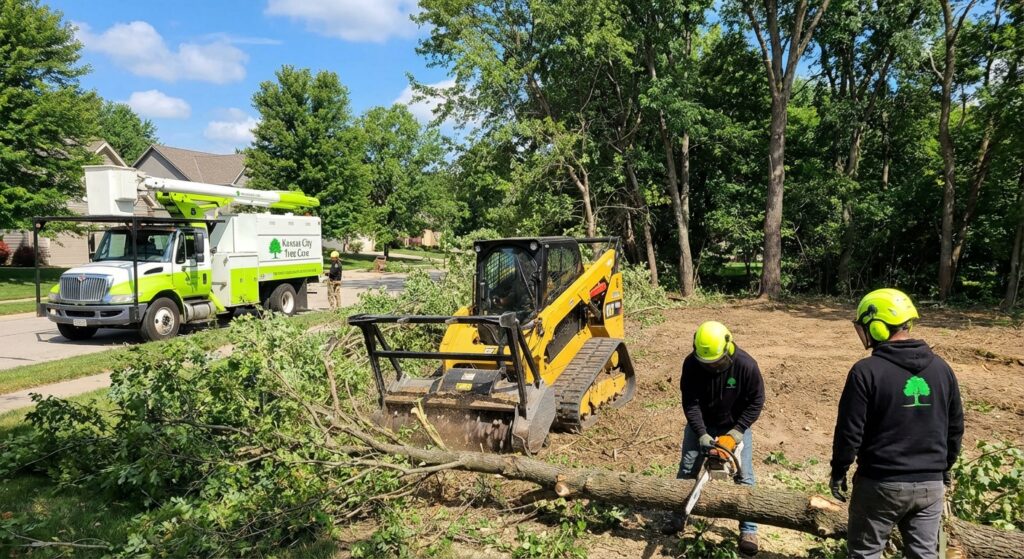
Forestry mulcher. A skid steer or excavator with a mulching head that grinds trees, brush, and stumps into mulch in place. Ideal for lots with small to medium trees and brush. Leaves the processed material on-site as ground cover — no hauling required. This is often the most cost-effective approach for residential lots in the KC metro.
Excavator with grapple. For removing larger trees and stumps. The excavator grabs, lifts, and piles material for chipping or hauling. Necessary for trees over 18-24 inches in diameter that a mulcher can’t handle.
Bulldozer. For pushing material, rough grading, and handling heavy root systems. Less selective than an excavator — better for total clearing than selective work.
Chainsaw crews. For selective tree removal where precision matters — close to structures, near trees being preserved, or where equipment access is limited.
Chippers. For processing brush and small diameter material into chips for hauling or on-site use.
Selective vs. Complete Clearing
Not every project requires stripping the site bare. Selective clearing preserves desirable trees while removing everything else:
When to keep trees:
- Large, healthy oaks — especially bur oaks, which are irreplaceable on a human timescale
- Trees that provide natural screening from neighboring properties or roads
- Trees outside the construction footprint that won’t be damaged by equipment
- Trees required to be preserved by municipal ordinance
How to protect preserved trees during construction:
- Install tree protection fencing at the drip line before any equipment enters the site
- No equipment traffic, material storage, or soil disturbance within the fenced area
- No grade changes within the root zone (adding or removing more than 2-3 inches of soil can kill a tree)
- If utilities must cross root zones, use tunneling rather than trenching
Trees that appear healthy but have 50%+ of their root zone disturbed during construction often decline and die within 2-5 years. This is one of the most common and expensive mistakes in residential development — the homeowner buys a lot with “preserved mature trees” that die within a few years of construction. An arborist consultation before clearing identifies which trees can realistically survive construction and which can’t.
Land Clearing for Residential Homeowners
You don’t have to be a developer to need land clearing. Common residential scenarios in the KC metro:
Building on a wooded lot. Bought an undeveloped lot and building a custom home. Full or selective clearing needed before construction begins.
Yard reclamation. Neglected areas of your property that have become overgrown with volunteer trees, brush, and invasive species. A forestry mulcher can reclaim these areas in a day.
Pool or outbuilding site prep. Clearing a 2,000-3,000 sq ft area for a pool, shop, or detached garage. Usually requires removing 3-10 trees plus understory.
Fire break or defensible space. For properties bordering wooded areas, clearing brush and thinning trees creates defensible space. While wildfire risk is lower in the KC metro than western states, eastern redcedar encroachment on rural properties creates legitimate fire risk.
Working with General Contractors and Builders
If you’re a general contractor or builder in the KC metro, the clearing phase sets the tone for your entire project. Here’s how we make it work smoothly.
Site assessment and bid. We walk the property with your site plan, identify what stays and what goes, flag any utility conflicts (Evergy overhead lines, buried gas and water, fiber optic), and provide a fixed-price bid within 48 hours. No surprises once the equipment shows up.
Permit coordination. For sites requiring land disturbance permits, we provide the vegetation removal section of your erosion control plan. In cities like Olathe and Lenexa, tree preservation requirements may dictate which trees must remain. We identify and protect those with fencing and root zone barriers before clearing begins.
Schedule alignment. Clearing needs to happen before surveying, grading, and utility installation. We coordinate directly with your project timeline to avoid gaps. Most residential lots clear in 1-3 days; multi-acre sites in 1-2 weeks. We’ve never held up a builder’s schedule.
For developers working in new subdivisions across Johnson County and south Kansas City, we handle phased clearing — processing lots in the sequence they’ll be built. This reduces overall mobilization costs and keeps pace with your construction schedule.
What Happens to the Material After Clearing
One question we hear from both homeowners and builders: where does it all go?
Wood chips and mulch. Brush, branches, and small trees are processed through industrial chippers on-site. The resulting mulch can be spread on-site for erosion control, delivered to landscaping operations, or hauled to composting facilities. On residential clearing jobs, we often leave a portion for the homeowner’s future landscaping — quality wood mulch saves $40-$60 per cubic yard at retail.
Logs and trunk wood. Large-diameter trees produce usable lumber and firewood. Some clearing jobs produce thousands of board feet of walnut, oak, or hedge. We can coordinate with local sawmills to salvage valuable hardwoods rather than just grinding them up. Black walnut — common in KC’s older wooded areas — can be worth $500-$2,000 per log depending on diameter and quality.
Root material and stumps. After grinding, root material is typically left in place and compacted, then covered with fill material. For construction sites, root material needs to be hauled off-site — decomposing roots under a foundation create voids and settling. We haul root waste to approved disposal sites in the KC area.
Nothing goes to landfill. All vegetative material is recycled, composted, or repurposed. It’s better for the environment and it keeps disposal costs down for the project.
Timeline: How Long Does Land Clearing Take in Kansas City?
Project timelines depend on the site, but here’s what KC contractors can typically expect:
- Single residential lot (0.25-0.5 acres, light to moderate vegetation): 1-2 days. Mobilize equipment, clear, chip, grind stumps, haul debris. Your site is ready for surveying by midweek if we start Monday.
- Larger residential lot (0.5-1 acre, heavily wooded): 2-4 days. More trees mean more processing time, more stump grinding, and more debris volume to manage.
- Multi-acre commercial site: 1-3 weeks depending on density, terrain, and access. These projects often run concurrently with hazardous tree assessment and utility locating.
Weather delays are the biggest wildcard. KC’s clay soil becomes unworkable after heavy rain — driving a 40,000-pound excavator on saturated clay creates ruts that need regrading and adds cost. We monitor weather closely and will postpone mobilization rather than damage your site.
For builders on tight schedules, we offer priority scheduling for clearing projects booked 2+ weeks in advance. Call us early in your planning process — the clearing crew is often the first contractor on-site and the one most affected by weather delays.
Frequently Asked Questions
How much does land clearing cost per acre in Kansas City?
Lightly wooded land runs $3,000-$5,000 per acre. Moderately to heavily wooded land costs $5,000-$8,000+ per acre. Factors include tree size and density, terrain, soil conditions, environmental restrictions, and disposal requirements. Get a site-specific estimate — per-acre averages vary significantly based on what’s actually on the property.
We handle land clearing projects across Olathe, Grandview, and throughout the KC metro:
Do I need a permit for land clearing in the KC area?
For sites over 1 acre, you’ll likely need a land disturbance permit and stormwater pollution prevention plan. Smaller sites may need permits if they’re in a flood plain, near streams, in certain zoning districts, or subject to tree preservation ordinances. Your contractor or city planning department can advise on requirements for your specific site.
How long does land clearing take?
A lightly wooded residential lot can be cleared in 1-2 days. Moderately wooded acre lots take 2-4 days. Heavily wooded multi-acre sites may take 1-2 weeks depending on conditions. Weather delays are common in KC — wet clay soil can halt equipment operations until conditions dry out.
Can I clear land myself?
Small-scale brush clearing with a chainsaw and your own equipment — sure. But for anything involving large trees, stumps, or more than a quarter acre, professional equipment is dramatically faster and safer. A forestry mulcher can clear in hours what would take a homeowner weeks with hand tools. And the disposal logistics of multiple large trees is a significant challenge without commercial hauling capability.
What’s the difference between land clearing and tree removal?
Tree removal is taking down individual trees on developed property. Land clearing is processing an entire area — all trees, brush, stumps, and vegetation — to prepare for new construction or land use. Different equipment, different process, different pricing. Read our full guide comparing the two.
Get Your Site Ready
Whether you’re a homeowner building on a wooded lot, a contractor preparing a commercial site, or a property owner reclaiming overgrown acreage, proper land clearing sets the foundation for everything that comes after. Done right, it saves time and money in the construction phase. Done wrong, it creates problems (settling, drainage, tree death) that persist for years.
We clear land throughout the Kansas City metro — both sides of the state line, residential and commercial. Licensed, insured, and experienced with KC’s soil conditions, regulations, and tree species.
Call Kansas City Tree Care at 913-894-4767 for a free land clearing estimate.