You Might Not Need a Permit — But You Need to Know the Rules
Your neighbor just had a massive cottonwood taken down without a hitch. No inspectors showed up, no paperwork, no hassle. Now you’re looking at that dying ash tree in your front yard and wondering — do I need a tree removal permit in Kansas City before I call someone?
It’s one of the most common questions we get. And the honest answer is that most KC metro homeowners don’t need a permit to remove a tree on their own private property. But “most” isn’t “all.” The rules change depending on which city you’re in, whether the tree sits in a public right-of-way, and whether the tree qualifies as a heritage or protected specimen.
We’ve handled tree removals across all 16 cities in our service area for over 35 years. Here’s what actually matters when it comes to permits, ordinances, and staying on the right side of the rules.
Does Kansas City, Missouri Require Tree Removal Permits?
Kansas City, MO has a more layered regulatory framework for trees than most cities on the Kansas side. The city’s Urban Forestry Program, managed under KC Parks and Recreation, oversees trees on public land and within the public right-of-way.
For most homeowners removing a tree on their own private residential property, no permit is required. You can hire a tree service and have it taken down without filing any paperwork with the city.
But there are important exceptions. The KCMO Zoning and Development Code (Chapter 88, Article VIII) includes tree preservation provisions that apply when a property owner is doing development work that triggers a land disturbance permit. If you’re building an addition, installing a pool, or doing major grading, any significant trees on the property may be subject to preservation review.
The city also maintains authority over all trees in the public right-of-way. That strip of land between the sidewalk and the curb — even though it feels like your yard — typically belongs to the city. Removing a right-of-way tree without authorization from KC Parks can result in fines and mandatory replacement plantings.
KCMO’s Urban Forestry Code and What It Covers
The KCMO Urban Forestry ordinance (Section 56-541 through 56-556) gives the city authority to manage, protect, and regulate trees on public property and within public rights-of-way. Key provisions include:
- No person shall remove, damage, or destroy any tree on public property without written authorization from the Director of Parks and Recreation
- The city maintains a list of recommended and prohibited species for new plantings
- Property owners are responsible for maintaining clearance over sidewalks (8 feet) and streets (14 feet) for trees adjacent to their property
- The city can require removal of diseased or hazardous trees that pose a public safety risk
For day-to-day tree removal on private property, this ordinance doesn’t directly apply. But it’s worth knowing — especially if your tree sits close to a sidewalk or street and you’re unsure exactly where your property line ends.
Heritage Trees and Protected Species in KCMO
KCMO doesn’t have a formal “heritage tree” registry the way some larger cities do. However, certain trees receive de facto protection through the city’s development review process and historic preservation programs.
Trees that tend to get extra scrutiny include:
- Large-caliper specimens — trees with a diameter at breast height (DBH) of 30 inches or more are often flagged during development review
- Trees within historic districts — this is the big one for neighborhoods like Brookside, Waldo, and the Country Club District
- Landmark trees — exceptionally old or historically significant trees may be documented by the city’s urban forestry program
If you’re in Brookside or the historic parts of Waldo and want to remove a large, healthy tree, it’s worth a quick call to the city’s urban forestry division first. Historic district designation can add an extra layer of review for significant landscape changes, even on private property.
That said, if the tree is dead, structurally compromised, or poses a genuine hazard, removal is generally permitted regardless of district status. Safety always takes priority over preservation.
Neighborhood-Specific Rules: Brookside, Waldo, and Historic Districts
We’ve done a lot of work in Brookside and Waldo over the years, and the tree regulations there are a little different from other parts of Kansas City.
Brookside sits within a designated historic area, which means the Kansas City Historic Preservation Commission may have a say in significant exterior changes — including the removal of large, mature trees that contribute to the neighborhood’s character. In practice, this mostly comes up when someone is doing major construction or wants to clear multiple healthy trees.
Waldo has a mix of historic and non-historic properties. The 75th Street corridor and surrounding blocks include some historically designated areas. If you’re unsure whether your specific property falls under historic review, check the KCMO Historic Districts map available through the city’s planning department.
Other KCMO neighborhoods like the Plaza area, Hyde Park, and Valentine have similar historic protections. The key takeaway: if your home is in a designated historic district and you want to remove a large, visually prominent tree, check with the Historic Preservation Commission before scheduling the work.
For dead, diseased, or hazardous trees in these neighborhoods, we’ve never had an issue. We provide a written arborist assessment documenting the condition, and that documentation satisfies both the city and any neighborhood review boards.
How to Apply for a Tree Removal Permit in KCMO
If you’re in one of those situations where a permit or approval is actually required — development project, right-of-way tree, or historic district removal — here’s the process:
For right-of-way trees:
- Contact KC Parks and Recreation’s Urban Forestry Division at (816) 513-7500
- Request a right-of-way tree removal review
- A city arborist will inspect the tree and determine if removal is warranted
- If approved, the city may handle the removal themselves or authorize your contractor to do it
- Timeline: typically 2-4 weeks from request to approval
For development-related removals:
- Submit a tree preservation plan as part of your land disturbance permit application
- The plan should include a survey of existing trees, which trees will be removed, and proposed mitigation (replacement plantings or fee-in-lieu)
- Plan review is part of the overall development permit process — timeline varies, but allow 4-8 weeks
- Mitigation costs run approximately $300-$600 per tree for replacement plantings
For historic district removals:
- Contact the Historic Preservation office at (816) 513-2902
- Describe the tree and reason for removal
- You may need to appear before the Landmarks Commission if the tree is significant
- Having a certified arborist’s written assessment accelerates approval
Fines and Consequences for Unauthorized Tree Removal
Here’s what’s at stake if you skip the required approvals:
Right-of-way tree removal without permission: Fines up to $500 per tree under the KCMO municipal code, plus mandatory replacement at the homeowner’s expense. Replacement typically means planting a 2-inch caliper tree of an approved species — that runs $400-$800 installed when you factor in the tree, delivery, planting, and a one-year warranty.
Development violations: Removing trees during a construction project without an approved tree preservation plan can trigger stop-work orders on the entire project. Resolution typically involves submitting a retroactive plan, paying mitigation fees, and sometimes replanting at 2:1 or 3:1 ratios. We’ve seen these situations add $2,000-$5,000+ to a project’s cost.
Historic district violations: Unauthorized removal of a significant tree in a historic district can result in a citation from the Historic Preservation Commission. Penalties vary but may include mandatory replacement and restoration of the landscape to its prior character.
For typical private property tree removal outside these scenarios, there are no fines because no permit was needed in the first place. The vast majority of our residential jobs fall into this category.
Exemptions: When You Can Skip the Paperwork Entirely
Even in situations where tree regulations exist, several categories of removal are universally exempt across the KC metro:
- Dead trees — no jurisdiction requires you to keep a dead tree standing. In fact, most municipal codes require property owners to remove dead trees within a reasonable timeframe
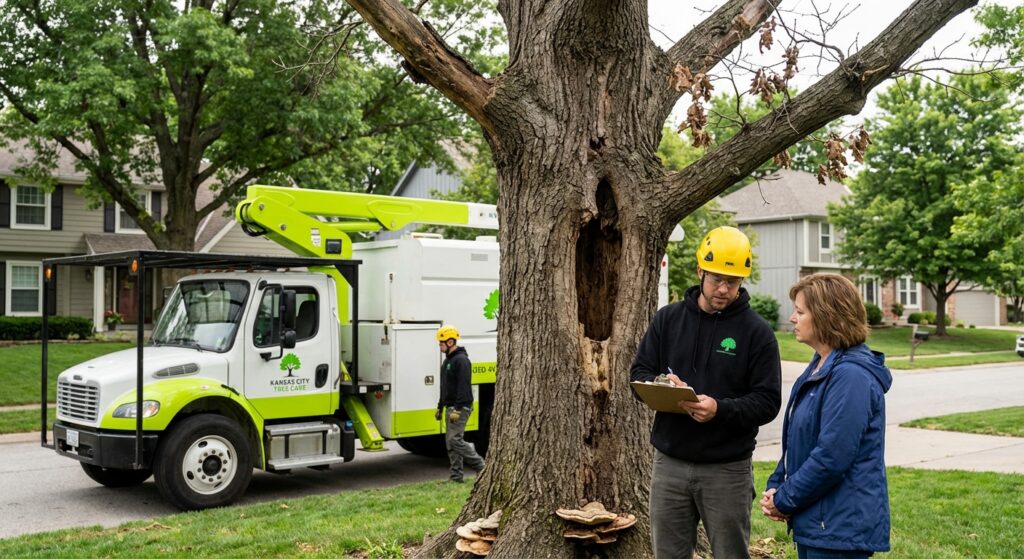
- Hazardous trees — trees that pose an imminent danger to people or structures can be removed immediately. Document the hazard with photos and, ideally, a professional assessment
- Storm-damaged trees — after severe weather events, emergency removal of damaged trees is always permitted. Our storm recovery crew responds across the entire metro
- Diseased trees — trees with confirmed diseases (especially Emerald Ash Borer) are generally exempt from preservation requirements
- Small trees — most preservation ordinances only apply to trees above a certain size threshold, typically 6-8 inches DBH
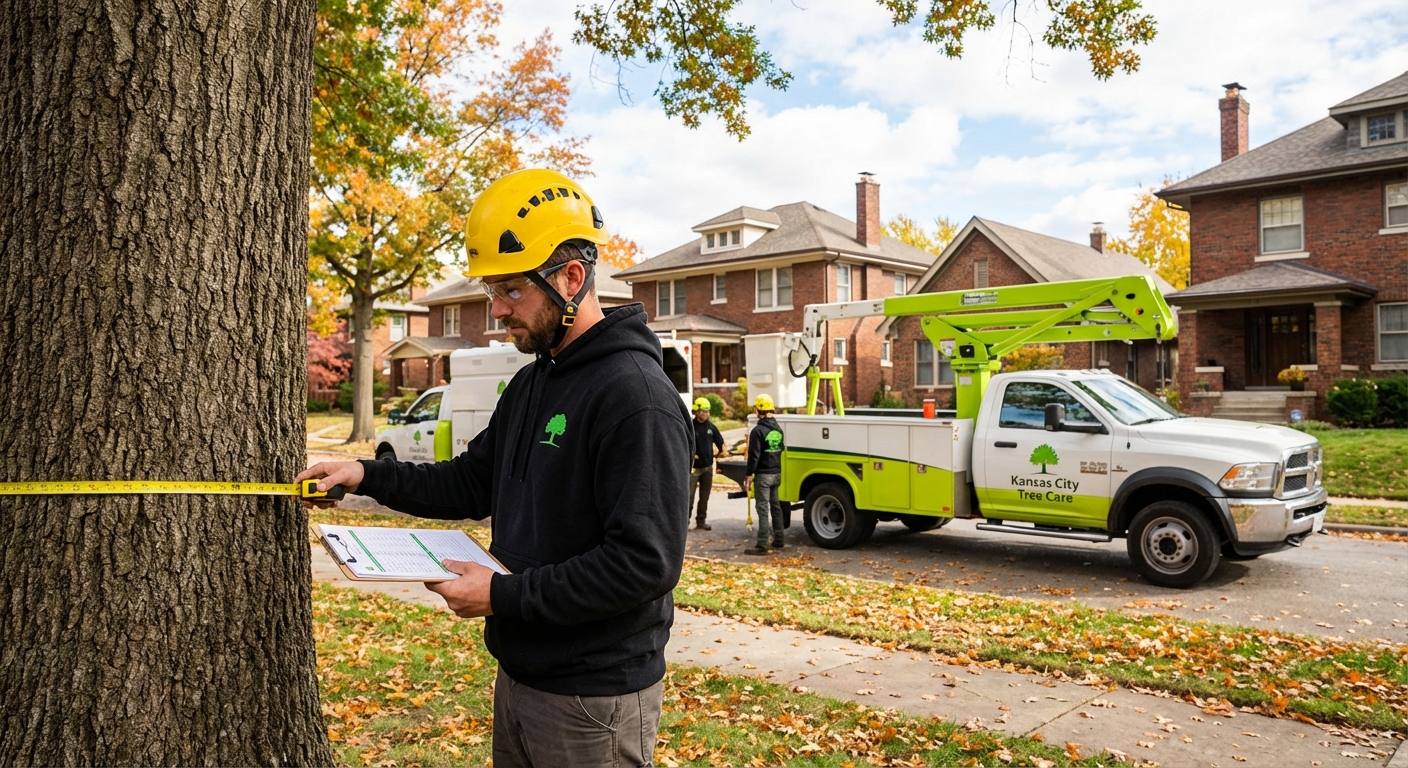
When we do a removal that falls into any gray area, we always document the tree’s condition before work begins. Photos, measurements, and an arborist’s notes protect you if questions arise later.
Johnson County Cities: Simpler Rules, Fewer Hurdles
On the Kansas side of the metro, tree removal regulations are significantly less complex. Cities like Overland Park, Olathe, and Shawnee do not require permits for tree removal on private residential property.
Overland Park’s Forestry Division manages city-owned trees and right-of-way trees. If the tree is between the sidewalk and the curb, contact the city before doing anything. But for trees on your property — your land, your tree, your decision.
Leawood has slightly more involved tree preservation rules tied to construction and renovation projects. If your tree removal is connected to a building permit, Leawood’s Community Development department may want to see what’s being removed and what’s being planted to replace it.
Prairie Village, Mission, Fairway, Lenexa, and Roeland Park all have minimal regulation for private residential tree removal. Street trees are city-managed in all of these communities.
The one exception worth noting on the Kansas side is HOA restrictions. Johnson County has a very high percentage of HOA-governed communities, and many of those covenants require architectural committee approval before removing any tree. The city won’t stop you, but your HOA might. Check your CC&Rs before scheduling work.
Utility Line Trees: A Special Situation
Trees growing into power lines follow a completely different set of rules. Evergy (formerly KCP&L) is the primary electric utility for the KC metro and maintains a vegetation management program for trees that interfere with overhead power lines.
If your tree is growing into or near power lines, contact Evergy first. They’ll send a crew to trim branches within their easement at no charge to you. However, Evergy typically only removes the branches threatening their lines — not the entire tree. If you want the full tree removed, you’ll need to hire a tree removal company to take care of the rest.
Never attempt to trim or remove a tree within 10 feet of power lines yourself. This is lethal work. Contact Evergy or a qualified line-clearance contractor. No permit question is worth a safety risk.
For trees near gas lines and underground utilities, call 811 at least two business days before any removal work begins. This is a free service and is required by Kansas and Missouri law. The utility companies will mark their buried lines so our crew knows exactly where to avoid when removing stumps or grinding roots.
What a Professional Tree Service Handles for You
When you hire an experienced tree service company, navigating the permit and regulatory landscape should be part of what you’re paying for. Here’s what we handle on every job:
- Property line verification — we confirm whether the tree is on private property or in the public right-of-way before starting any work
- Local regulation check — we know the specific rules for each of the 16 cities in our service area and advise accordingly
- 811 utility locates — we call in utility locates before any ground work, including stump grinding
- HOA documentation — if your HOA requires an arborist assessment for approval, we provide professional written evaluations with photos and condition ratings
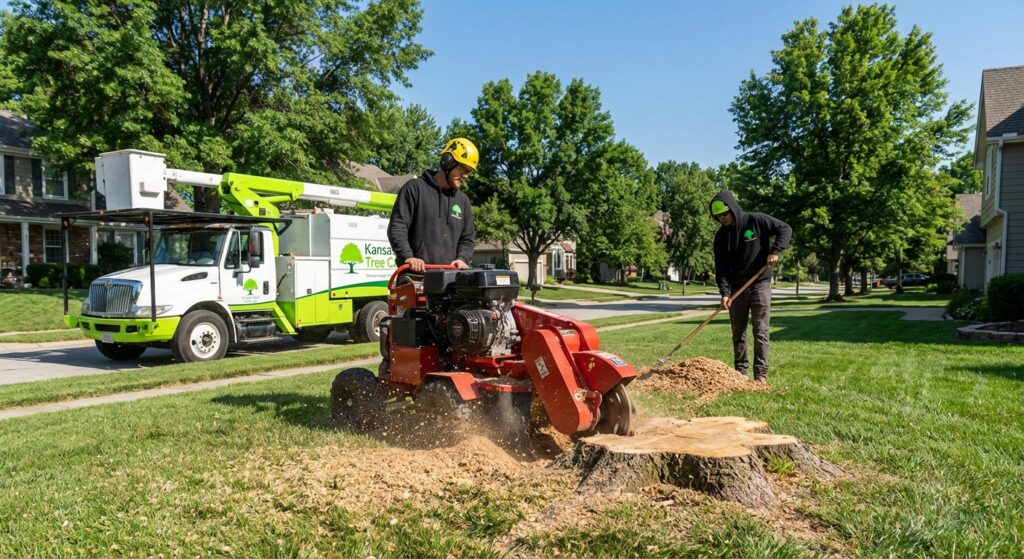
- Full cleanup and disposal — removal, branch chipping, stump grinding, and debris hauling
- Insurance coverage — our liability insurance protects your property throughout the job
You shouldn’t have to become a tree permit expert to get a dead ash out of your front yard. That’s our job. We’ve been working across Kansas City and every city in the metro for over three decades, and we handle the regulatory side so our customers don’t have to.
Frequently Asked Questions
How much does a tree removal permit cost in Kansas City?
For private residential tree removal on your own property, there’s no permit or fee in most KC metro cities. If a right-of-way tree removal is approved by the city, there’s typically no application fee — but you’ll pay for the removal itself. Development-related tree mitigation fees run $300-$600 per tree when replacement plantings are required.
Can my HOA stop me from removing a tree in my yard?
Yes. HOA covenants are private contracts and carry legal weight. Many Johnson County HOAs require architectural committee approval before any tree removal. The approval process usually takes 2-4 weeks. Dead or hazardous trees are typically exempted, especially with a written arborist assessment documenting the condition.
Do I need a permit to remove a tree in Overland Park?
No. Overland Park does not require permits for removing trees on private residential property. Right-of-way trees (between the sidewalk and the street) are city-managed and require city authorization. If tree removal is part of a construction project that needs a building permit, tree preservation requirements may apply.
What if a tree is growing into my neighbor’s property — who’s responsible?
In both Kansas and Missouri, you have the right to trim branches that overhang your property back to the property line. You cannot go onto your neighbor’s property or damage the tree in a way that kills it. If you’re concerned about a neighbor’s tree, start with a conversation. If that doesn’t work, a certified arborist’s written assessment can help make your case to code enforcement.
Does Kansas City require replacement trees after removal?
Not for standard residential removals on private property. Replacement requirements typically only kick in for right-of-way trees, development projects, and some historic district removals. When replacement is required, it’s usually at a 1:1 or 2:1 ratio with approved species of a minimum caliper size.
How long does the approval process take?
For right-of-way trees in KCMO, expect 2-4 weeks from request to city arborist inspection and decision. HOA approvals typically run 2-4 weeks depending on the board’s meeting schedule. Development permit reviews are longer — 4-8 weeks as part of the overall building permit process.
We Know the Rules So You Don’t Have To
Navigating tree removal regulations shouldn’t be the hard part. The hard part is getting a 60-foot oak out of a tight backyard without damaging the deck, the fence, or the neighbor’s shed. That’s what we focus on.
With 35+ years of experience across the KC metro, ISA certification, BBB accreditation, and full insurance, we handle Kansas City tree removal the right way — including checking the regulations for your specific city and neighborhood before we ever fire up a chainsaw.
Call Kansas City Tree Care at 913-894-4767 for a free estimate. We’ll let you know exactly what’s needed for your situation — no pressure, no obligation.