That Tree You Love Might Be Wrecking Your Foundation
You bought the house in Midtown partly because of the trees. That massive silver maple shading the whole front yard. The row of elms along the side. They made the property feel established, substantial, like it had been there forever. And they have — which is exactly the problem.
Older Kansas City homes and big trees go hand in hand. But the root systems supporting those 60-foot canopies don’t stop at some polite property boundary. They go where the water is, and in KC’s clay soil, that often means straight toward your foundation, your sewer line, and your basement walls.
We’ve been called to hundreds of KC properties where tree roots are causing real structural damage. Here’s what’s actually happening underground, which trees cause the most problems, and what your real options are — from root barriers to removal.
How Tree Roots Damage Foundations in Kansas City
Tree roots don’t punch through concrete. That’s a common misconception. What they actually do is more subtle and, in some ways, more destructive.
Soil moisture extraction. Large trees can pull 50-100+ gallons of water per day from the soil during summer. In Kansas City’s clay soil, that moisture removal causes the clay to shrink. When clay shrinks, it pulls away from the foundation — creating voids, settling unevenly, and allowing the foundation to shift. This is called “subsidence,” and it’s the number one way trees damage foundations in the KC metro.
Root intrusion into existing cracks. Tree roots are opportunistic. They follow moisture gradients, and a cracked or deteriorating foundation wall is a moisture highway. Roots don’t create the initial crack, but they will exploit it — growing into gaps, expanding as they thicken, and widening cracks that might otherwise have stayed minor.
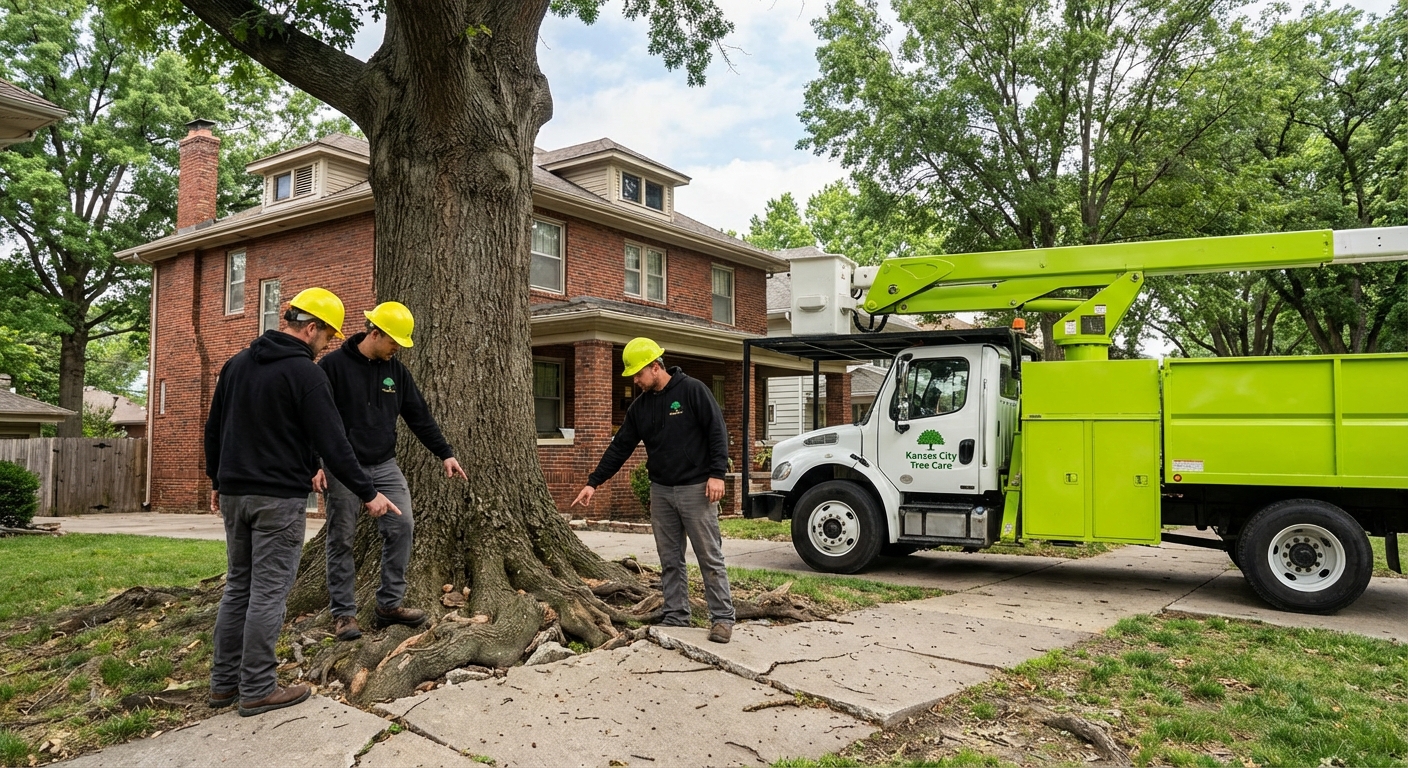
Heaving. Less common than subsidence in KC, but it happens. Large surface roots growing directly under a slab foundation or driveway can physically lift the concrete over time. We see this most often with silver maples, cottonwoods, and willows — all aggressive surface-root species that are extremely common in Kansas City yards.
The damage usually shows up inside the house first: doors that won’t close, cracks running diagonally from window corners, uneven floors, gaps between the wall and ceiling. By the time you’re seeing those signs, the foundation has already moved.
KC’s Clay Soil Makes Everything Worse
Kansas City sits on some of the most expansive clay soil in the Midwest. If you’ve ever watched your yard crack open during a July drought and then turn into a swamp after September rains, you’ve seen this clay in action. It swells when wet, shrinks when dry, and moves your foundation with every cycle.
Trees amplify this problem dramatically. A large tree creates a localized “dry zone” in the soil around its root system. During summer, while the rest of your yard’s clay is at relatively stable moisture, the soil within 20-30 feet of a big tree can be significantly drier. That asymmetric drying causes one side of your foundation to settle more than the other — differential settlement — which is far more damaging than uniform settling.
Neighborhoods with the worst clay soil issues tend to be in the older parts of the metro. Midtown, Westport, Waldo, Brookside, the older sections of Independence, and many homes in Overland Park built before the 1980s are all prime candidates. These areas have mature trees with massive root systems and foundations that are 40-80+ years old — the worst combination.
Problem Trees for Kansas City Foundations
Not all trees are equal when it comes to foundation risk. Some species have aggressive, wide-spreading root systems that actively seek moisture. Others are relatively well-behaved. Here’s what we see causing the most damage in KC:
Silver maple. The single biggest offender in the Kansas City metro. Silver maples have aggressive, shallow root systems that spread 2-3 times the canopy width. They’re fast-growing, weak-wooded, and planted everywhere in older KC neighborhoods. If you have a silver maple within 20 feet of your foundation, root problems are a question of when, not if.
Cottonwood. Massive trees with root systems to match. Cottonwoods can send roots 50+ feet from the trunk, and they’re water-seekers — they’ll find your sewer line, your irrigation system, and the moist soil along your foundation. Common along the Kansas City river bottoms and in Riverside, Parkville, and older neighborhoods throughout the metro.
Willow. Willows are beautiful and absolutely terrible near structures. Their root systems are the most aggressive water-seekers of any common KC tree. A willow within 40 feet of your foundation or sewer line will find it.
American elm. Large elms have extensive root systems. The elms lining streets in older KC neighborhoods — Mission, Prairie Village, Fairway — are gorgeous but their roots are often directly under sidewalks, driveways, and foundation walls.
Sweetgum. Increasingly planted as a street tree in KC, sweetgums have aggressive surface roots that cause heaving in driveways, sidewalks, and shallow foundations.
Lower-risk species: Oaks (deeper root systems), most conifers, Japanese maples, redbuds, and dogwoods are generally safer near foundations. They’re not zero-risk, but their root architecture is less problematic.
Sewer Line Damage from Tree Roots
Foundation damage gets the attention, but sewer line intrusion is actually more common and often shows up first. KC’s older neighborhoods — anything built before the 1970s — typically have clay tile or Orangeburg (compressed fiber) sewer laterals connecting the house to the city main. These materials deteriorate over time, developing cracks and joint separations that tree roots exploit immediately.
Signs your sewer line has root intrusion:
- Slow drains throughout the house (not just one sink)
- Gurgling sounds in toilets
- Sewage odors in the basement or yard
- Patches of unusually green, lush grass over the sewer line path
- Recurring backups despite repeated snaking
A sewer camera inspection ($150-$350) will show exactly where roots have entered and how bad the damage is. Repair options range from hydro-jetting to clear roots ($300-$600, temporary fix) to full sewer line replacement ($3,000-$10,000+ depending on depth and length).
Removing the tree doesn’t kill roots in the sewer immediately — existing roots can continue growing for months after the tree is gone. You’ll need to address both the tree and the pipe. Our full-service tree care team can handle the tree side while coordinating timing with your plumber.
Insurance and Liability for Tree Root Damage in Missouri
Here’s where KC homeowners get frustrated: most homeowners insurance policies do not cover foundation damage caused by tree roots. Insurance typically covers “sudden and accidental” damage — a tree falling on your house during a storm qualifies. Gradual damage from root growth over years does not.
Some policies cover sewer line damage separately, especially if you’ve added sewer backup coverage (which every KC homeowner should have, given our combined sewer system). Check your policy specifically for sewer line and foundation coverage.
Liability for a neighbor’s tree: Missouri law gets complicated here. Generally, you have the right to trim roots and branches that cross your property line — at your expense. But if your neighbor’s tree is causing provable damage to your foundation and they refuse to address it after written notice, you may have grounds for a civil claim. We recommend documenting everything — photos, dates, arborist reports — and consulting a property attorney before taking action.
In Kansas, the rules are similar. You can cut encroaching roots at the property line, but you can’t damage the tree’s health in doing so. If cutting the offending roots would kill the tree, you’ve got a legal situation that needs professional guidance. Our ISA certified arborists can provide documented assessments that hold up in disputes.
Root Barriers vs. Tree Removal
When a tree is causing foundation or sewer problems, you’ve got two main options: install a barrier or remove the tree. The right answer depends on the tree, its location, and the severity of damage already done.
Root barriers are vertical panels (typically high-density polyethylene or fiberglass) installed in a trench between the tree and the structure. They physically redirect root growth downward and away from the foundation.
- Cost: $1,500-$4,000 for a typical KC residential installation, depending on length, depth, and soil conditions
- Depth: Usually installed 30-48 inches deep
- Best for: Trees that are 25+ feet from the foundation, species with moderate root aggression, situations where the tree has significant value (large healthy oak, mature shade tree)
- Limitations: Won’t help if roots have already damaged the foundation. Won’t stop roots that have already passed the barrier location. May stress the tree by cutting off a portion of its root system.
Tree removal is the permanent solution when the tree is too close, the species is too aggressive, or the damage is already significant.
- Cost: $1,500-$5,000+ for a large tree near a structure (higher than open-yard removals due to proximity and risk)
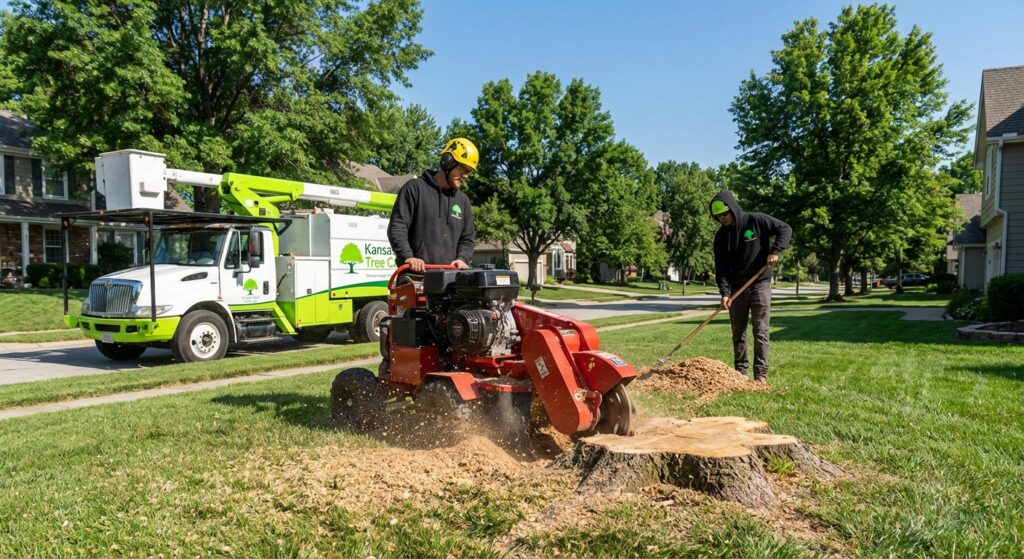
- Stump grinding is essential — a living stump will continue sending out roots. Budget $200-$500 for stump grinding. Our stump grinding service removes the stump 6-8 inches below grade.
- Best for: Trees within 15 feet of the foundation, silver maples, willows, or cottonwoods at any distance under 30 feet, situations where foundation repair is already needed
A realistic scenario: a 50-foot silver maple growing 15 feet from your Westport home’s foundation. Root barrier? Not practical — too close, too aggressive a species. That tree needs to come out. But a 40-foot red oak growing 30 feet from the same foundation? A root barrier is a reasonable option that preserves a valuable tree.
Choosing the Right Replacement Trees
If you do remove a problem tree, don’t make the same mistake twice. Choose a replacement species that’s appropriate for its location relative to your house.
Within 15-20 feet of the foundation:
- Eastern redbud (compact, deep roots, beautiful spring bloom)
- Japanese maple (small root system, slow-growing)
- Serviceberry (understory tree, non-aggressive roots)
- Ornamental pear — not the Bradford type, which has weak branch structure, but varieties like Cleveland Select
20-30 feet from the foundation:
- Bur oak (deep taproot, well-adapted to KC clay)
- Kentucky coffeetree (drought-tolerant, deep-rooted, native)
- Baldcypress (surprisingly well-adapted to KC, non-aggressive roots)
30+ feet from the foundation:
- Most shade trees are fine at this distance, including red oaks, hackberry, and honeylocust
- Still avoid silver maple, cottonwood, and willow — their roots travel far enough to cause problems even from 30+ feet
Our team can help you select species that work for your specific site. Soil conditions, sun exposure, available space, and proximity to structures all factor into the right choice. A quick consultation with our arborist can save you from planting a future problem.
Liability When a Neighbor’s Tree Damages Your Foundation
This comes up constantly in KC’s older, densely planted neighborhoods. Your neighbor’s 70-year-old silver maple sits 10 feet from the property line, and its roots are clearly under your foundation. What can you legally do?
Step 1: Document the damage with photos and get a written assessment from a certified arborist and a structural engineer. You need evidence connecting the specific tree to the specific damage.
Step 2: Send your neighbor a written letter (certified mail) with the documentation, requesting they address the tree. Many neighbors are reasonable once they understand the situation and the liability they’re exposed to.
Step 3: If they refuse, you have the legal right to cut roots at your property line. But be careful — if cutting those roots kills the tree, you could be liable for the tree’s value. Have an arborist assess what root cutting is safe.
Step 4: If damage is significant and your neighbor won’t cooperate, consult a property attorney. Missouri courts have ruled in favor of homeowners whose foundations were damaged by a neighbor’s tree when the neighbor was notified and failed to act.
Our hazardous tree evaluations include detailed documentation that’s useful for insurance claims and legal proceedings. We stay out of the legal dispute itself, but we can provide the professional assessment both sides need.
Frequently Asked Questions
How close is too close for a tree near my foundation?
It depends on the species. Aggressive-root trees like silver maple, cottonwood, and willow should be at least 30-40 feet from any structure. More moderate species like oaks and maples can be as close as 20 feet. Small ornamental trees are generally safe at 10-15 feet. When in doubt, get an arborist assessment before the tree gets too big to move.
Will removing a tree near my foundation cause more settling?
It can, actually. Removing a tree that’s been extracting moisture from the soil for decades can cause the clay to rehydrate and swell, potentially causing “heave” — upward foundation movement. This is more common after removing very large trees from extremely close proximity. A gradual approach — sometimes removing the tree in stages over a year — can minimize this risk.
Does homeowners insurance cover foundation damage from tree roots?
In most cases, no. Standard homeowners policies cover sudden damage (storm, falling tree) but exclude gradual damage from root growth. Some policies offer optional foundation coverage. Sewer line damage may be covered if you have sewer backup endorsement. Review your specific policy and ask your agent about endorsements.
How do I know if tree roots are causing my foundation cracks?
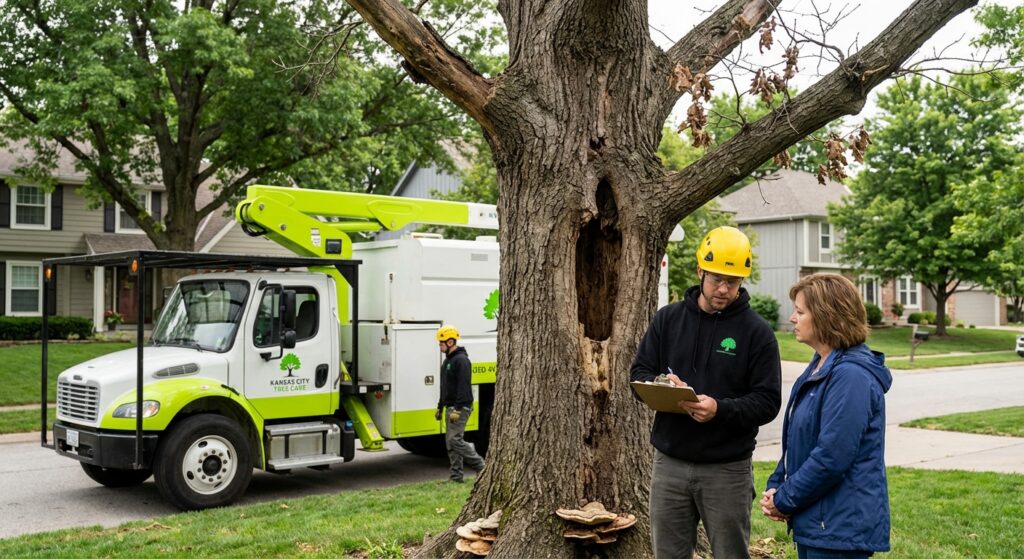
Look for diagonal cracks radiating from window or door corners, doors that stick seasonally (worse in summer when the tree is pulling the most water), and cracks that are wider at the top than the bottom (indicating settlement). A structural engineer can confirm root-related damage, and our arborists can identify which tree is the culprit based on root mapping and species behavior.
Can root pruning save the tree and protect my foundation?
Sometimes. Cutting roots on the foundation side — combined with a root barrier — can protect the structure while preserving the tree. But you can’t cut more than 25-30% of a tree’s root system without risking the tree’s health or stability. If most of the problematic roots are on the house side, the math may not work in the tree’s favor.
Get an Expert Assessment Before the Damage Gets Worse
Foundation repair in Kansas City runs $5,000-$25,000+ depending on severity. Sewer line replacement is another $3,000-$10,000. A tree evaluation and root management plan costs a fraction of that and can prevent the damage from escalating. The homeowners who save the most money are the ones who address tree-root conflicts early — before the foundation engineer gets involved.
Kansas City Tree Care evaluates root-structure conflicts across the entire KC metro — Midtown, Westport, Waldo, Brookside, Overland Park, Olathe, Shawnee, Lee’s Summit, and every community in the area. ISA certified, BBB accredited, licensed and insured, with 35+ years of experience.
Call us at 913-894-4767 for a free tree and root assessment.