Tree Support Strategies: Protect Your Trees
In this guide (11 sections)
- Some Trees Are Worth Saving – Cabling Makes That Possible
- What Tree Cabling and Bracing Actually Does
- When Cabling Works (and When It Doesn’t)
- The Installation Process
- Cabling Costs in Kansas City
- Species That Commonly Need Cabling in KC
- Maintenance and Lifespan of Cable Systems
- Cabling + Pruning: The Combined Approach
- Frequently Asked Questions
- Protect What You’ve Got
- Related Reading
Some Trees Are Worth Saving – Cabling Makes That Possible
You’ve got a 50-year-old silver maple in your front yard. It’s massive, it provides shade over the entire house, and it’s got a major structural problem – the trunk splits into two co-dominant stems about 8 feet up, and you can see bark growing into the V-shaped union instead of forming a healthy ridge. Every time a storm rolls through, you wonder if tonight’s the night it splits in half.
You’ve got two options: remove a tree that’s been part of your property for decades, or install a cable system that supports the weak union and lets the tree stand safely for another 20+ years. For most homeowners in this situation, cabling and bracing is the right call.
We install cable systems on trees across the Kansas City metro every month. Here’s what the technology actually does, when it works, when it doesn’t, and what it costs.
What Tree Cabling and Bracing Actually Does
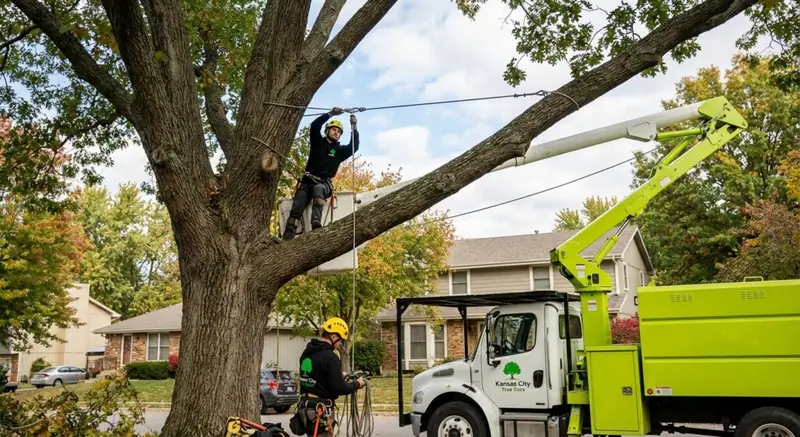
Cabling involves installing flexible steel or synthetic cable between two or more major branches or stems high in the canopy. The cable limits how far the branches can move apart in wind, reducing stress on the weak attachment point below. Think of it like a seatbelt for the tree – it doesn’t prevent all movement, but it prevents the movement that causes failure.
Bracing uses threaded steel rods installed through weak branch unions, split crotches, or cracked trunks. The rod provides rigid support at the point of weakness. It’s used when the defect is in the trunk or at a low branch junction where cables aren’t effective.
Most jobs use cabling alone. Some use both cable and brace together for maximum support. The choice depends on where the defect is and how severe it is.
Modern cable systems have evolved significantly. Traditional steel cables with hardware are still used, but newer dynamic cable systems (like Cobra) use synthetic rope that allows more natural movement while still preventing catastrophic failure. Dynamic systems are lighter, less invasive (no drilling), and better suited for medium-risk situations.
When Cabling Works (and When It Doesn’t)
Cabling and bracing is highly effective for specific structural problems. It’s not a universal fix for every tree issue:
Good candidates for cabling:
- Co-dominant stems with included bark – the single most common reason for cabling in the KC metro. Two stems that grew together without forming a strong union need support to prevent splitting. This is endemic in silver maples, Bradford pears, and many oaks throughout Johnson County.
- Heavy lateral branches – branches that extend far from the trunk with too much weight at the tips. Cabling to the trunk or an opposing branch redistributes load and prevents the branch from tearing off.
- Previously damaged trees – trees that survived a storm but lost branches on one side, creating asymmetric weight distribution. Cabling helps balance the remaining canopy.
- High-value trees in important locations – a structurally imperfect tree that provides major shade, windbreak, or aesthetic value may be worth supporting rather than replacing.
Poor candidates for cabling:
- Trees with significant decay – cabling supports structural weakness, not material failure. If the wood itself is rotting, a cable attached to decaying wood won’t hold.
- Trees with root problems – no amount of canopy support helps if the root system is compromised. The tree will go over from below.
- Dead trees or trees in severe decline – cabling extends the safe life of a living tree with a structural defect. It doesn’t resurrect a dying tree.
- Bradford pears with multiple defects – these trees have co-dominant stems at every branch junction. You can’t cable every one. At some point, removal and replacement is more practical.
The Installation Process
Here’s what happens when we install a cable system:
1. Assessment. A certified arborist evaluates the tree’s specific defect, overall health, target zone (what’s at risk if it fails), and determines whether cabling is appropriate. Not every tree with a structural defect needs or benefits from cabling.
2. Cable placement design. The arborist determines where cables should go – typically placed at about 2/3 the height between the defect and the branch tips. Multiple cables may be needed for trees with several co-dominant stems or multiple weak unions.
3. Installation. For traditional steel cable: a climber ascends the tree, drills through each branch at the anchor points, installs J-hooks or eye bolts, and strings the cable with appropriate tension. The cable is not taut – it’s installed with calculated slack so the tree can move naturally in light winds but is caught before dangerous separation occurs.
For dynamic (synthetic) systems: anchor slings are wrapped around branches without drilling. The synthetic cable is then tensioned between anchors. This method is less invasive and can be installed and adjusted more easily.
4. Documentation. The arborist records what was installed, where, and provides maintenance recommendations. Cable systems need periodic inspection – typically every 2-3 years – to verify hardware condition and cable tension.
Total installation time: 2-4 hours for most residential trees. Complex systems on large trees may take a full day.
Cabling Costs in Kansas City
Realistic pricing for the KC metro:
Single cable installation: $300-$600. This covers one cable between two co-dominant stems – the most common residential job.
Multi-cable system: $500-$1,200. Trees with three or more stems or multiple defects requiring several cables.
Cable + brace combination: $600-$1,500. When both flexible support (cable) and rigid support (brace rod) are needed at different locations on the same tree.
Dynamic cable system (Cobra or similar): $400-$800 per cable. Slightly higher material cost but less invasive installation (no drilling).
Compare this to alternatives:
- Tree removal: $1,000-$5,000+
- Replacement tree purchase and planting: $200-$1,000
- 20-30 years waiting for the new tree to reach comparable size: priceless (literally)
- Emergency removal after storm failure: $2,000-$8,000+
- Property damage from tree failure: $5,000-$50,000+
Cabling is almost always the most cost-effective option when it’s appropriate. A $500 cable installation on a 40-year-old tree buys another 20+ years of safe service from a tree that would cost thousands to replace in terms of shade, aesthetics, and property value.
Species That Commonly Need Cabling in KC
Based on our work across the metro, these species account for the majority of cabling installations:
Silver maple (Acer saccharinum). The king of co-dominant stems. Silver maples grow fast and frequently develop multiple leaders that grow nearly equal in size with tight, bark-included unions. They’re everywhere in KC – especially in neighborhoods built from the 1960s through 1980s. Without cabling, these unions are the most common point of failure during storms. We cable more silver maples than any other species in the Kansas City area.
Pin oak (Quercus palustris). While generally strong-wooded, pin oaks in KC often develop heavy lateral branches that extend far from the trunk. Combined with their dense, layered canopy that catches wind, these overextended branches can tear off during straight-line wind events. Cabling supports the heaviest laterals and reduces the leverage that causes failure.
Red oak (Quercus rubra). Large, heavy trees that sometimes develop co-dominant stems. Given the oak wilt risk in Missouri, preserving healthy red oaks through cabling is preferable to removing them and creating pruning wounds during the wrong season.
Hackberry (Celtis occidentalis). Extremely common throughout the KC metro. Generally tough trees, but they occasionally develop co-dominant stems and wide-spreading branches that benefit from support, especially in exposed locations.
Bur oak (Quercus macrocarpa). These massive native oaks sometimes have individual branches that weigh thousands of pounds. When a branch on a 100-year-old bur oak extends 30 feet from the trunk, cabling provides critical support for what is often an irreplaceable specimen.
Maintenance and Lifespan of Cable Systems
Cable systems aren’t install-and-forget. Here’s what ongoing maintenance looks like:
Inspection schedule: Every 2-3 years for steel cable systems. Annually for dynamic systems. After any significant storm event. The inspector checks cable tension, hardware condition, tree growth around hardware points, and whether the tree’s growth has changed the load dynamics.
Steel cable lifespan: 15-25 years depending on cable gauge, weather exposure, and tree growth. As the tree grows, hardware can become embedded in the bark (a process called encapsulation). This isn’t necessarily a problem unless it creates stress points. Replacement cables are installed before the originals fail.
Dynamic cable lifespan: 8-12 years for synthetic systems. The materials degrade faster than steel but are easier and cheaper to replace.
Cost of inspection: $75-$150 per visit, typically combined with other tree maintenance.
Cabling + Pruning: The Combined Approach
Cabling is most effective when combined with proper pruning. Here’s why:
If the tree has too much structural damage for cabling, professional removal is the safer choice. Our guide on signs your tree needs removal helps you understand when cabling has reached its limits.
Weight reduction. Thinning and reducing branches reduces the load on weak attachments. Less weight = less force on the cable and the union it’s supporting. We almost always recommend pruning at the time of cable installation.
Improved wind profile. Thinning the canopy lets wind pass through rather than pushing against it. This reduces the lateral forces that try to pull co-dominant stems apart.
Deadwood removal. Dead branches above a cable system can fall on the cable or create unpredictable loads during storms. Cleaning out dead wood improves the system’s effectiveness.
The combined cost of cabling + pruning is typically 30-40% less than doing them separately because the climber is already in the tree. If you’re cabling, prune at the same time.
Frequently Asked Questions
How much does tree cabling cost in Kansas City?
A single cable installation typically costs $300-$600 in the KC metro. Multi-cable systems run $500-$1,200. Dynamic (synthetic) systems are $400-$800 per cable. Compare this to tree removal ($1,000-$5,000+) – cabling is usually the most cost-effective way to preserve a structurally valuable tree.
We install cabling and bracing throughout Overland Park, Shawnee, and across the KC metro:
How long does a cable system last?
Steel cable systems last 15-25 years with periodic inspection. Dynamic (synthetic) systems last 8-12 years. Both require inspection every 2-3 years and may need adjustment or replacement as the tree grows. A well-maintained cable system can support a tree for the rest of its natural life.
Can cabling save a tree that’s already splitting?
If the split hasn’t progressed past the initial crack and the wood on both sides is sound, yes – a combination of brace rod and cable can stabilize a splitting union. The brace holds the crack closed while the cable prevents the stems from separating further. However, if the split extends more than a few inches down the trunk, or if there’s decay in the split zone, the tree may be too compromised for cabling to be safe.
Do cables damage the tree?
Traditional steel cable hardware (bolts through branches) creates small wounds that the tree grows around over time. This is comparable to a pruning cut and heals similarly. Dynamic systems use slings that don’t penetrate the bark at all. In both cases, the benefit of preventing catastrophic failure far outweighs any minor impact from installation.
Should I cable or remove my silver maple?
It depends on the tree’s overall health and the severity of the structural defect. A healthy silver maple with one co-dominant union and no other problems is a good cabling candidate – it can provide decades more shade and value. A silver maple with multiple defects, significant decay, heavy lean, AND a co-dominant stem is probably better off removed and replaced with a stronger species. An arborist assessment will tell you which situation you’re in.
Protect What You’ve Got
Mature trees are irreplaceable in the short term. A silver maple you cable today has been growing for 40-60 years. If you remove it and plant a new tree, you’re looking at 20-30 years before you have comparable shade and presence. That’s a long wait – and a significant drop in property value in the meantime.
We install cable and brace systems throughout the Kansas City metro – Overland Park, Olathe, Shawnee, Lenexa, Leawood, Lee’s Summit, Independence, and all surrounding communities. ISA certified, licensed, insured, and 30+ years of structural support experience in KC.
Call Kansas City Tree Care at 913-894-4767 for a free cabling assessment.
Related Reading

About Kansas City Tree Care
Kansas City Tree Care was founded in 1996 by Zach Johnson, who has worked in the tree trade since 1990. Our crews cover more than 30 cities across the Kansas City metro from our office at 1505 Merriam Lane in Kansas City, KS.