
Tree Removal
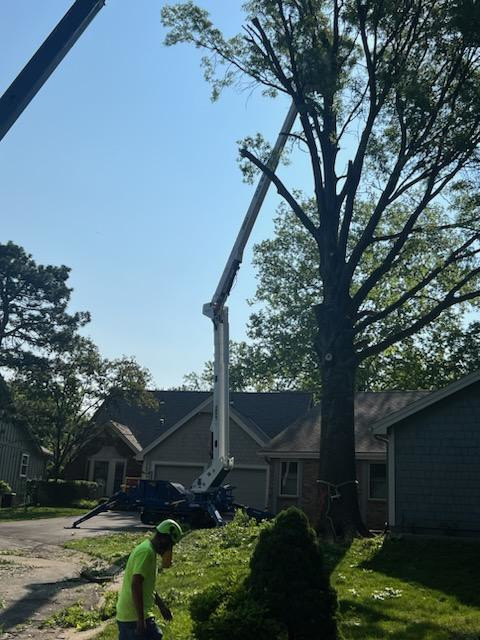
Tree Removal
When you decide to seek assistance from our team, we want you to know that we prioritize the preservation of your trees above all else. While it is unfortunate, there are instances where trees cannot be salvaged due to storm damage, structural failure, or fatal diseases. In such cases, residential tree removal becomes essential.
At Kansas City Tree Care, we specialize in expert tree removal as part of our comprehensive tree care services in Kansas City. Whatever your unique circumstances or requirements, we are dedicated to providing personalized attention and exceptional care.
When Do You Need Tree Removal?
Not every tree problem requires tree removal, but there are situations where removing a tree is the safest and most cost-effective option for Kansas City homeowners. Dead or dying trees are the most obvious candidates for tree removal — a dead tree is structurally unpredictable and can fall without warning during storms or even on calm days. Trees with significant trunk decay, large cavities, or mushroom growth at the base have compromised structural integrity that no amount of pruning or cabling can fix.
Storm-damaged trees are another common reason for tree removal in Kansas City. The Kansas City metro averages 50–60 thunderstorm days per year, and straight-line winds regularly exceed 60 mph. Trees that have lost more than 50% of their canopy, have split trunks, or have exposed root plates after a storm are typically beyond saving. Our arborists assess storm-damaged trees and give you an honest recommendation — if the tree can be saved through pruning and cabling, we’ll tell you. If tree removal is the safer and more economical choice, we’ll explain why.
Trees growing too close to your home, foundation, sewer lines, or driveway can cause expensive property damage over time. Root intrusion into sewer lines is one of the most common and expensive plumbing problems in older Kansas City neighborhoods. If a tree’s root system is cracking your foundation or heaving your driveway, tree removal followed by stump grinding is often the best long-term solution. Trees that lean significantly toward structures, especially after soil saturation from heavy rain, pose an immediate hazard that should be addressed before the next storm.
How Much Does Tree Removal Cost in Kansas City?
Tree removal costs in Kansas City depend on the tree’s size, species, location, and the complexity of the job. Small trees under 25 feet — like ornamental pears, crabapples, and eastern redbuds — typically cost $300–$600 to remove. Medium-sized trees between 25 and 50 feet, including most maples, sweetgums, and younger oaks, run $600–$1,500. Large trees over 50 feet tall — mature oaks, cottonwoods, sycamores, and elms — range from $1,500–$3,500 depending on proximity to structures and power lines.
Several factors affect the cost of tree removal beyond just the height. Trees leaning over homes, garages, or fences require sectional dismantling with rigging equipment, which takes more time and crew. Trees near power lines may require coordination with Evergy or a bucket truck for safe access. Trees with extensive root systems near foundations may need more careful stump grinding. Dead trees can be more dangerous to remove than live ones because the wood is brittle and unpredictable. We provide free, detailed estimates that break down every cost so there are no surprises.
Our Tree Removal Process
Every tree removal project starts with a free on-site assessment by one of our experienced crew leaders. We evaluate the tree’s condition, lean, species, proximity to structures and power lines, and the best approach for safe removal. We discuss the plan with you, confirm the estimate, and schedule the work at a time that works for your household.
On removal day, our crew arrives with the right equipment for the job — chainsaws, chippers, a bucket truck or crane if needed, and rigging gear for trees near structures. For straightforward removals in open areas, we use directional felling techniques to drop the tree safely. For trees near homes, fences, or power lines, we use sectional dismantling — our climbers ascend the tree and remove it in manageable sections that are lowered on ropes to prevent damage below. The entire tree is processed through our chipper, and all debris is hauled away. We rake the area clean so your property looks better than when we arrived.
Why Choose Kansas City Tree Care for Tree Removal
Kansas City Tree Care has performed thousands of tree removals across the Kansas City metro over 35+ years. Our crews are experienced with every species common to the area, from massive cottonwoods along the Missouri River bottomlands to tight-space removals of pin oaks in Prairie Village’s compact lots. We are fully licensed, bonded, and insured with comprehensive liability coverage and workers’ compensation — which means your property and your family are protected. We hold a BBB accreditation with a 4.3-star rating from 220+ reviews, and every tree removal estimate is free with no obligation.
Kansas City Tree Removal Regulations and Permits
Permit requirements for tree removal in Kansas City vary by municipality. In Kansas City, Missouri, you generally need a permit to remove trees over 10 inches in diameter on public right-of-way. On the Kansas side, regulations differ by city — Overland Park, Leawood, and Olathe each have their own tree preservation ordinances, particularly for commercial properties and new development. Most residential tree removals on private property do not require permits, but some subdivisions have HOA covenants that restrict tree removal. Our team is familiar with regulations in all 16 cities we serve and handles permitting as part of your tree removal project at no extra charge.
Why Hiring Professional Tree Removal Matters
Tree removal is one of the most dangerous types of property work. Falling trees and limbs are unpredictable, and a single miscalculation can cause catastrophic damage to homes, vehicles, fences, or utility lines. Professional tree removal companies carry specialized equipment, training, and insurance that make the job safe. Our crews are trained in proper felling techniques, rigging, crane operations, and emergency procedures. We carry comprehensive liability insurance and workers’ compensation — if you hire an uninsured operator and something goes wrong, you could be responsible for property damage and medical bills. Investing in professional tree removal from Kansas City Tree Care protects your property, your family, and your peace of mind. Call 913-894-4767 for a free tree removal estimate.
Frequently Asked Questions About Tree Removal in Kansas City
Tree removal in Kansas City costs $300–$3,500 depending on tree size, species, and location. Small ornamental trees run $300–$600. Medium trees (25–50 feet) cost $600–$1,500. Large mature trees near structures range $1,500–$3,500. Stump grinding adds $150–$400 depending on diameter. Kansas City Tree Care provides free estimates with a detailed cost breakdown and no hidden fees. Call 913-894-4767 for your free estimate.
Permit requirements vary by city in the Kansas City metro. Kansas City, MO requires permits for trees over 10 inches diameter on public right-of-way. Most residential tree removals on private property do not require permits, though some HOAs have restrictions. Overland Park, Leawood, and Olathe have specific tree preservation ordinances for commercial properties. Our team handles all permit requirements at no extra charge.
Most tree removals in Kansas City take 3–6 hours including cleanup. Small trees can be completed in 1–2 hours. Large trees near structures that require sectional dismantling and rigging may take a full day. Stump grinding adds 30–60 minutes. Our crews arrive with all necessary equipment and complete full debris cleanup before leaving your property.
After tree removal, you have two options for the remaining stump. We recommend stump grinding, which uses specialized equipment to grind the stump 6–12 inches below ground level. The area is filled with wood chips and can be covered with soil for replanting or sodding. Leaving a stump attracts termites, carpenter ants, and wood-boring beetles that can spread to your home. Stump grinding is available as part of your tree removal or as a standalone service.
Yes, removing trees near structures is one of our specialties. Our crews use sectional dismantling techniques — climbers ascend the tree and remove it in sections that are lowered on ropes to prevent damage below. For very large trees or extremely tight spaces, we use crane-assisted removal. We carry comprehensive liability insurance that covers your property during the work. We have removed trees within feet of homes, garages, pools, and fences throughout the Kansas City metro.
Yes, Kansas City Tree Care provides 24-hour emergency tree removal across the entire Kansas City metro. When a tree falls on your home, blocks your driveway, or threatens power lines, our emergency crews respond with chainsaws, chippers, bucket trucks, and crane equipment. We prioritize life-safety situations first, then property-threatening emergencies. Call 913-894-4767 any time day or night for emergency tree service.
Homeowner’s insurance typically covers tree removal when a tree falls on a structure (house, garage, fence) or blocks access to your property. Most policies cover the cost of removing the tree and repairing the damage, minus your deductible. However, insurance usually does not cover removing a standing dead or hazardous tree before it falls. We recommend documenting tree conditions with photos and contacting your insurance company early. We can provide documentation to support your claim.
Tree removal can be done safely any time of year. Winter is often ideal because frozen ground reduces lawn damage from heavy equipment, deciduous trees have less weight without leaves, and scheduling is more flexible. However, dead, hazardous, or storm-damaged trees should be removed immediately regardless of season. Spring and summer are our busiest seasons due to storm damage, so scheduling may take longer. Call for a free estimate — we’ll recommend the best timing for your specific situation.